
Global impact of the US slamming the door on vaccines: ‘We are giving up the most powerful weapon we have against pandemics’
The Trump administration’s unscientific moves are alarming international public health experts, who are calling for a stronger European role
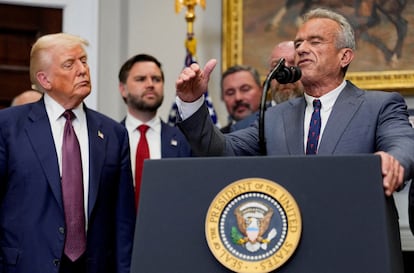
The US’s $500 million cut in messenger RNA (mRNA) vaccine research is not just another reduction. The budgetary gap slows the progress of a promising technology that proved effective during the Covid pandemic and is the great hope for quickly halting other similar public health threats. It also fuels distrust in vaccines. While Secretary of Health and Human Services Robert F. Kennedy Jr. dismisses the vaccine advisory committee with a stroke of his pen to appoint candidates more aligned with an ideology that often clashes with scientific evidence, international public health experts are concerned about the crumbling of a key element of the global architecture for preparing for health emergencies.
The excuse for the cutbacks is that the technology poses more risks than benefits, something unsupported by scientific evidence: thanks to it, the Covid pandemic changed its course and the most vulnerable were protected a year after the virus began to sweep across the globe.
Kennedy has taken advantage of a breeding ground for vaccine resistance that Donald Trump himself fueled. An example of how far this climate can go was the deadly attack on the Centers for Disease Control and Prevention (CDC) headquarters two weeks ago by a man who blamed the Covid vaccine for making him depressed and suicidal. Employees at the federal agency, one of the agencies under the Department of Health led by Kennedy, warn that this is not an isolated incident. A union representing CDC workers said the attack, in which a police officer was killed, was not random, but the result of “months of mistreatment, neglect, and defamation that CDC staff have endured.”
The consequences of the halt in vaccine investment go beyond the United States and could impact the entire world. “If the United States sneezes, the world catches a cold,” summarizes ISGlobal Health Institute immunologist Adelaida Sarukhan, who warns of an “enormous” impact on the response capacity to a new pathogen. She gives the example of a potential flu pandemic, something that is always on the radar of health professionals: “With traditional techniques, it would take 18 months to manufacture enough doses to immunize a quarter of the planet; with messenger RNA vaccines, almost the entire world could be vaccinated within a year. We are giving up the fastest and most powerful weapon we currently have against pandemics.”
In the vacuum left by the United States, a silent battle is being waged: one that pits science against misinformation, investment against ideological retreat. “In that arena, returning to slower production and leaving the field open to anti-vaccine rhetoric is a luxury we cannot afford,” Sarukhan summarizes.
mRNA technology uses a synthetic copy of the genetic instructions our cells read to make proteins. In a vaccine, this mRNA encodes a protein from the pathogen — for example, the coronavirus spike — which, when produced inside the body, triggers an immune response without the need to introduce the entire virus. Although its development dates back to research that began in the 1990s, it was the Covid pandemic that demonstrated its potential. Based on the genetic sequence of a virus, a prototype vaccine can be designed and manufactured in a matter of weeks, drastically shortening lead times compared to traditional techniques.
Its speed is due to the fact that the same technological platform can be used for different pathogens, so it’s enough to change the mRNA sequence to adapt it to a new target, without having to redo the entire process from scratch. In addition to infectious diseases, this versatility opens the door to applications in other fields, such as therapeutic cancer vaccines, personalized treatments for rare or autoimmune diseases, and even therapies for tissue regeneration. Due to its modularity, scalability, and adaptability, mRNA is now considered one of the most promising biomedical tools.
Jaime Jesús Pérez, president of the Spanish Association of Vaccinology, maintains that there are no real reasons to distrust this technology. “But since they were the most widely administered during Covid, they have become an easy target for deniers and conspiracy theorists,” he explains.
Amós García Rojas, a vaccinologist who has represented Spain for three years at the World Health Organization, goes further: “Cutting funding for vaccine research, for science, is investing in ignorance.” “Vaccines have been one of the most important steps in improving citizens’ health. If we halt their development, we leave a terrible gap that sooner or later will translate into setbacks in global health,” he warns. And he points out that replacing the most qualified people on committees with people with little scientific background encourages “the debate to be filled with speculation and baseless opinions.”
The cuts, Sarukhan points out, not only threaten the development of vaccines and treatments like those mentioned, but also erode preparedness against bioterrorism, an area Washington had previously considered a priority. Furthermore, they could slow down initiatives aimed at providing low-income countries with their own vaccine manufacturing capacity, a plan in several African countries that could be jeopardized.
Other developing countries look to U.S. health authorities for drug approval, as they lack equivalent agencies. In the case of vaccines, this is now being called into question by the change in the advisory board.
The alternative, both financially and as a scientific benchmark, could be Europe. Adrián H. Aginagalde, spokesperson for the Spanish Society of Preventive Medicine, Public Health, and Healthcare Management, mentions the precedent of World War II, when the massive scientific investment of the Allies proved decisive. “If the U.S. withdraws, it’s our turn,” he states. Without alternative leadership, he warns, the pattern seen in Africa of preventable diseases that continue to circulate due to the lack of mass vaccination programs will be repeated.
Spanish Secretary of State for Health, Javier Padilla, is clear that Europe “must fill the gap” left by the United States. He points out that the Pfizer vaccine was the result of a transatlantic collaboration: “BioNTech was a spin-off of a European university.” “The world is becoming increasingly multipolar, and I believe that Europe must, on the one hand, assume an increased focus on investment in vaccines and, on the other, assume a certain leadership role in coordinating and encouraging other regions that are currently jumping on the bandwagon, so to speak, of investment in this area,” he concludes.
The influence of anti-vaxxers
Kennedy’s revisionism regarding vaccines not only undermines scientific truth and public health, it also contributes, as the attack on the CDC offices demonstrates, to fueling the misinformation surrounding an anti-vaccine movement directly responsible for the worst measles epidemic in the country since 1992, eight years before the disease was declared eradicated, and for whose treatment Kennedy recommended, to the outrage of scientists, cod liver oil and vitamin A.
As of August 5, there were 1,356 confirmed measles cases in 41 states, and 32 outbreaks declared so far this year, according to the CDC, most of them in unimmunized children. “The current outbreak we are seeing in the United States underscores the importance of maintaining adequate levels of measles vaccination,” said William Moss, executive director of the International Vaccine Access Center (IVAC), who co-directs the measles tracking project with the Johns Hopkins University School of Public Health. “The United States risks losing its measles-free status if cases continue at this rate. As vaccine confidence continues to be undermined, immunization is more important than ever to end this outbreak and prevent future outbreaks from occurring.”
Sign up for our weekly newsletter to get more English-language news coverage from EL PAÍS USA Edition









































