
Pau Brunet, the 12-year-old social media star helping people make sense of the complex world of autism
The youngster shares videos about how to cope with ASD with his 1.2 million followers. An interview with soccer star Marc Cucurella has turned him into a major influencer
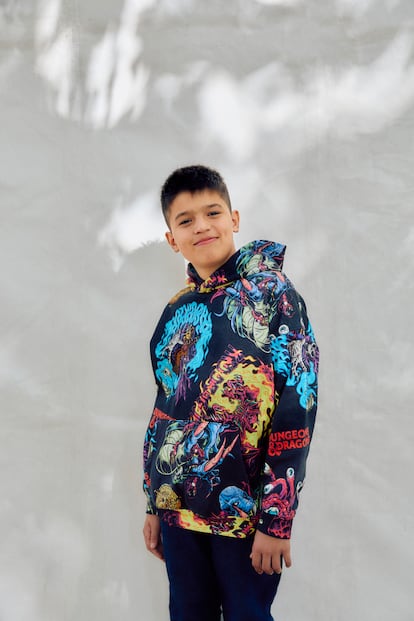

One day, feeling bored, Pau Brunet decided to unravel the meaning of irony. “I wanted to see if I could understand the one thing my parents thought I’d never be able to figure out…” And he succeeded, not all at once, but step by step, aware of how difficult it is for him to grasp life’s many double meanings and the balance necessary to confront them.
Balance is a complex word in his life. Pau is 12 years old, autistic, and his ASD diagnosis reflects some of the imbalances he’s been aware of since childhood. He’s a walking contrast, a person of extraordinary intelligence who lacks some skills that would harmonize his daily life, while he has others in excess. Charisma, for example, as he demonstrates on social media, where he has more than 1.2 million followers and helps others understand, with the help of his parents, the extremely complex world of autism.
His fame was already considerable before an interview catapulted him into another realm. It was with Marc Cucurella and it went viral on TikTok, Instagram, and his YouTube channel. In it, the Chelsea and Spain national team soccer player broke down in tears while talking about his son Mateo, who is also autistic, to the comfort and compassion of Pau and his father, Félix, who stood by him with astonishing empathy. “I expected it to be a normal interview, but he decided to take it a step further. When he started crying, I tried to calm him down and give him his space,” Pau explains, as part of his manual for conversations with his guests.
It was Cucurella who contacted them. The effect has been so widespread that it has brought Pau’s social media to a more general audience. He works on the videos he uploads with his parents. “We make it beautiful and edit it for the fans. We explain autism to people.” And how does he define it? “Well, as a way of experiencing the world and of living,” he replies.
In his case, he has an IQ of 129, bordering on the 130 threshold for high abilities. “However, his memory drops to 60, which is a sign of full-blown ADHD,” explains his father. And there are other alterations: “I hear five times more; I’m like a broken radio; I hear everyone at once; that’s no longer harmony, and I notice my body’s actual weight five times less. My senses are altered; that’s part of autism.” All of this makes it difficult for him to be in noisy places, such as airports or train stations, although he enjoys traveling, especially when he’s taken to spas or on motorhome excursions.
His body temperature sensors aren’t working either. He loves to shower with very hot water before performing his stereotypical actions: “That is,” he clarifies, “self-regulation movements that are like the art of resting before getting tired,” he says with unintentional irony. It’s a preventive rest that he practices every day when he wakes up and after his morning shower.
He feels cold when it’s hot, and vice versa. “I may want the fan on when my parents need three blankets,” he says. “One day we’ll get a picture of you at the North Pole in short sleeves!” his father says.
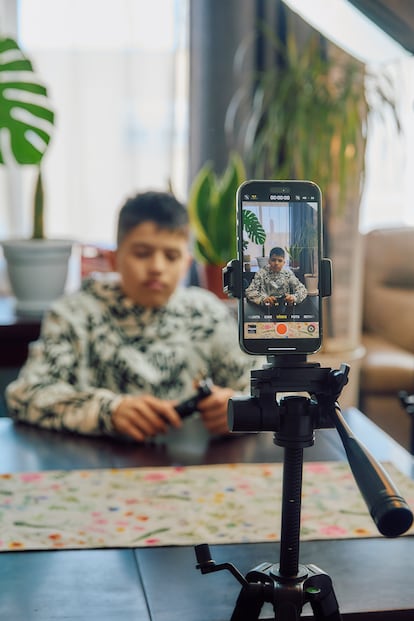
Although he tries hard to find his bearings, he has a poor sense of direction. But he tries to resolve this by memorizing routes or by working on a puzzle of fragmented spaces: “Based on a 360-degree plan, piecing together photos as if I were a drone entering the rooms.” Like his father, a magician by profession, he rehearses so that the audience doesn’t discover the angle from which he performs the trick.
With these skills, the two combine to find everyday solutions, which are also supported by their mother, Daniela, who is Mexican and works as an operating room assistant in a hospital in Girona, in Spain’s northeastern Catalonia region. Her job helps her warn Pau about certain dangers: “She tells you everything in detail. So you can see how dangerous some things are. It leaves us with those little traumas...”
The feeling of not fitting in also traumatized him during the first 10 years of his life. He had no friends at school. “They formed cliques, they left me out,” he recalls. For some time now, he’s been good friends with some of his classmates. He’s even adopted a very specific definition of friendship: “Someone who loves you indefinitely and accepts you. Maybe not as much as my parents or a pet, but they’re people you trust and know can’t hurt you. They share the same interest as you: not getting bored.”
He’s learned to differentiate between true friends and those who approach him out of self-interest. Since that video with Marc Cucurella, he’s endured a few storms in his life. Recess became a minor torment: “I like school, but when it’s time for recess... Hmm, too many stimuli. I became a bit popular because of that video and it was a bit crazy. I can’t deal with 20 people in the same place in less than 20 seconds!”
Then, in class, he relaxes and learns when science time comes around. The problem is literature, ancient texts, poetry, anything that involves uncontrollable polysemy on the part of language. But this has become less of an issue since he decided to take on as a challenge something that no one thought he was capable of: irony. “He began to distinguish it by the tone we used to say something to him,” says his father. “Sometimes it can also become very cutting,” says Pau. Offensive, even, if it turns into sarcasm. But now, he even enjoys trying them out. I ask him:
— Do you like it?
— What do you think?
He responds with a tone of irony…
— See… Well, you know, my neurons are clogged, plugged with cork… There’s another one.
More of a metaphor, we might think. A whole world in which he’ll also learn to navigate. Because this kid, with his imbalances, his healthy obsession with planets and stars, his conscious way of wandering off course, and his unique sense of gravity, is a walking poet.
Sign up for our weekly newsletter to get more English-language news coverage from EL PAÍS USA Edition









































