
Operation Save the Yen: Japan partially turns off the cheap money tap, with a little help from its ‘American friend’
The Bank of Japan has aligned itself with the Federal Reserve, raising interest rates to curb the currency’s depreciation and get inflation under control
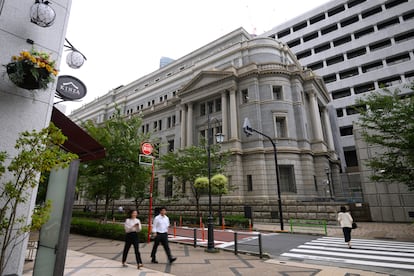

The Bank of Japan had already announced an interest rate hike, in order to close the gap somewhat with the U.S. rate. However, by the time Japan’s monetary authority confirmed the increase on Friday, September 18, the Federal Reserve had already preempted it with another hike that further widened the gap between the two economies.
The Japanese increase was 0.25 percentage points. This brought Japan’s rates to 1.25%, a 31-year high that ended decades of ultra-loose monetary policy. The move was widely expected by analysts: U.S. Treasury Secretary Scott Bessent had repeatedly advocated for a stronger yen, while Bank of Japan (BOJ) Governor Kazuo Ueda had expressed support for the measure. The main objective of the rate hike was to curb depreciation of the Japanese currency and get inflation under control.
Sayuri Shirai is a professor at Keio University (Tokyo) and served as a member of the Bank of Japan’s (BOJ) Policy Council from 2011 to 2016. She explains that the underlying tension is between the central bank, which is willing to raise rates in order to strengthen the yen, and the government of Prime Minister Sanae Takaichi, which prefers low interest rates to support its expansionary fiscal policy. However, the academic asserts, American pressure gave the BOJ a pretext to raise rates. She adds that, “until Bessent’s statements, there was no clear direction.”
The risk of a devalued yen
A devalued yen presents a major concern for the United States: when the currency is too weak, Japan is forced to sell off U.S. Treasuries, in order to access physical American dollars (which, in turn, are used to prop up the yen). Hence, with too big of a difference between the two currencies, the fear of massive sell-off becomes imminent. Additionally, with Tokyo having promised to invest $550 billion in the U.S. through 2029 (in exchange for lower tariffs on Japanese goods), a weak yen makes such a commitment more shaky. By raising interest rates, the Bank of Japan makes returns on Japanese assets more appealing to local and foreign investors, thus making the yen stronger and U.S. dollar investment more feasible.
Bessent began his current campaign in favor of a stronger yen with the joint intervention that took place on July 31, when the United States and Japan made massive purchases and managed to lift the Japanese currency, which had fallen to 164 yen to the U.S. dollar, its worst level in 40 years, to 157 yen. It was the first coordinated action between the two countries in defense of the yen since 1998, with the American president describing it as a gesture of friendship toward Japan. In doing so, however, Donald Trump didn’t miss the opportunity for sarcasm: “Japan’s been very good to us, with the exception, of course, of Pearl Harbor.”
Shirai believes that the United States intervened for its own benefit, pointing to the nearly $1.2 trillion in U.S. Treasury bonds held by Japan. Selling them to repatriate yen would increase the cost of U.S. debt.
In an export-oriented economy like Japan’s, dependent on imported materials, currency fluctuations have mixed effects. For companies like Toyota, a one-yen drop in the currency’s value against the dollar increases their operating profit by 50 billion yen (approximately $317 million), according to a study by the local news agency Jiji Press. However, the gross foreign exchange gain is affected by dollar-denominated payments for purchases of steel, electronic components, lithium for batteries, freight and insurance.
Another expert consulted by EL PAÍS, Tsuyoshi Ueno, an analyst at the NLI (Nippon Life Insurance) Research Institute, refers to the past two decades of wage stagnation, during which the average Japanese citizen lost purchasing power, while the country was flooded with tourists whose spending power was multiplied by a weakened yen. He adds that, even though wages have begun to rise, the pressure on households continues, due to the rapid currency depreciation. “Japan is at a turning point,” he warns.
The U.S. Treasury’s support for the yen, he argues, stems from Japan’s inability to curb the currency’s weakness, despite repeated unilateral interventions since 2022. “It was necessary to send a stronger warning to speculators,” he adds, suggesting that, despite Bessent’s defense of American interests, “he may have created a sense of indebtedness and gratitude in Japan.”
Back in 1999, when the BOJ lowered its interest rates to zero, the Japanese currency became a favorite for “carry trades” (borrowing in yen to invest in higher-yielding assets). This fueled one of the largest speculative operations in the global financial system.
Ippei Fujiwara, a professor of macroeconomics at Keio University and the University of Tokyo who was an economist with the BOJ from 1993 to 2011, summarizes the joint intervention as an “alignment of interests” between Japan and the United States. His main concern is the fiscal sustainability of a country with a debt “whose ratio to GDP is 250%,” a figure that includes sovereign bonds and all of Japan’s government debt. Fujiwara fears that the rate normalization process, which is necessary to combat inflation, will increase debt-servicing costs and generate unexpected increases in the sale of new Japanese government bonds (JGBs). He emphasizes the need to monitor who exactly bears this fiscal burden, citing demographics.
Although almost 90% of Japan’s debt is held by Japanese citizens, Fujiwara warns that this financing has thus far relied on the savings of baby boomers, who are now around 75 years old. Facing massive expenses as they pay for medicine and care, they can no longer accumulate money. According to the professor’s scenario, Japan will begin to depend on less-predictable foreign investors.
Rate hikes on the horizon
Ueno, from the NLI Research Institute, outlines a scenario for the coming months, in which there are two 0.25 percentage point interest rate hikes in 2027, one in January and another in July, bringing Japan’s interest rate to 1.75%. The U.S. Federal Reserve’s increase announced on September 16 was also 0.25 percentage points. And, by leaving rates in the average range of 3.87%, it places them around 2.6 percentage points above the BOJ’s rates.
“There’s a slightly greater resolve when it comes to containing the yen’s depreciation,” Ueno concludes. Professor Shirai, for her part, anticipates two similar rate hikes in December of this year and in March of 2027.
Still, the academic considers the expectation that interest rates will reach levels close to 2% to be unrealistic. This is due to the direct effect that this would have on Japanese household mortgages, of which, she notes, more than 70% are based on variable rates that are reviewed every six months.
Despite the pressure being applied on the Bank of Japan by Washington and Takaichi, Shirai supports the monetary authority’s technical independence, although she fears that the public may not feel the same way.
Sign up for our weekly newsletter to get more English-language news coverage from EL PAÍS USA Edition









































