
Trump increases his control over economic data after firing the head of labor statistics
With his replacement, and that of the Fed governor whose resignation paves the way for Powell’s succession, the US president could consolidate his economic agenda for the remainder of his term
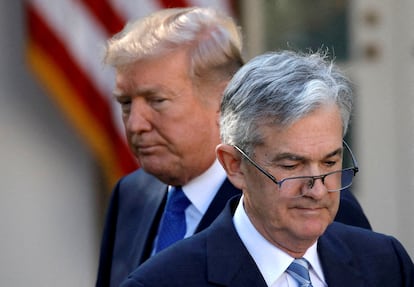

US President Donald Trump has two prime opportunities to intervene in the country’s economic policy: the appointments of the head of the Bureau of Labor Statistics, which compiles employment data, and the replacement for Federal Reserve Governor Adriana Kugler. The first, Erika McEntarfer, was abruptly fired on Friday due to poor employment data for July; the second resigned that same day.
The dotted line connecting the two cases is that both were appointed by Democratic presidents, and with their departure, Trump now has room to maneuver to control economic data in the face of two other worrying signs: the anxiety caused by his tariff war and the contraction in consumer spending. Although most economists believe a recession is unlikely, the type of decline in hiring shown by the July data has historically foreshadowed turbulence. Trump’s actions will also be especially relevant in the second case, as Kugler’s departure comes as the countdown to the replacement of Fed Chairman Jerome Powell, whose term theoretically ends in May, could accelerate a succession sooner than expected.
The president has announced that he will replace McEntarfer, whom he accused without evidence of manipulating figures to harm him politically, “in the next three or four days,” without providing further details. An example of a career official—one of those that the Trump administration is firing en masse—McEntarfer worked as a government economist for decades and was confirmed by the Senate by an 86-4 vote in January 2024 in a bipartisan vote, including favorable votes by current Vice President J.D. Vance and Secretary of State Marco Rubio, who were both senators at the time.
Without providing any evidence to support the dismissal allegations, White House National Economic Advisor Kevin Hassett insisted on NBC on Sunday that his administration had not killed the messenger about the poor jobs data. “The president wants his own people there, so that when we see the numbers, they’re more transparent and more reliable,” said Hassett, the nominee to replace Powell at the helm of the Fed.
The Bureau of Labor Statistics released July hiring data on Friday, along with the usual downward revisions to its previous job growth estimates for May and June. According to Hassett, the data contained partisan patterns. “The data cannot be propaganda,” he emphasized.
But for economists and statisticians, Trump’s actions threaten to taint the Bureau’s nonpartisan work, risking scaring investors, as this vital economic data underpins the pricing of trillions of dollars’ worth of global assets and shapes interest-rate decisions. President Trump is moving dangerously close to that, wrote Daniel Hornung, former deputy director of the National Economic Council, on Friday, warning that it would be a terrible mistake with lasting economic consequences.
William Beach, who headed the Bureau during Trump’s first term, called the firing “damaging.” “I don’t see that there’s any grounds at all for this firing. And it really hurts the statistical system. It undermines the credibility of the Bureau of Labor Statistics,” he told CNN.
The weak employment figures—73,000 hires, well below the 110,000 analysts had forecast—could push the Federal Reserve to cut interest rates, which is precisely what Trump wants. The probability of a cut in September rose to 83% as of Monday morning, nearly double what it was before the report was released on Friday.
Trump’s repeated threats to Powell, whom he never tires of disparaging, have found in Governor Kugler’s resignation a perfect battering ram to attack the Fed; as with McEntarfer, the president has said he would likely choose the new governor “in the next few days.” Both cases, which require confirmation by the Senate—currently on summer recess—would help him consolidate his economic agenda for the remainder of his term.
The position left vacant by Kugler, who resigned five months early, is one of the few expected to remain vacant during Trump’s presidency, as none of the other five governors will complete their term during this timeframe. “I think she left because she agreed with me on interest rates,” meaning she was on the opposite side of those who decided to keep them unchanged, Trump said Sunday night, adding that he has “a couple of people in mind” to replace her.
The favorites to fill Powell’s role are Hassett, Stanford’s Kevin Warsh, and U.S. Treasury Secretary Scott Bessent.
Sign up for our weekly newsletter to get more English-language news coverage from EL PAÍS USA Edition









































