
Claude Canizares, NASA astrophysicist: ‘If scientists can’t speak the truth, society really isn’t in a very good place’
The former vice president of MIT warns of the ‘devastating’ consequences of Donald Trump’s policies on the world of science
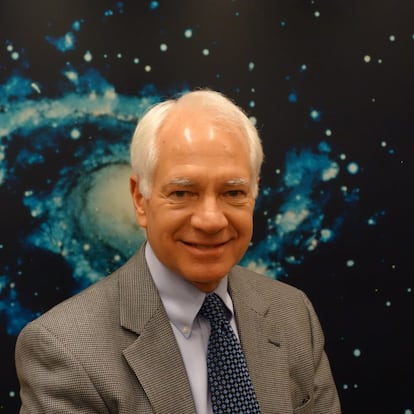

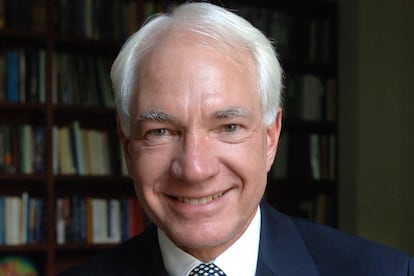
American astrophysicist Claude Canizares says his surname should be Cañizares – with an ñ – like his father, a Cuban doctor who emigrated to France in the 1930s and later settled in the United States.
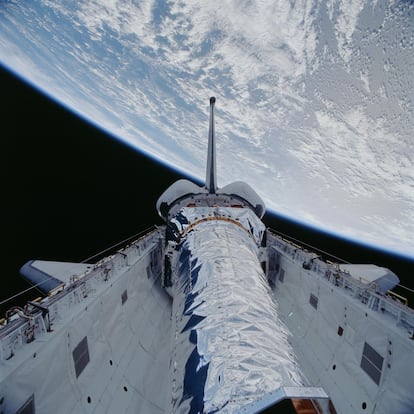
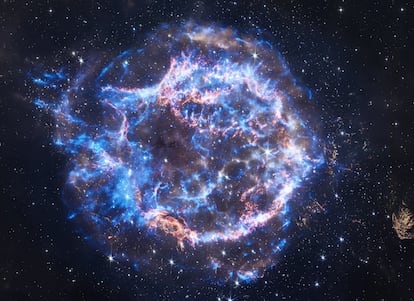
This scientist is now 80 years old, having spent 50 of those years as an astrophysicist at the Massachusetts Institute of Technology (MIT), one of the country’s top universities, where he previously served as director of scientific research and as vice president. Canizares currently co-directs NASA’s Chandra X-Ray Observatory Center, which celebrated its 26th anniversary this year. However, the telescope’s days may be numbered: Donald Trump is planning to slash the U.S. space agency’s budget by a brutal 50%. Canizares is one of more than 300 signatories of a letter published this week warning of the “catastrophic” consequences of these cuts, which are unprecedented in the country’s history.
Trump hasn’t just attacked NASA. He has also targeted the National Institutes of Health (NIH) — the world’s largest biomedical research organization — the National Science Foundation, the National Oceanic and Atmospheric Administration, and the Environmental Protection Agency (EPA), as well as some of the nation’s top universities. Hundreds of layoffs and budget cuts are expected, jeopardizing American dominance in global science.
According to a recent study, these cuts will ultimately lead to a decline in the nation’s wealth similar to that of the Great Recession of 2007-2009. Employees of the aforementioned organizations have also rebelled against these policies, signing open letters. Many of them, however, don’t dare to add their names or speak up publicly.
Canizares — who has just become professor emeritus at MIT after a long academic career — says that he no longer fears retaliation. In this teleconference interview with EL PAÍS, he explains that the consequences of this attack on science could even threaten the lives of astronauts.
Question. Why did you decide to sign the manifesto?
Answer. There’s a huge amount of undiscovered truth. We — the international scientific establishment — spend a considerable amount of energy trying to prioritize what science gets done, what’s the most important [research] and what’s the most likely to make significant breakthroughs in all fields of science.
The recent activities in the U.S. have been almost incredibly arbitrary, with no regard to the effect on the whole scientific establishment worldwide.
In the letter of dissent we signed — The Voyager Declaration — NASA scientists warn that these arbitrary cuts even endanger the safety of our astronauts. It’s extraordinary to see NASA scientists criticizing their own institution, because many of the signatories are the most knowledgeable about each program. When something like this happens, the government must listen.
Q. Is there any precedent for what’s happening in the U.S. scientific sector?
A. In my lifetime, it’s unprecedented.
Q. How would you describe the current situation in the country’s academic community?
A. The attacks, in some cases, really have nothing to do with the quality or impact of the research. It’s just a scattergun approach to making a budget, which is hardly the best way.
Q. What other impacts might these cuts have on NASA and other public agencies?
A. [These cuts] will be devastating. First of all, in the workforce: the younger generations who are going to make scientific breakthroughs in the future are being denied the opportunity. And frankly, they’re losing their jobs. [Many young researchers] are going to leave [the U.S.].
[Our country] benefits tremendously from international participants who come to the U.S., get their graduate degrees and then stay on, becoming faculty members at our major universities. The number of [American] Nobel Prize winners who were born outside of the U.S. is very large. But now, [among our] postdoctoral scientists who are very promising, [many] are going back to Europe to pursue their careers because of the uncertainty.
Q. Is there fear of government retaliation?
A. Yes, it’s a grave concern. If scientists can’t speak the truth, society really isn’t in a very good place. Science is all about truth, about facing facts. And yet, universities are under attack.
There’s a big legal battle between our neighbor, Harvard University, and the [Trump] administration. When I was growing up in the U.S., our universities were the crown jewels [of] national security and science. And now, this is all threatened by people who aren’t taking into account the grave impact that this will have.
Q. You’ve known many U.S. presidents. What do you think of Trump?
A. I feel frankly ashamed that the United States would elect someone who celebrates ignorance. People who are experts in their field should be the ones making the decisions about what [scientific research] can be done. We all accept the fact that the budget isn’t limitless and that we have to make choices. But let’s do it intelligently and not mindlessly.
Q. Is there any hope that the situation can be reversed?
A. Many of my colleagues at MIT and elsewhere are still ready to work with the administration to try to make the best decisions that can be made. One hopes that this doesn’t mean just a scattergun approach at budgeting, but [rather] that the priorities of the scientific community are accepted.
[Members of] the scientific community aren’t likely to become fervent Trump supporters, but they can be helpful in working with the administration to [write] budgets [and] achieve goals without sacrificing the workforce and the scientific breakthroughs of the future.
Q. Do you think the Trump administration will agree to sit down and negotiate?
A. I don’t know. It’s hard to be optimistic at this point. But I hope that [both sides will come to] some compromise. This will be difficult for scientists… but organizations like the National Academy of Sciences have reached out and have tried to sit down with administration leaders to see if there’s a best outcome that can be achieved.
Q. What would you say to those young researchers you mentioned?
A. Working in science is a privilege. We have the ability to open doors we didn’t know existed, to discover new things about how planets and galaxies form, for example. In the last 50 years, our knowledge of the universe has increased at least 1,000-fold. Being able to participate in this is wonderful. I encourage young people — and all those who want to be part of this — to hang in there. We’ll get through these tough times and science will always progress.
It’s the nature of human curiosity to want to discover things like that. It won’t disappear. These attempts to make arbitrary reductions in our scientific progress [will fail]. In the end, ignorance will not triumph over truth.
Sign up for our weekly newsletter to get more English-language news coverage from EL PAÍS USA Edition









































