
‘Bella ciao’: The tumultuous life of the antifascist anthem
An essay traces the origins, success, and controversies surrounding a partisan song that went global thanks to melodic singers and a Netflix series


The lyrics are so simple they fit in a single sentence: a partisan one morning meets the invader, senses he will die and asks his girl to bury him in the mountain, under the shade of a flower, so people will see it and say, “How beautiful! It is the flower of the partisan killed for freedom.” That’s it. Nothing more. Well: that, and the word “bella,” which is heard 18 times, and the word “ciao,” repeated 30 times.
So why all the fuss about Bella ciao? Why is it sung in Gaza with a lute and in the trenches of Ukraine? Why did Laura Pausini refuse to sing it to avoid trouble? Why do Iranian women sing it as a challenge to the oppressor by removing the hijab? Why did several members of the European Parliament sing it in Strasbourg after a xenophobic speech by Viktor Orbán? Why was it sung in city squares during the 15M protest movement in Spain and also by supporters of Catalan independence? Why did it triumph on balconies during the Covid pandemic and why is it heard at demonstrations, rallies, and funerals? Why does Becky G sing it in a Latin rhythm amid gold bars and neon lights? Why did Lazio ultras threaten Albanian full-back Elseid Hysaj for singing it at his welcome dinner at the Italian soccer club? Why?
Historian Marcello Flores has dug into the history of this song in the essay Bella ciao. Historia de un himno popular (Bella ciao: The Story of a Folk Anthem, Altamarea), which arrives in Spanish bookstores this month. His journey begins, amid the mist that breeds great legends, in the rice fields of northern Italy where the mondine, seasonal female laborers, sang a 19th-century work melody that may have inspired Bella ciao. He even traces research back to French and Spanish songs from the 16th century and to two Yiddish traditional songs that could be its musical antecedent. But the book soon lands in the battlefields of World War II. That is where the great struggle over Bella ciao begins.
Today there is a belief that Bella ciao was the great anthem of those Italian partisans with rifles on their shoulders and raised fists. But that is false. There were other songs that were much more popular. More explicit. Redder. Fischia il vento was the big hit. In it, the wind whistles, the storm rages, shoes are worn out and yet the partisans keep walking. It speaks of fascist traitors, red flags, and conquering the red spring. That combat song was written by Felice Cascione, a 25-year-old doctor who served as a partisan commander in the Imperia area. He composed it one night around a fire with his comrades. His mother, a teacher, corrected some lines of the lyrics before the young Cascione was wounded while trying to recover medical supplies after a skirmish, and then executed in cold blood by a Blackshirt militiaman.
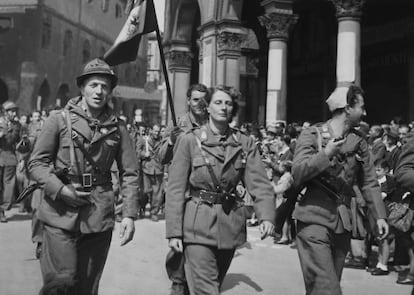
A murdered doctor. Another partisan fallen in the fight for freedom. Fischia il vento remained as the flower of his memory. However, in the 1960s, Bella ciao displaced that song and was established as the great song of the Resistance. That is what Flores recounts in his book. That there were two moments. In 1962, Bella ciao was collected in the Nuovo Canzoniere Italiano as one of the principal partisan songs. The following year, Bella ciao entered the repertoire of light and commercial music through the great melodic singer Yves Montand, a former French Resistance fighter who had actually been born in the Italian province of Pistoia to antifascist parents who emigrated to Marseille when he was two years old.
Montand was followed by Claudio Villa, Anna Identici, and Gigliola Cinquetti. Bella ciao was already playing on radios and being hummed by a new generation. But more than that, it was politically useful in the streets because it unified democratic Italy. “By having the German invader as its only referent, it could be accepted as a unifying song, welcomed not only by Christian Democrats and Socialists, but also by the army and partisan associations. Those were the years of the posthumous construction of the memory of the Resistance,” Flores explains.
That has changed in recent times. “If today in Italy Bella ciao tastes bitter to someone and is associated with a post-Communist imaginary, it is because media distortion has given it a color it did not have before,” writes Flores, who specializes in the study of totalitarian regimes, genocides, and human rights in the 20th century.
Bella ciao is no longer a song everyone in Italy knows, but it’s more universal than ever after the hit Netflix series Money Heist catapulted it to fame by a twist of fate: the screenwriters were stuck on a scene, and one of them — Javier Gómez Santander — started listening to Bella ciao, as he often does, because it’s a song that lifts his spirits. Then he thought, “This is the song. We have to start with Bella ciao.” The rest is history. As researcher Irene Matas analyzed in an academic article titled “Bella Ciao: From Antifascist Symbol to Pop Icon,” the series’ overwhelming success has caused the song to “permeate all social strata, regardless of ideology.”
Flores, 80, sang it publicly for the first time to protest the execution of communist Julián Grimau by the Franco dictatorship in April 1963. Much time has passed. Or maybe not that much. In an interview with EL PAÍS, Flores says that “the world has always been polarized between defenders of freedom — those who choose to fight for it — and those who fight against it, even if they deny it with their lips. Indeed, the current opposition to Bella ciao in Italy may be a symptom of that stance on the part of a neo-fascist right wing. But I believe — and I hope — that in the coming years, the path of freedom will once again be considered the most appropriate and beneficial for everyone. In the meantime, let’s not forget the tragic memories that cast a shadow over our present, and let’s find in them those beautiful flowers that deserve to be told.”
Freedom and death: that is what Bella ciao is all about. Life beyond the grave. The struggle, the commitment, and remembrance. More than just a phrase and two words.
Sign up for our weekly newsletter to get more English-language news coverage from EL PAÍS USA Edition









































