
The return of fascism
The impression that a totalitarian movement has taken hold in the US has only grown stronger since the ICE operation in Minneapolis
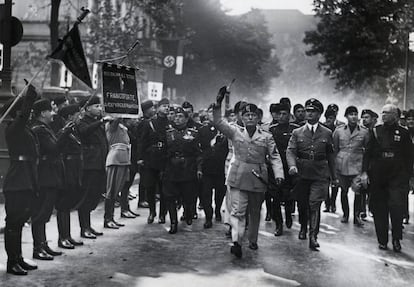

The 1920s were marked by fascism, a word that should not be used lightly. The same is true of the concept of genocide; once used, there is no turning back. “It’s an avalanche of a word: once you utter it, it just keeps growing,” said David Grossman in an interview with the Italian journalist Francesca Caferri when the Israeli writer first defined what was taking place in Gaza as genocide. Since the beginning of Donald Trump’s second presidency a year ago, but especially since the brutal deployment in Minneapolis of federal paramilitaries from ICE and the Border Patrol, the impression that fascism has taken hold in the United States has only grown among writers, commentators, historians, and citizens.
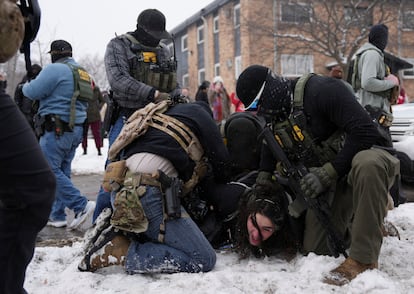
Images of heavily armed, unidentified, and masked individuals beating people protesting their presence — a right protected by the First Amendment, which generously guarantees freedom of speech in the U.S. — and arresting citizens solely because of their accent or skin color — including children like little Liam Conejo Ramos — are incompatible with a fully democratic society. The shooting deaths of two civilians, Renee Nicole Good and Alex Pretti, with images that appear to show an extrajudicial execution in the latter case, sparked global outrage and a wave of references to what happened in Europe in the last century, when Mussolini’s Blackshirts and Hitler’s Brownshirts took over the streets of Italy and Germany.
The writer Stephen King, a vocal critic of Trump on social media, spoke directly of an “American Gestapo” in a post on X; Siri Hustvedt wrote an article in this newspaper titled “A new type of fascism affecting the entire world.” The mere presence of a few ICE agents in Italy during the Winter Olympics has provoked a wave of outrage in the country and required a ludicrous clarification from the Foreign Minister and Deputy Prime Minister, Antonio Tajani, which demonstrates the current international image of the United States: “It’s not like the SS are coming.”
“Yes, it’s fascism,” Jonathan Rauch wrote this week in a scathing article in The Atlantic. “Until recently, I resisted using the F-word to describe President Trump. For one thing, there were too many elements of classical fascism that didn’t seem to fit. For another, the term has been overused to the point of meaninglessness, especially by left-leaning types who call you a fascist if you oppose abortion or affirmative action,” he noted before clarifying: “When the facts change, I change my mind.” He then goes on to explain, point by point, all the aspects — from the glorification of brute force to the dehumanization of entire segments of the population — that make Trump’s America a country firmly headed toward the abyss of fascism.
The first to sound the alarm was Robert Paxton, a 93-year-old historian and expert on fascism who, throughout his long career, has demonstrated remarkable lucidity and courage. Paxton, born in 1932, published a book in 1972 that confronted France with its worst demons. In Vichy France, he departed from the official narrative of the heroic struggle against the German invaders during World War II to describe a country torn apart by a civil war between collaborators and resistance fighters, the latter being far smaller than had been portrayed. He received much criticism at the time, but he was right, and his view of history (which, incidentally, reflects that of so many European countries) is now considered canonical. Also the author of the essay The Anatomy of Fascism, he had resisted using the word until January 2021 when, after the assault on the Capitol, he wrote in an article: “I withdraw my objection to using this label, which no longer seems only acceptable, but necessary.”
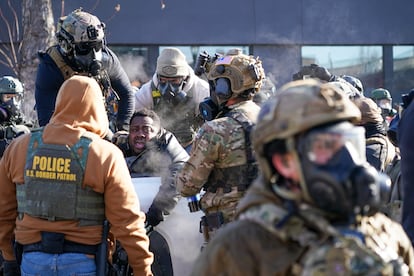
But in Minneapolis, we have also seen thousands of people who seem to have learned one of the great lessons of the 1930s: if you don’t fight for freedom, you can lose it. The American novelist Joyce Carol Oates also reminded us on X: “It is generally forgotten that 15,000-20,000 Germans were killed protesting Hitler, or aligning themselves with groups protesting Hitler. Always there are courageous persons in opposition to a rising authoritarian state, as we are seeing in the US; if those in opposition are not quickly joined by many more, indeed many many more, the effort will be lost.”
Are we then witnessing a return of fascism, and not only in the United States? The answer is far more significant than we might think because, as Hervé Le Tellier points out in his magnificent new novel/essay, El nombre en el muro (The Name on the Wall), “let us remember: fascism moves faster than any democracy. Barely nine weeks separated Hitler’s rise to the Chancellorship and the first antisemitic measures.” It is not only Americans who are gambling with their future freedom.
Sign up for our weekly newsletter to get more English-language news coverage from EL PAÍS USA Edition









































