
‘American Doctor’: US medics trying to save lives in Gaza while Israel bombs hospitals
Award-winning filmmaker Poh Si Teng is premiering the documentary in theaters across the United States and at international film festivals; it is already considered one of the favorites for an Oscar
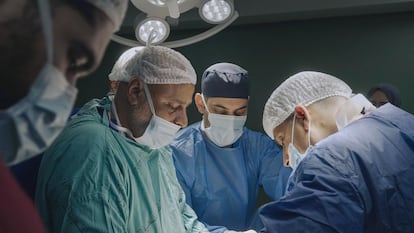

For filmmaker Poh Si Teng, it is not enough for the media to keep updating the death toll in Gaza since the start of the Israeli offensive (which now stands at over 75,000). She argues that full stories must be told. Her documentary American Doctor, newly released in U.S. theaters and already a favorite to win the 2027 Oscar in its category, focuses less on the massacre of civilians and more on the humanitarian work that has emerged in response.
“The figures only tell part of the story. Many Americans and Western citizens do not feel sufficiently involved or compelled to influence their governments, and I don’t think that’s due to a lack of data — in the case of Gaza it’s because they don’t see the full picture. It’s one of those places that seems remote to them and they can’t identify with what’s happening there,” the filmmaker and journalist argued in mid-August, when she was presenting her feature in New York.
American Doctor follows three protagonists, three U.S. doctors from very different backgrounds who volunteered to work in Gaza’s besieged hospitals while Israel was bombing health workers and patients. Dr. Thaer Ahmad is a Palestinian-American emergency physician from Chicago. He is a humanitarian worker who has provided medical assistance in conflict zones including Gaza, Syria, Lebanon, Jordan, Turkey and Kenya. He completed five medical missions in Gaza, but since 2024 Israeli authorities have denied him entry on five occasions because of his Palestinian origin.
Dr. Feroze Sidhwa is a trauma surgeon from California, the son of Zoroastrian parents [a pre-Islamic religion that arose in ancient Persia and is a minority today] who emigrated to the United States from Pakistan; he is also a regular participant in humanitarian missions. “I am not Palestinian, nor Israeli, nor Jewish, nor Muslim, nor Christian... I am simply a U.S. citizen who does not want his government involved in criminal acts,” he says at one point in the film. The third is Dr. Mark Perlmutter of North Carolina, an outspoken Jewish orthopedic surgeon who has publicly opposed the current Israeli regime. He was at Ground Zero on 9/11 and in New Orleans after Hurricane Katrina.
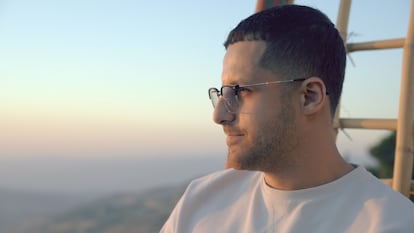
Throughout the documentary, we see the three doctors leave their families, partners, and friends to return to the conflict zone. There they themselves become targets of the Israeli army, which they say is focused on destroying the civilian population. “Our profession should be protected by international law. That is not happening in Gaza. There is a military strategy there that targets doctors, nurses, journalists in particular... We are not talking about unavoidable war casualties; the intent here is very different,” Dr. Ahmad said during one of the New York screenings of the film.
American Doctor also follows its three protagonists outside Gaza, showing how they struggle on a much murkier battleground: bureaucracy. They try, without much success, to gain support in the U.S. Capitol, meeting with lawmakers to advise, inform, and raise awareness among their country’s political class. They meet with Republican senators such as Thom Tillis (North Carolina) and Ted Cruz (Texas), who are shown as all too used to looking the other way. Their other front is the media. They give numerous interviews to try to reach public opinion. “It’s such a complex issue that the human factor is often lost,” says Dr. Sidhwa. “Once, Mark [Perlmutter] and I were on CNN talking about the number of children we found with gunshot wounds to the head. The journalist’s response was to say that CNN had not independently verified what we were saying. If you don’t have access to the places where we are, it’s impossible to verify it,” the doctor recalls.
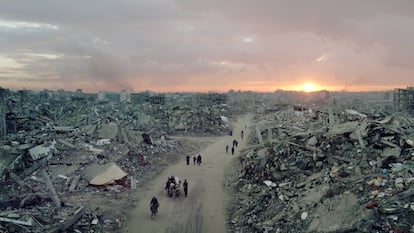
Emmy-winning Poh Si Teng does not shy away from images showing civilian victims, but she prefers to address the conflict from a broader perspective. That is in fact the debate that opens American Doctor, in a conversation she has with Dr. Perlmutter in which he argues for showing explicit footage of killings of Palestinian children. “As journalists or nonfiction storytellers, we know there is a thin line, a very delicate balance in what you show. If you show too much, the viewer may feel it is gratuitous and you end up alienating them. But showing too little is not the solution,” the filmmaker explains.
“This is our war, that of Americans. And as citizens who pay taxes in a country that calls itself a democracy, we all bear responsibility,” the director says of the reasons that led her to make the documentary, which after its premiere at the Sundance Film Festival has played at the most prestigious European documentary festivals, including CPH:DOX, Thessaloniki, and Visions du Réel, and is selling out screenings in mid-September at Canada’s Hot Docs.
Watermelon Pictures, the producer of American Doctor, operates a streaming platform for films, animation and documentaries called Watermelon+, which curates nonfiction cinema and content focused on marginalized or underrepresented communities. Recently, content related to Palestine has taken on special prominence in its catalogue, which is available internationally for a fee of around $5 per month.
Sign up for our weekly newsletter to get more English-language news coverage from EL PAÍS USA Edition









































