
Decapitated heads and mutilated frames: Why ‘The Odyssey’ can only be fully appreciated in a handful of cinemas worldwide
Christopher Nolan’s decision to shoot in IMAX 70mm pushes cinematic spectacle toward new frontiers and fuels debate over the limitations of standard theaters
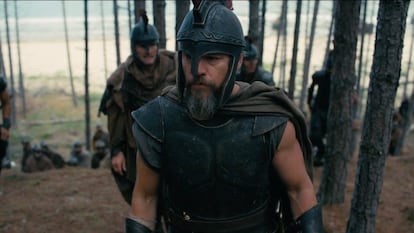

The most famous line in film history about shooting and projection systems was uttered by Fritz Lang in the 1950s: “Cinemascope is only good for filming snakes and funerals.” In an era when people were beginning to stay home to watch television, cinema was plunged into crisis and the industry tried to respond with more spectacular systems to lure audiences back to theaters. The Austrian director — renowned creator of Metropolis and Fury, among many others — thought such a wide panorama (2.35:1, and even 2.55:1) did not fit the natural proportion of the human face nor the framing a director should control. Without specifying it, Lang was speaking of the artist’s gaze. Of its importance, of its essence. In practical terms: what remains inside the frame and what stays outside.
More than 70 years later, another celebrated director, this one contemporary — the British filmmaker Christopher Nolan — working at a moment far removed in time though similar in its attempt to respond technologically and perhaps artistically to the audience’s changing habits and a drifting away from theaters, has shot The Odyssey in IMAX 70mm, a system with much higher resolution and an aspect that is as wide horizontally but taller vertically and more enveloping, which could well answer Lang’s reservations. The problem is that only a handful of cinemas worldwide (three in the entire European Union and 25 in the United States) have the technology required to project it the way Nolan intended. In Spain the experience can be only half-lived: there are theaters with IMAX technology or that can accommodate 70mm, but not both at once. In the vast majority of cinemas, therefore, viewers see frames cropped at the top and bottom. In other words, the artist’s gaze is blurred.
the difference is crazy pic.twitter.com/rzCpxMCpiY
— kira 👾 (@kirawontmiss) July 17, 2026
The director of The Dark Knight, Inception and Oppenheimer knew this would happen. So why did he do it? Nolan has explained in various interviews that the geometric translation was calculated during filming in collaboration with his director of photography, Hoyte van Hoytema. To ensure that no vital part of a scene would be lost when moving from a somewhat squarer giant screen (aspect ratio 1.43:1) to the traditional panorama of most theaters (flat, 1.85:1; and scope, 2.39:1), the staging (that is, the composition of the frame) led him to always place essential elements at the center of the shot, and during filming, when looking through the viewfinder, they had visible guide lines showing all formats and aspect ratios. At any moment they knew what would be inside and outside the frame, depending on each cinema.
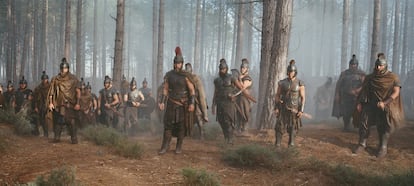
However, the mortal fight against giants means that these appear whole in those few theaters and with their heads cut off in most others; a tower collapsing on fire is not seen in full; the mast of a ship at sea disappears; a wide close-up of Matt Damon with room above the head becomes an ultra-close shot, cropped from forehead to chin, far more intimate. The gaze changes. Translated: it would be unthinkable for a great photographer to compose a masterpiece (as some of Nolan’s images are) and for that image, depending on where it was seen, to be complete in one place and have a character with his feet cut off in another. What is the central, essential part of Velázquez‘s Las meninas? And the superfluous, and therefore removable? Perhaps the ceiling and the lamp? And what about large-format paintings such as Liberty Leading the People (2.60 meters high by 3.25 meters wide)? What part could be cut if it did not fit on a wall?
The question is who cares about all this in a film that is already a resounding success (both in special venues and in conventional theaters). Certainly not the majority of viewers (among both self-described film buffs and those who typically watch movies on their phones), but for the cinematic language and for art, the operation is at least questionable. For some it is even madness because Nolan is also limiting himself in how he configures staging. If legs, a head, or an object are cut, let it be for narrative reasons, concept, metaphor, or visual sense — not for technological reasons or pure spectacle.
The verdict could be that masterpieces can be made in IMAX 70mm and in wider or even narrower formats, with higher resolution and hard-grain texture, with spectacular sound and with more conventional sound. It could even be that configurations can be used as a narrative element: Xavier Dolan’s powerful widening of the frame in Mommy, from the square 1:1 to the panoramic, served as a metaphor for the air entering the protagonist’s life from his mental imprisonment, and as an unusual breaking of the fourth wall.
To Nolan, as to other great defenders of celluloid over digital — and of 70mm in particular, such as Paul Thomas Anderson, Quentin Tarantino and Ryan Coogler — credit is due for insisting on an extraordinary in-theater experience. Also for perhaps forcing a change, and for how films like The Odyssey push new frontiers in cinematic spectacle at a time when exhibition conditions are poor or could be improved on too many screens.
Only 41 cinemas on EARTH can actually show what Nolan filmed. 🤯
— FILMYNEWS (@filmynewsnetwrk) July 14, 2026
🇺🇸 26
🇨🇦 7
🇬🇧 3
🇪🇺 4
🇦🇺 1#TheOdyssey pic.twitter.com/yT5TJe36xI
Since the silent era, cinema has gone through multiple shooting and exhibition systems, and some were abandoned or evolved because they were expensive, useless, or commercially outcompeted: Cinerama, VistaVision, Panavision... And when broadcasting to television, a few atrocities have been committed: converting a wide format to a narrow one by means of pan & scan when CRT televisions broadcast in 4:3, thus avoiding black bars at the top and bottom and filling the screen with films that needed those bars because they were in cinemascope; or today, when some platforms transform films from the classic traditional format to widescreen to fill current plasma TV screens and avoid black bars on the sides. Returning to painting, how can you represent masterpieces such as Edward Hopper’s Nighthawks (1942) or Telemaco Signorini’s La sirga (1864) in a squarer format when they are, in a sense, the cinemascope and the Cinerama before cinemascope and Cinerama?
Regardless of whether the film is good or bad for other reasons (and it is good), is The Odyssey another atrocity? At minimum, it is more than likely that filmmakers such as Hitchcock, Dreyer, Tarkovsky or Ford would have considered the response. Lang, who abhorred cinemascope and repeated that mythical line while playing himself in Jean-Luc Godard’s Contempt, about a fictional shoot of precisely the epic Odyssey, ended up making, shortly afterward, a great widescreen film: Moonfleet. So it is not a matter of snakes or funerals, cyclopes or giants, but of gaze. Whether that gaze is cold or intimate, tender or simply violent, depends on the framing. The frame, the limits of the shot, are the border between the ordinary and the extraordinary. It is through arranging the physical and human elements within the frame that one achieves shock.
Sign up for our weekly newsletter to get more English-language news coverage from EL PAÍS USA Edition









































