
What would happen if a tradwife woke up in 1855?
In ‘Yesteryear,’ Caro Claire Burke portrays an influencer returning to an era she idolizes online to examine Trump’s United States, fanaticism, and regression
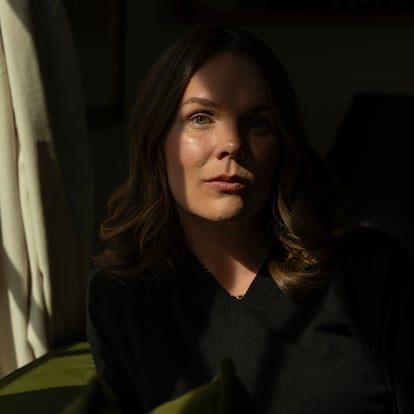

Be careful what you wish for, as the saying goes, although it is not entirely clear what Yesteryear’s protagonist intended when she downloaded the Instagram app and started her journey as an influencer. Here’s what we can say for sure: Natalie, or Nattie, is a devout Christian and a proud housewife. She is intelligent but believes little can be learned at university. Well-married — no, phenomenally well-married — to the youngest son of a senator who is a potential presidential candidate. A potential presidential candidate for none other than the United States.
We also know that Natalie has kneaded a not-inconsiderable amount of bread and gained several million followers on her account, which promotes the benefits of bucolic life on a ranch in the mountains of Idaho. To help her manage her idyllic traditional lifestyle she has a producer, two nannies, and five children, with a sixth on the way. But then Nattie wakes up in 1855. Yes, the era of cowboys and the gold rush (and smallpox, and sandstorms) that she so lovingly depicted in her posts. There is a search for meaning in religion and gender roles; there is the manosphere and post-feminism; there are antagonistic political factions.
Yesteryear is one of those books that resemble a treatise on a time and a place. In this case, our deranged 21st century and the United States of Donald Trump, fanaticism, and regression — a country against which we inevitably compare ourselves, no matter how much distance separates us. Yesteryear is Caro Claire Burke’s debut novel but Burke has plenty of experience in online writing, evident in the novel’s style. What she narrates and how she narrates it has an audiovisual cadence so obvious that Anne Hathaway has already been cast in the role of Natalie for the movie.
Burke starts with the post-pandemic phenomenon of tradwife influencers — women who assume the role of the traditional housewife, devoted mothers who never cooks with additives and always looks impeccable, despite the workload; who wear cottagecore dresses sent to them by brands to promote their line surreptitiously. Burke uses this as a vehicle to get to the heart of the culture wars. And what is revealed is a search for meaning and belonging in religion and gender roles, structured spaces that make disorientation difficult; the manosphere versus post-feminism. There are irreconcilable political factions and the inescapable control of social networks, that panopticon where each individual, from the supposed anonymity of their smartphone, has voluntarily enlisted to become a vigilante and sniper.
Yesteryear is riven with underlying themes: the idealization of motherhood; the overlap of isolation and overexposure; food ethics; dependence on psychotropic drugs... The novel talks about people who promote unpasteurized milk while letting their cows die one after another. It talks of families who build their legacies on cemeteries of secrets. Of anesthetized brains, of the challenge of being honest in a rotten system, of appearance as a vital aspiration. Of women turned into their own bosses who, trapped by capitalism while at the same time promoting it, think that feminism works against them.
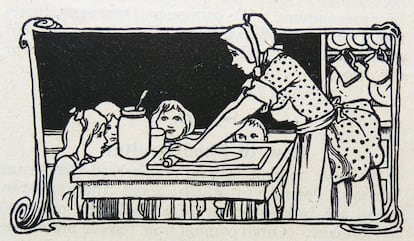
Nattie and Caleb meet in a church, attached to Harvard — that den of iniquity filled with women like Reena, their roommate, a self-proclaimed feminist who sleeps with anyone, the kind who is content to join male-led corporations where women are invariably treated as inferiors, while missing the chance to fulfill their biological destiny. That’s Reena and that’s how the “Angry Women” Natalie disparages are.
It’s not that Natalie cares about not having friends, not at all. She knows that her children and her husband are more than enough, sometimes you could say too much. For example, when her daughter Clementine arrives when she is still 19, she fails to manage her emotions, the rejections, that hint of evil that she senses in the baby, which of course she will never mention. Smile, she says to herself, go on, you are building the perfect family, the perfect life, even if it is obvious that your husband, now that you know him a little, lacks ambition and, let’s not fool ourselves, intelligence. Shouldn’t she have been born a man and he a woman?
Thou shalt not judge the counsel of the Lord. But what is the Lord looking for when he sends Natalie to the Old Time Ranch? Everything will be explained in due course. The final twist will put everything and everyone in its place — Nattie, her pious mother and her wayward sister, her husband Caleb and his presidential wannabe father and, above all, their children. Those six children who grew up without going to school, who learned to recite the 10 commandments before learning about oceans. And who, for the first time in history, are part of a generation raised not only behind but also in front of a screen, exposed to the scrutiny of the entire world. We already know that the past was not as romantic as it is depicted by influencers like Natalie, and the present does not look entirely promising, but what of the future? What kind of life will be left for these screenbabies?
Sign up for our weekly newsletter to get more English-language news coverage from EL PAÍS USA Edition









































