
Sergio Ramírez: ‘It is paradoxical that I should join the RAE precisely for being an exile’
The Cervantes Prize winner reflects in Panama on his entry into the Royal Spanish Academy, the richness of Central American speech and ‘cabanga,’ that deep nostalgia that marks his work from exile
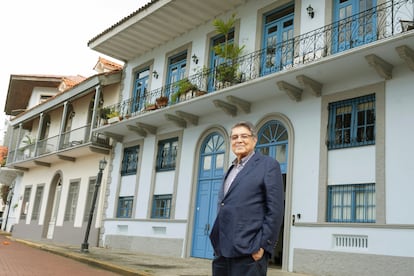

There is a word from Central American Spanish that has been echoing in Sergio Ramírez’s mind these days. Cabanga — a warm, aching sorrow tied to the geography of the isthmus where he was born. Cabanga arrives when the afternoon suddenly drops over the clay rooftops and the crowns of wild trees, when the golden light catches the enormous tropical flowers and sways in step with the breezes off the Great Lake. And with it comes absence — forced, in his case: the absence of Nicaragua, a country that will not let him return. A country — with its melodic accent that drops its S’s, collapses its words, sounds like a drumbeat or a heavy raindrop, addresses others as vos, stresses its verbs, and has an audible tilde — that seems to whisper to him: “Come back, come home.”
According to the Royal Spanish Academy (RAE), cabanga means melancholy, a soft sadness, longing, nostalgia. The reference is fitting, because this Thursday Ramírez was chosen to occupy a seat of the Royal Spanish Academy, an honor that he says crowns his literary career. The news reached him in Panama, just an hour’s flight from Nicaragua, only a few hundred miles from the house and library he left behind for who knows how long. Close — so close — that if he strains his ear, he can almost hear that fluid, musical accent, touched with Caribbean warmth. Qué cabanga!
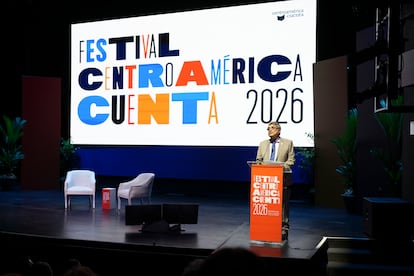
On Thursday morning, already under Panama’s heat, Ramírez received the call from across the Atlantic with the good news. It came just as he was leaving an event for another writer friend, the Colombian writer Héctor Abad Faciolince, who had just been inducted into the Panamanian Academy of Language (APL), as part of the activities of the Centroamérica Cuenta festival, which Ramírez founded. A double celebration in the so-called waist of the world. A major moment for Central American letters — a historically peripheral literary region that today reminds the world it has an active, distinct voice at the heart of the institutions that safeguard the language.
Ramírez, 83, winner of the 2017 Cervantes Prize, speaks for this interview during the festival he founded, from the residence of the Spanish ambassador in Panama, who has hosted him for lunch. The writer — stripped of his Nicaraguan nationality by Daniel Ortega’s regime — now takes a seat in the institution that watches over the Spanish language, a recognition that, in his words, belongs to all of Nicaragua.
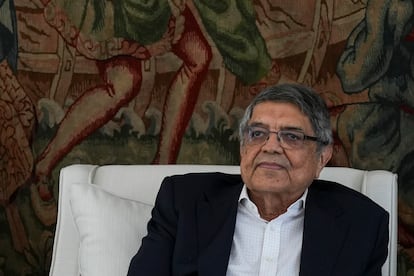
Question. What does it mean for a writer in exile to be named a member of the RAE?
Answer. It is paradoxical that I come to occupy this seat in the RAE precisely because I am an exile, because I am banished. Had I stayed inside Nicaragua for whatever reason, I would not have had this opportunity, because it is a position that is only open to Spanish citizens residing in Spain. But what matters is turning circumstances into advantages. I feel that this recognition belongs to Nicaragua, because that is the country I come from; language is my homeland, and it always travels with me.
Q. When your nomination was presented, your defense of liberty in the face of what you call the new dictatorship in Nicaragua was highlighted. What did those words mean to you?
A. It is recognition that I have tried to be a writer who does not keep silent. I admire very good writers who prefer not to comment, but I feel that my duty as a writer and as a citizen is to speak out. If I have an important platform, I point out that my homeland lives under a dictatorship and I denounce the abuses against freedom of expression, freedom of the press, and the exiled journalists. I could not speak about anything else.
Q. You received the news here in Panama, during the Centroamérica Cuenta festival. What was that moment like?
A. It was very moving. I was attending Héctor Abad Faciolince’s induction as a member of the Panamanian Academy of Language. As I was leaving, I received a call from Santiago Muñoz Machado, the director of the RAE, informing me that I had been elected after the vote. I realized that this is my world: I went from hearing Héctor’s beautiful words about language to speaking with the director of the RAE. You look back in amazement at everything you have lived; I have had time to live many lives.
Q. What can Central Americans expect from having a representative in the RAE?
A. Recently, I read a comment on social networks that sums it up well: someone said they were going to send me a cachimbazo [a big bunch] of Nicaraguan words for me to put in the dictionary. I think that captures what this means.
Q. Central America has often been seen as a cultural periphery. What role does its language play within the wider Spanish‑speaking world?
A. We are countries culturally marginal in terms of reading rates, [with] few bookstores, and poor public libraries. Yet very important writers emerge. We are a region of “first violins”: there are excellent soloists, but the orchestra is missing — that cultural and educational articulation that would provide an organized push. That is why the Centroamérica Cuenta festival exists: to promote those talents.
Q. You mentioned that one of the things you most regret about exile is not hearing the Nicaraguan accent every day.
A. Language is in the ear, and I love listening to Nicaraguan speech. I have developed a register for languages; in Spain, I already distinguish Andalusian from Galician — it is a gift of the ear. But the voices of my childhood always resonate with me. In the countryside of Nicaragua, people still speak with accents and use terms from the Golden Age, mixed with words from Chorotega. It is a very rich language that is never lost, but you have to keep refreshing it constantly.
Q. Is there a word that has stayed suspended in your memory?
A. I love the word cabanga.
Q. Do you feel cabanga right now?
A. Yes, I have cabanga for the country. It is the loss of what one loves: the loss of Nicaragua is the cabanga. That nostalgia is strongly shaping my current literary work. Distance and exile have much to do with nostalgia, and nostalgia is an excellent instrument for exalting language.
Sign up for our weekly newsletter to get more English-language news coverage from EL PAÍS USA Edition









































