
As Hollywood holds back, television pushes back against Trump 2.0
This year’s Golden Globes were extremely cautious in their approach to the president, who has instead been openly challenged by shows such as ‘South Park’ and by hosts Stephen Colbert and Jimmy Kimmel


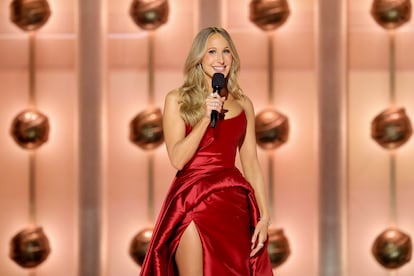
When the Golden Globes kicked off on January 11 at 5 p.m., the eyes and ears of the United States — and, by extension, the world — turned to Nikki Glaser. The show’s host was virtually unknown in 2025, when she first presented the ceremony, but her quick wit and charm quickly established her as one of the country’s most beloved comedians and earned her an invitation to return this year.
But today, the United States is a different place after 12 months of Donald Trump in power. With such pressing issues as Greenland, Iran, Venezuela, and the immigration enforcement operations and protests against them, Glaser had plenty to talk about. However, the comedian smiled, made fun of Leonardo DiCaprio and the age of his girlfriends, for the umpteenth time, and, although she made a handful of good jokes — including one about the CBS network and the poor quality of its news and another about the “best editing” award for the Department of Justice, for the Epstein documents — she barely uttered a word about the delicate and complex situation in the country, much to everyone’s surprise... Or perhaps no one’s?
Hollywood maintains a delicate and complex relationship with national politics, especially during Trump’s second term. But this is nothing new; it’s a pattern that has been repeating itself for 100 years and is far from changing. In the pantheon of film and television, there have always been actors, directors, and producers openly candid about the realities of their country; some have championed this stance throughout their careers. Others, however, have seen their careers suffer as a result.
“There’s a history of actors suddenly finding they can’t get hired. It’s also this kind of shadow process to stifle dissent or stifle statements too,” explains Matthew Macallister, PhD in communications and a media professor at Penn State University. “We’ve also seen a willingness to really be vengeful to public figures,” adds Macallister, who is a popular culture specialist at the Bellisario Center. That’s why some talent ignore these issues or sweep them under the rug, whether out of fear, ignorance, or prudence.
Glaser’s case seems to be the latter. Although there were a few stars at the Golden Globes who did speak out about the country’s situation, and plenty of well-known figures sign letters for one cause or another — in support of Israel, in support of Palestine, against censorship — she chose to remain silent. Even though she had considered speaking. A couple of days after the event, on Howard Stern’s podcast, Glaser broke down how she prepared the ceremony and why she held back some jokes. “It’s not funny,” she admitted.
She had one about ICE, for example, the Immigration and Customs Enforcement agency. “I was going to come in at some point and say, ‘I’m hearing from the bar that we’re out of ice. And you know, we don’t really need ice. And actually, I hate ice.’ It just felt like, oh, even that’s just being too trivial,” she said on the podcast.
In another joke, she called the Beverly Hilton hotel, where the ceremony was held, the “Trump Beverly Hilton” — a reference to the Kennedy Center’s name change. She even ran it by comedian Steve Martin, who advised against using it. They both reached the same conclusion: “It was like, you just don’t say that guy’s name right now. I just want to give it space,” she said. As she explained in the interview: “It’s hard to strike the right tone.”
Although politics has never held back from attacking Hollywood, and Trump even less so — with open hostility toward the industry expressed through threatening all‑caps messages — the industry is more subtle. The Golden Globes demonstrated this. Mark Ruffalo and Jean Smart spoke loudly and clearly about what worried them, but they did so before the ceremony. Smart, who won the award for best actress in a comedy series for Hacks, even had to calm herself as she took the stage, saying there was “so much that could be said tonight” but that she had already said her “rant on the red carpet” and that, in accepting her award, she was going to do “the right thing.” It seems the right thing was to stay silent.
On arriving at the Golden Globes, Ruffalo didn’t stop talking to every reporter who put a microphone in front of him, criticizing that Venezuela had been invaded and that Trump had flouted every international law. Both of Ruffalo and Smart wore a pin in tribute to Renée Good, who was killed by an ICE agent in Minneapolis.
The Golden Globes mark the start of the awards season, but they also highlight the prevailing silence of the first year of Trump’s second term. Even the 2025 Oscars, hosted by Conan O’Brien, were completely apolitical; only the creators of the Palestinian‑Israeli film No Other Land and actor Adrien Brody lightly addressed political issues, in this case the situation in Gaza. The name of the then newly inaugurated president was not mentioned, not even remotely.

This year, when the season’s most talked‑about — and so far most awarded — film deals precisely with power struggles and immigration raids (One Battle After Another, by Paul Thomas Anderson), its lead stars appear to be holding their tongues. That doesn’t mean that the entire cultural industry has fallen silent, but Hollywood — its pinnacle — has shut its mouth.
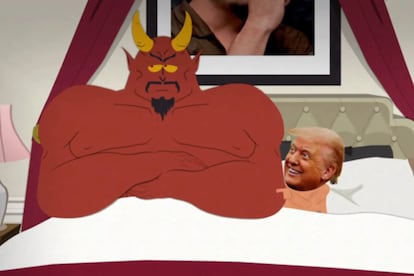
But there are other cultural forces, including in film and television, that are standing up against the president and his policies. Take, for example, South Park, which has been stirring trouble for almost 30 years: in its latest season, the president tries to sleep with the devil, is depicted with a tiny penis, and on top of that Satan reveals he is pregnant with Trump’s child. Of course, South Park has been dismissed by Trump’s inner circle. “The left has no authentic or original content, which is why their popularity continues to hit record lows,” said a White House spokesperson in July. “This show hasn’t been relevant for over 20 years and is hanging on by a thread with uninspired ideas in a desperate attempt for attention.”
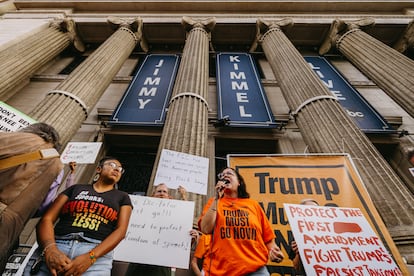
In recent months, the battle has taken place on television, despite the complex landscape of mergers, lawsuits, and shifts in the media scene — and with the telecommunications commission being wielded as a political weapon. The abrupt end of Stephen Colbert’s program and the cancellation (briefly, only for a few days) of Jimmy Kimmel’s show created a Streisand effect against the president: when you try to censor someone to silence what you dislike, and instead you end up in the spotlight. Kimmel and Colbert, along with Jimmy Fallon, Jon Stewart, Seth Meyers — the iconic late-night hosts of American television — spoke out. The comedians got serious and managed to turn the situation around, with both Colbert and especially Kimmel coming out stronger, both in ratings and in their messaging. And the Trump administration continued to be their favorite target, as it has been week after week on Saturday Night Live.
“Hollywood is a bit of a punching bag for the right generally, it’s one of the institutions that often is charged with leaning liberal and addressing issues of like racism, sexism and prejudice and so it’s education that way. It’s an easy target to make ideological charges against,” Professor MacAllister tells EL PAÍS. And yet, as he points out, the heart of the industry doesn’t always incline toward progressive politics, since it’s run by “business people that are also invested in free market economic policies.” But, he adds: “Hollywood is also the domain of art, of addressing social issues and of creativity. And that makes it a kind of easy target to go after.”
Even so, there is still fear and caution. As the professor points out, the awards ceremonies don’t seem as “explicitly political” as they have been in the past. It also depends on the actors’ standing in the industry: some, like Ruffalo, George Clooney (whose wife, Amal Clooney, is also a high-profile human rights lawyer and both have become French citizens), or Matt Damon (who this week said the situation in Minneapolis was “alarming” and compared what happened to the Nazi “brown shirts”), have a level of fame and exposure solid enough that they don’t fear for their careers. Others, on the other hand, prefer not to take that risk.
“High-profile tragedies or outrages or events like Renee Good are going to encourage a little bit more outspokenness. In some cases, it may be unavoidable; it would be foolish,” Macallister argues.
For him, the fact that there are corporate changes — such as the future purchase of Warner Bros., with Paramount and Netflix pulling on opposite ends of the rope — can push people toward even more caution, but everything has a limit.
“We seem to be crossing particular milestones where things seem to begin pretty anti-democratic and pretty dangerous. I think all of that is coming into play, and I’m sure some actors are calculating about this and others feel like they just have to speak up,” he reflects. “If Hollywood actors are like many parts of society maybe, many of them we just don’t hear from very often unless there’s a particular issue that really speaks to the heart.”
Sign up for our weekly newsletter to get more English-language news coverage from EL PAÍS USA Edition









































