
The ‘dynasties’ that keep cumbia alive in a corner of Mexico: ‘The people of Monterrey are reinventing the idea of Colombia’
A passion for Colombian music has helped forge a unique identity in this Mexican city. It gives a distinctive folklore, aesthetic and way of life to the rough neighborhood of La Independencia


Cumbia is Mario Alberto Alfaro’s passion. The 52-year-old is a member of a collective that keeps this musical genre – which originates from Colombia’s Caribbean coast – alive in La Independencia, a rough neighborhood in Monterrey, Mexico. Alfaro is part of a musical “dynasty” that, since the 1970s, has forged an entire culture around Colombia, a country that has become the stuff of legend in the streets of this industrial Mexican city nestled in the foothills of the Sierra Madre Oriental. Here, cumbia isn’t just a soundtrack amidst hardship. Rather, it’s a way of life that preserves and amplifies the rhythms that fuse African, Indigenous and Spanish culture. “Cumbia is something very special… but it sounds cooler with our tunes,” Alfaro proudly declares. He adds: “For me, it’s the most beautiful thing in the world. Any song you play touches your soul. It’s something magical. And that’s what we strive for here in Monterrey: to preserve it.”
Alfaro’s musical “dynasty,” a term used to describe the oldest DJ crews in the area, is known as the Zorro Agustín dynasty. The nickname “Zorro” was given to his brother, the band’s founder, back in the 1970s. “He was my mentor, may he rest in peace. I started playing around with the sounds he left us when I was 15. I [would go on stage] with friends so they could help me with the equipment, my records, my speakers. I quickly learned how to play a song on the turntable. Many people struggle since they don’t have the rhythm, but I knew the groove of the record,” the musician explains.
On a sunny October morning, Alfaro welcomes a group of Colombian artists, government officials and journalists. They’re visiting La Independencia, drawn by its passion for cumbia, but also by the love that Colombia as a whole inspires in a Mexican neighborhood where the cheerful, passionate and hospitable residents view the South American country as a kind of Mecca.
In Monterrey, La Independencia is infamous for being considered a violent neighborhood. However, much of that bad reputation is steeped in old taboos. This is according to Yasodari Sánchez, a diligent and enthusiastic Monterrey-born academic who has done extensive work on the city’s cumbia culture. It is she who opens the doors of the neighborhood to foreign visitors.
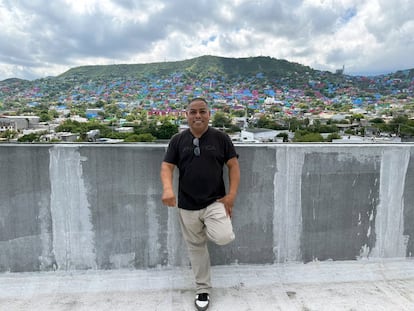
The neighborhood, she explains, began to form in the mid-19th century, populated by migrants from the nearby cities of San Luis Potosí and Zacatecas. Her own relatives were migrants: they came to work in an area that was rapidly developing its industrial sector.
La Indepe, as its inhabitants affectionately call it, was gradually established on the mountain slopes surrounding Monterrey, the capital of the state of Nuevo León. The urban sprawl consists of houses up to four stories high, alleys and staircases that rise into a labyrinth, which is dominated by the yellow, blue and red of the Colombian flag.
Sánchez explains that there are sometimes curfews in the neighborhood and that it has streets where it’s not advisable to walk. And, at night, cars must drive with their lights off. But she emphasizes that La Independencia is a hardworking community and that its residents are passionate and joyful, despite having been marginalized by a city that fears them.
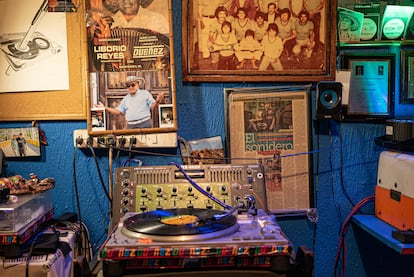
This researcher explains that the neighborhood has generated collective memory through music, dance, DJing and the appropriation of public spaces. She adds that the residents have forged their own identity, with their own unique folklore, esthetics and way of life. This is confirmed by sound engineer Mario Alfaro: “Here, on Saturdays and Sundays, wherever you are, you can hear the trumpets [and] the speakers playing one sound here, another there. When someone receives a new record, they put it on… and it’s a pleasure to hear that they’ve finally found the song they wanted. Some take pride in this, [boasting that] they have the best music in the neighborhood.”
Record-collecting and sharing are fundamental parts of the local music culture. The DJs and MCs aspire to always have a vast repertoire: they travel to record stores in Mexico City so that they can stay up-to-date. And those who can afford it also take trips to Colombia. “That’s the best source of that beautiful music we love,” Alfaro points out. In his case, he buys from collectors in the Mexican capital.
The purchasing of vinyl records represents a huge economic effort for these working-class people. There are records that can cost up to 8,000 pesos (about $400), the equivalent of the monthly minimum wage in Mexico. Alfaro proudly comments that he has managed to build a collection of 2,500 records. “Since it’s a huge investment, we have to buy something that’s playable, successful and rhythmic. I only have Colombian music; we don’t use anything [produced locally], because the most beautiful [records] are from Colombia,” he asserts.
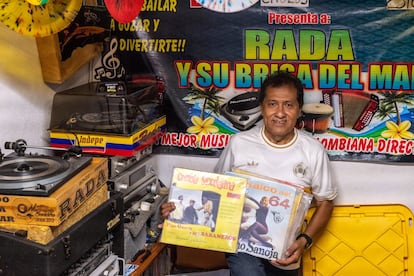
Another avid collector is José Rada García, 63, who has been involved in the local cumbia scene since 1974. The golden age, as he describes it.
Rada keeps his records in plastic boxes in a small, humble studio that he set up in the living room of his home. The front door is painted with the colors of the Colombian flag. And, during his interview with EL PAÍS, he wears a T-shirt that also displays the flag. He speaks enthusiastically about a trip he made to the South American country back in 2017: he brought back 500 records. Some of them were duplicates from his collection, meant to be traded with other bands. “Colombia is everything. Their taste in music is amazing,” he sighs.
Rada began playing cumbia music when he was 13 years old. He did so alongside his brother, who quickly abandoned the artform because he decided to enroll in the Police Academy. A young Rada eventually traveled to Tepito, a rough neighborhood in the Mexican capital, where he could find records at affordable prices. “For me, it was a huge joy, because I’m passionate about this music. Even if you can’t dance, you hear the rhythm and start moving your feet, just like that,” he smiles, moving his legs. “I mean, this is something very beautiful, because the music carries a message of joy,” he affirms.
An altar in Rada’s home includes pictures of legendary bands such as La Sonora Dinamita, composer Andrés Landero and musician Humberto Pabón of Grupo Cañaveral, one of the most important cumbia groups in Mexico.
La Independencia is known for preserving cumbia. This genre of music is seen as folkloric in Colombia, where it isn’t played with nearly the same passion as in the outskirts of Monterrey. But the Mexican neighborhood has also created its own fusion, a whole new culture that has attracted young people. Here, they also play the so-called cumbia rebajada – a subgenre characterized by a slower tempo. Rada explains that this was born accidentally, when a stereo system overheated, causing the record on the turntable to play more slowly.
Rada jokes that when there are power outages in this neighborhood, which is covered by a tangle of power lines, the turntable’s speed drops so much that records can play with astonishing slowness. That accident caught on and became a whole new way of making music in Monterrey. It became the favorite sound of the urban subculture, whose members are known as cholombianos: young people who wear baggy clothes and have long sideburns and tattoos. They’re part of a generation stigmatized by Monterrey society, one which has suffered the brutal state violence unleashed by the administration of former President Felipe Calderón (2006-2012). This story was told in the acclaimed film I’m No Longer Here (2019), selected as Mexico’s nominee for Best International Feature Film at the 2021 Oscars.
Even though Rada doesn’t like the film, he acknowledges that it generated a lot of interest in Monterrey’s cumbia culture and specifically brought attention to La Independencia, Mexico’s “little Colombia.”
During their October morning stroll through La Independencia, the Colombian delegation expressed admiration for the neighborhood. The artists and officials are in Mexico to participate in the Monterrey International Book Fair: Colombia is this year’s guest of honor.
“They’ve reinvented Colombia,” says Jaime Andrés Monsalve, music director for Colombian National Radio. He’s also the author of more than a dozen books on music. “There’s a reinvention of the country being undertaken by the Monterrey residents that’s absolutely unprecedented. We’ve had some clues in films like I’m No Longer Here. [And we’ve also seen this development] with the [creation] of cumbia rebajada and especially through people who have dedicated themselves to trying to archive Colombian musical heritage, which is an immense task,” he comments.
This adoration of Colombia baffles the visiting Colombians, who stroll in awe through La Independencia. They chat with local residents, listen to their stories and photograph their murals. Some of these images depict Our Lady of Guadalupe – their beloved protector – alongside accordions and traditional sombreros from the South American country. “We realized that much of our musical heritage has been scrutinized by Mexicans, sampled and brought here. All of this speaks to a love for our music… but that love has also become something extra-musical,” Monsalve explains.
Without hiding his admiration, he adds: “The fact that you see such a unique way of dancing cumbia – of listening to it, toning it down [and] adapting it to all the needs of the dance, but also to [the needs] of everyday life, [to the locals’] reason for existing – stirs me deeply.” His words express the wonder of a Colombian who sees his culture mimicked by the yellow, blue and red colors that shine on the houses of La Independencia, the Mexican branch of Colombian music.
Celso Piña’s Musical Altar
Celso Piña (1953-2019) is worshipped in La Independencia. For local residents, the musician is the greatest representative of a culture that idolizes cumbia. Piña lived in La Campana – another working-class neighborhood in Monterrey – where his sister, Verónica Piña, preserves the former home of the musician, who died unexpectedly in 2019 during surgery.
The house is a three-story building that houses Piña’s musical instruments, his awards, his album covers, and his passion for music. “I wanted to continue the legacy that my brother left behind. I don’t just want it to be like this, with the news saying, ‘today is the anniversary of Celso Piña’s death,’ and that’s it. No. We hold a cumbia festival [in this city]; we bring together more than 17,000 people to celebrate,” she affirms.
The house is run with support from the local government and via donations. For the family, ensuring its upkeep is a challenge. Despite this, however, they offer music and dance classes for children, “because we want them to dance to the songs that Celso played… in other words, [we want the kids] to dance in the Colombian style,” the musician’s sister explains. “It’s very important to me to maintain this house, because Celso’s legacy continues from here,” she reiterates.
Sign up for our weekly newsletter to get more English-language news coverage from EL PAÍS USA Edition









































