
Bill Condon, director: ‘My theory is that people really enjoy musicals, but they don’t think they’re cool’
The producer and screenwriter of ‘Kiss of the Spider Woman’ has been fighting for years to obtain the rights to the novel and film the musical, which stars and is also produced by Jennifer Lopez
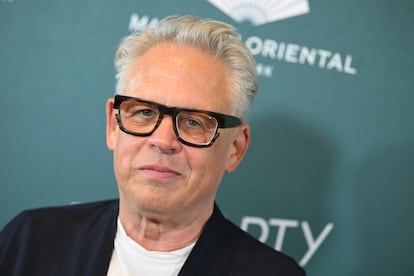

Over his nearly 40-year career behind the camera, Bill Condon, 69, has written and directed dramas (such as the award-winning Gods and Monsters), bittersweet comedies (the cancer-centered series The Big C), popular hits (the last two Twilight films and Emma Watson’s Beauty and the Beast), and even beloved musicals (Chicago and Dreamgirls). But few projects are like the one he now has in his hands, which blends elements of all these genres. Condon takes the helm of a long-cherished project, Kiss of the Spider Woman, this time serving as director, screenwriter, and producer. Remaking the 1985 hit movie has been a dream of Condon’s forever — one realized through persistence, determination, and the influence of its star: Jennifer Lopez.
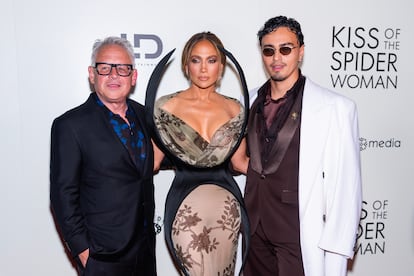
Lopez is both singer and actress in this film, but she also serves as producer and the driving force behind getting the project off the ground. Starring alongside Lopez (who takes over the role originally played by Sonia Braga in Héctor Babenco’s 1985 adaptation of Manuel Puig’s novel) are Diego Luna, stepping into Raul Julia’s role from 40 years ago, and Tonatiuh, a California-born actor of Mexican descent with perfect Spanish, who has emerged as the season’s breakout star. He takes on the role William Hurt played in 1985. In the story, Lopez’s Spider Woman is the glamorous film actress Luis Molina (Tonatiuh) dreams about — full of light, color, music, and dance — to endure his time in prison, where he shares a cell with Valentín Arregui (Luna), against the backdrop of Argentina’s military dictatorship.
The film is entirely Condon’s project, he acknowledges, and he always envisioned Lopez in the role. “I started this movie. And I wrote it on my own. I didn’t go to someone to ask for a script,” he recalls.
Having also written the screenplay for Chicago in 2002, he sees Kiss of the Spider Woman as the final part of a trilogy of sorts, following Cabaret and Chicago — the six-time Oscar-winning musical.
“It always felt this was the third part of the trilogy,” says Condon. “I went to the writers John Kander [composer] and Terrence McNally [who passed in 2020], while he was still alive, about 10 years ago. It then took a long time to find the rights because Babenco had the rights — Puig had given the rights to Babenco — but it was hard to track down who actually had them ... We were talking to the wrong people for years."
When he finally obtained the rights, he returned to Kander — who, at 98, composed the film’s score — and assured him he would carry the project forward. Condor recalls: “I told him, ‘No one’s going to get me money. The only way to make this movie with integrity is just let me do it and then find the money.’ So I did that, hoping that Jennifer Lopez would be in it. She was the one. I sent it to her, and she said yes right away. And then Ben Affleck, whom she was with the time, said yes. I still pinch myself that it happened.”
Affleck and Lopez themselves demonstrated the importance of the project to their lives and careers when, a few days ago, at the premiere in New York, they posed together on the red carpet for the first time since their divorce more than a year ago.
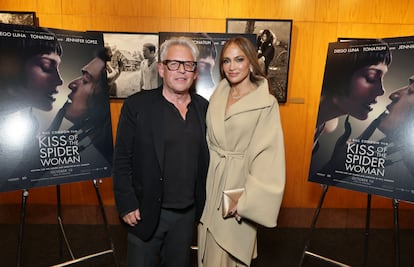
The film is actually two movies in one: the dark, painful, and confined space shared by Molina and Arregui, and the fantasy world of Lopez with her glittering musical numbers. To capture this, Condon chose to shoot in two locations, Uruguay and New York. The interview, with several outlets including EL PAÍS, takes place in Los Angeles, the cradle of cinema, though Condon did not shoot there this time. The Californian city has lost many productions due to the pandemic, strikes, and wildfires, but the director does not believe the industry is in danger.
“I think we all feel nervous about it,” he tells this newspaper. “But I have this I want to say. Somebody sent me this, it’s a list of the movies that are opening within 10 days of our movie.” He proceeds to list: "The Smashing Machine, P.T. Anderson [referring to the director of One Battle After Another], After the Hunt, House of Dynamite by Bigelow, Roofman, Panahi [It Was Just an Accident], Ballad of a Small Player, Frankenstein… And I’m leaving out Tron and many others."
He explains: “It’s been a slow return, but to me, it reminds me of what it was like 10 or 20 years ago. There are a lot of different movies, a lot of choices. It’s like what happened with Barbie and Oppenheimer, but it’s up to the audience to show up now. You know what I mean? And stop complaining that all we get is Marvel movies, because it’s not true. It’s always hard to get movies made, but the hard thing now is to get the audience back. And once that happens, it happens more and more, so I find this to be an interesting moment."
For Condon, filming scenes set during a political and social crisis like the Argentine dictatorship (“with tanks in the streets,” he recalls), even though it took place 40 years ago, also connected him to the present. He shot in Montevideo with much of the cast from Buenos Aires, resulting in a mix of Uruguayan and Argentine actors. “Seeing so many people who had personal stories to tell — cousins, uncles, grandparents who suffered under the regime — gives you an extra sense of awareness.”
He also sees a parallel with his native United States. “Seeing that happen here now, troops on the streets, masks... it was all in my mind. I don’t think it is an accident. There’s a movie about Putin, too. I think it’s a reflection,” he admits.
The movie was filmed before Donald Trump returned to the White House, but for Condon, “just because Trump hadn’t been elected yet, he didn’t come out of nowhere. So this strain in our country was happening, and you’re highly aware of it. The battle between MAGA and the rest of the country was absolutely front of mind.”
For this new adaptation, he drew more from Puig’s 1976 novel, written at the start of Argentina’s dictatorship, than from Babenco’s 1985 film. He says the original movie is “wonderful, but very much a Babenco movie,” and he left it out of his mind when creating his version.
For him, the magic was in the musical aspect — that eternally declared “dying” genre. “Musical movies have been dying since they were invented,” he laughs, recalling how 1927’s The Jazz Singer was the first sound musical, followed by dozens more, in a genre that rapidly fell out of favor by the decade’s end… until Busby Berkeley and Fred Astaire arrived, bringing it back with unstoppable force. “I could talk endlessly about this,” he admits, demonstrating encyclopedic knowledge of the subject.
Condon is fascinated by the genre and traces its history from the French wave of the 1960s to its decline in the 1970s and 1980s. “ there were fewer and fewer musicals, and so generations of people didn’t grow up with them. They weren’t aware of the vocabulary. So then they came back in the early 2000s. Moulin Rouge did it by creating this incredible fantasy world; we did it in Chicago," he recalls of his 2002 film.
“And then, slowly, with Dreamgirls, Hairspray, Les Misérables... There was now a decade of movies where people did start to sing to each other and the audience kind of relaxed into it. My theory is people really enjoy it, but they don’t think it’s cool, and they’re nervous about it, so you have to get them comfortable," he reflects. For him, the pandemic led to some major releases underperforming, “and musicals started to struggle again.”
The sheer scale of production with the rise of streaming platforms, and the fact that not all musicals succeed there, has created some anxiety in the industry, he believes.
“Maybe that’s change,” he hopes, with different musicals like the one he is presenting now. “The reason we made it independently, and didn’t make it for a huge budget, was because to tell this story correctly, it was never going to appeal to anybody. And I enjoy that. I enjoy we’re somewhere in the middle of being commercial and independent and I hope enough people come so that it makes its money back, but it is never intended to be that juggernaut that so many musicals try to be.”
Jennifer Lopez is probably in full agreement.
Sign up for our weekly newsletter to get more English-language news coverage from EL PAÍS USA Edition









































