
Julia Roberts: ‘I have a lot of confidence in the intellect of moviegoers’
In her first work with director Luca Guadagnino, the actress plays a university professor who becomes embroiled in a case of sexual harassment
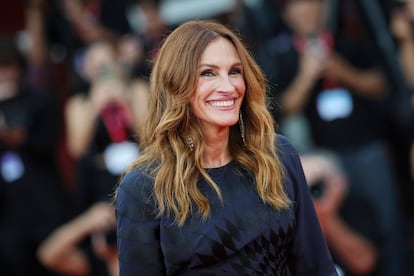

It seems strange, after so many years of seeing her on screen — and given that she rarely makes public appearances — to suddenly be sharing physical space with Julia Roberts. After nearly four decades in film and more than 50 screen appearances, and with that aura of stardom that has surrounded her ever since Pretty Woman, 35 years ago, Roberts, now 57, is still that magnetic woman with the big smile who somehow makes everyone pay attention to whatever she does.
In her latest role, she plays a philosophy professor, Alma Imhoff, under the direction of Italian filmmaker Luca Guadagnino, with whom she is working for the first time. After the Hunt opens in theaters on Friday, October 17, following its premiere at the Venice Film Festival. The actress and director arrive together at the bar of a luxury Los Angeles hotel to talk about the film — a professional challenge for Roberts, both because it’s hard to empathize with her cool, emotionally distant character and because the story delves into uncomfortable territory.
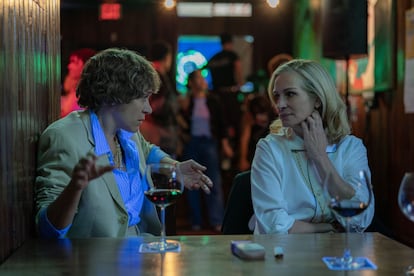
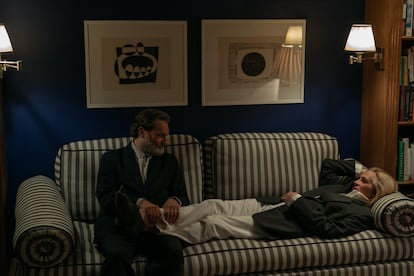
When Maggie (Ayo Edebiri), one of Alma’s brightest students — or perhaps not so bright — confides that she has been abused by Alma’s favorite colleague at Yale, fellow professor Hank (Andrew Garfield), the protagonist’s professional, personal, and moral worlds begin to crumble. Alma starts questioning many things. So do the viewers. Roberts knows this — and, with her thoughtful sense of humor, she enjoys the fact that the film provokes that kind of conversation.
After the Hunt revolves around what happens when a case of abuse comes to light — how each victim, and everyone around them, processes, experiences, and manages it. The nuances are endless. So many, in fact, that, as in real life, even the protagonists aren’t entirely sure what’s going on. Do they, as actors, know exactly what happens in the film? For the director, that wasn’t particularly important; in fact, what mattered was not to “impose a point of view that is definitive — letting the audience go out and see the movie and make up their mind.”
The Challengers and Call Me by Your Name director praises how great actors understand human behavior, “almost like a psychoanalyst.” “Call it intuition, call it observation, call it life, call it art, but when you see an actor perform... Kind of layers and depths about human behavior, it’s amazing.”
Roberts believes that everyone will interpret the story through their own lens, as “a reflection of our own life experience.”
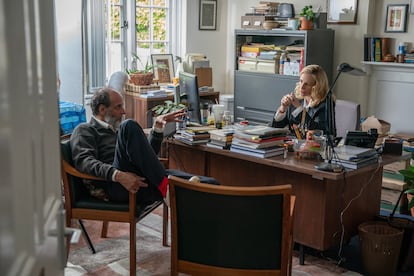
Sitting side by side and and chatting conspiratorially — at a roundtable with foreign media in which EL PAÍS was the only Spanish outlet — Roberts and Guadagnino listen intently to each other. They explain that their goal wasn’t to take #MeToo out of Hollywood and transplant the conversation elsewhere, but rather to use the world of the academic elite as another setting. “I don’t compartmentalize the incidence of MeToo in that way,” the actress says. “I’d say unfortunately we’re all too aware of incidents like this happening in this academic, university environment.” The director agrees: “The get-go wasn’t to try to understand the concept of MeToo in academia. It’s simply another stage on which to explore this universal struggle for power, for entitlement — for imposing your own version of things on others without really listening to them.”
For Roberts, the fact that the film sparks that kind of conversation is a very positive thing. During her appearance at the Venice Film Festival, she lamented that “the art of conversation is being lost.” Faced with the lively discussion around the movie, she seems to have regained some faith. “As someone who loves movies, I have a lot of confidence in the intellect of moviegoers. I think when you make that effort to go sit in the dark with people, you’re making yourself completely available to what is then shared with you,” she reflects. And she knew, too, “in Luca’s hands that it would be as it should be.”
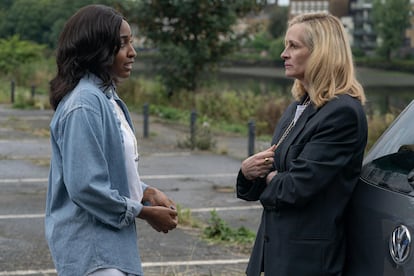
That ultimate confidence is what drives her to leave the comfort of her home and support projects like this. “We all have that voice, right, that little feeling somewhere in us that when we meet another person, we feel inherently drawn or something that makes you step away a little bit. And I have complete trust in my little voice inside of me; it has served me really beautifully in my life,” she admits openly. “And the first time I was really face to face with this man [Guadagnino], just every cell in my body was saying, ‘yay!’” she adds, laughing.
She admits that, in addition to the opportunity to work with Guadagnino, she was hooked on Nora Garrett’s script, helping her make some changes during filming. She also loved the atmosphere, “the powder keg of this school, this really small town”: “I liked that setting, I thought it was really intriguing and had so much potential to it. And then really it was Luca and our conversations about what it could be, and Alma.”
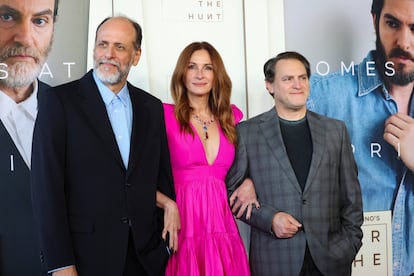
Alma is the center of the film. She found the character of the seemingly charming but internally cold professor, with a complex marriage, fascinating. “I don’t need to love her, but I do have a huge resource of empathy for her. I think she has so much damage that she’s shouldering and shielding herself from all the time. And there was something really interesting about how to unravel her and when to let the light shine through the cracks a little bit. And it was definitely something very profound to explore for me because she has a completely different natural instinct to the world than I do. That’s what makes it fun to play, fun in a perverse way” she says. In one scene, the academic appears on the floor of her home next to a framed poster of The Flower of My Secret. “Alma loves that movie very much,” Guadagnino explains of Pedro Almodóvar’s 1995 film. “She is very much in awe of the character of Leocadia. I think Alma might have got some sense of style from [Spanish actress] Marisa Paredes. And she loved the soundtrack. In another scene, she listened to Miles Davis’ Soleada [which also features in The Flower of My Secret]. She has a very vivid mind.”
Her husband is played by Michael Stuhlbarg, at times charming, at times unbearable. This duality is a constant in the characters in the film, played by an array of established and emerging talent. Roberts was particularly drawn to these colleagues. “We put together this dream cast. I’ve talked to one or more of them every week since we wrapped,” she reveals. And was she really nervous about meeting Chloë Sevigny? Julia Roberts herself? “And working with her,” she admits. “There’s loads of people that make me nervous, and I think it’s also excitement, someone about to walk into your house that you’ve never met before, that you admire.” She was also excited to work with Ayo Edebiri, whom she describes as “extraordinary.” “She is so thoughtful and innovative, I mean she really is a great representation of her generation. I just think she’s so smart and we had such a beautiful time, you know, she’s very serious about her work but also knows when she can put that down and just enjoy the space, the company and be happy, which is how I like to do it. You just don’t want to sit in that serious space all day, every day. So I think she’s very adept at that.”
The star tries to keep her personal life out of the spotlight. Married for 23 years to Daniel Moder, with whom she has three children — 20-year-old twins Hazel and Phinnaeus, and 18-year-old Henry — she acknowledges that for her, privacy is a sacred right and that everyone is “entitled to privacy, even people that have a public aspect to their life, and you just have to decide what levels of openness.” “I think it changes as you get older,” she acknowledges. “It has for me, certainly where I feel more comfortable with what I want to keep to myself and I don’t feel like I’m being insulting to the person to say I’d rather keep that to myself, whereas as a younger person you feel like it’s bad manners not to answer all the questions that people are asking you. I realized it’s not about manners, it’s about what I want do with that information.”
Her children are already the same age as the protagonists of her film, in that complex university environment. How does she deal with issues of sexual violence, as the mother of a daughter and two sons? “You do the best you can, but I also wouldn’t want them or myself to live in a constant state of worry and fear because that diminishes the quality of life that you’re living,” she acknowledges. “I worry about all my children equally, and about young people in general. It’s a part of the world that I’ve never been able to understand. You can’t protect them, hopefully fill them up with enough knowledge and understanding and awareness and, as my daughter always says, head on a swivel,” she says of Hazel, whom she describes as a “pretty darn tough girl”: “I don’t worry for her more because she’s female.”
Sign up for our weekly newsletter to get more English-language news coverage from EL PAÍS USA Edition









































