
Two pop icons at the Prado: Natalia Lafourcade and Our Lady of Guadalupe
On tour with her album ‘Cancionera,’ the Mexican artist confesses to being a fan of this venerated image of the Virgin Mary, and tells us about her relationship with this religious figure
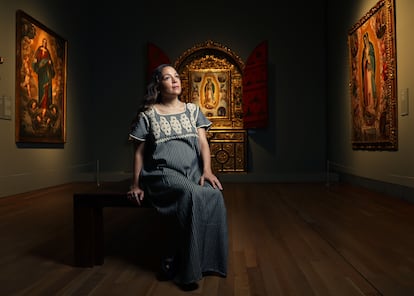

Natalia Lafourcade, 41, stands in front of a painting of the Virgin of Guadalupe made with mother-of-pearl inlays and says serenely, “What a beauty. I am not Catholic but I love the Guadalupana. It is something that a lot of people feel. We have our faith, our belief in the divine, in the mystical, in having something to hold on to on the path of life in a very deep and energetic way.”
The artwork left the Monastery of the Capuchin Mothers in Castellón de la Plana several weeks ago and is part of the exhibition So far, so close. Guadalupe of Mexico in Spain at the Prado Museum, which EL PAÍS toured with the artist on the morning of July 23 on the eve of Lafourcade’s concert in Madrid.
The Virgin of Guadalupe and Lafourcade are both pop icons. In the words of the artist: “She has her meaning, her role; she is an archetype. On other words, she is a universal feminine force.” Indeed, the Virgin of Guadalupe brings together more than 10 million pilgrims every December on the outskirts of Mexico City, in an act of worship. Her image has been reproduced over and again since the 17th century, not only in works considered strictly artistic but also more commercially such as prints on T-shirts, key rings, and notebooks. Meanwhile, Lafourcade has just released Cancionera, her ninth studio album. She has also made documentaries, published books and is the Latin artist with the most Grammy awards – 22 in total, 18 of them Latin Grammys. She is also among the 50 Best Latin Pop Artists of All Time as picked by Billboard.
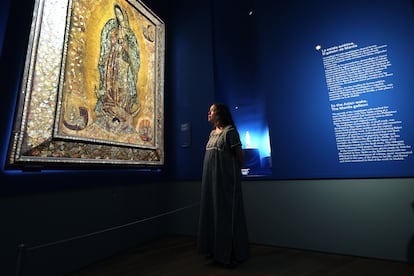
The two have been closely bound for years. Lafourcade has an altar for the Virgin in her home. “She is the one who takes care of you,” she says. “You have to put candles, flowers, you talk to her, you ask her things. There is a lot of the miraculous about her; she is the one who fulfills these kinds of ideas for us.” The image of Guadalupe was ushered into Lafourcade’s home just as she started to focus her career on Mexican culture after returning in 2002 from Canada.
“I was a child when my mom separated from my father. When the church found out, they kicked my mom out. They told her that she was not welcome because she was a sinner, so my mother guided us to other forms of faith — the divine, the spiritual,” she says. Years later, already back in Mexico, Lafourcade connected with the Virgin of Guadalupe for various reasons, but there was one in particular: “I made a work trip with the person who is now my husband. He was about to return home to Venezuela, but by that time I was already in love. Since I didn’t know if he was, I bought two images of the Virgin in the port of Acapulco. That way I thought we would be connected forever.”
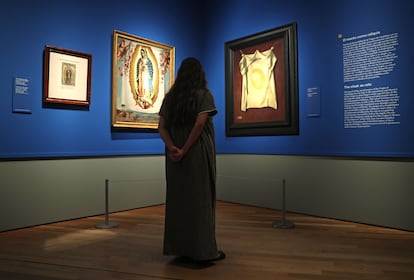
That Virgin who united them, together with another made of clay, still stands on the altar in Lafourcade’s house. These are two popular versions of this figure who appeared to the Indigenous peasant, Juan Diego. Seeing them helps us understand that behind the success of the cult of Guadalupe has been the ability to reproduce her. Many Mexican and Spanish artists copied the image in different sizes and formats, which are included in the Prado exhibition.
In Lafourcade’s own repertoire, there is also a song linked to the Virgin of Guadalupe. In 2017, she included Mexicana hermosa in her work Muses: A Tribute to Latin American Folklore in the Hands of Los Macorinos.
“Actually, it wasn’t written for her,” Lafourcade explains. “I wanted to make a tribute to Latin American folklore and include a song for Mexico. I met with Gustavo Guerrero, one of the producers of the album, and gradually lyrics came together that are really a tribute to women, to the Indigenous women of the countryside, to the mothers who take care of them... And in the middle of the composition we said to ourselves: ‘It seems that the Guadalupana is present in some way.’
Years later, Lafourcade allows the song to mean different things to different people. During her recent U.S. tour, it was the Mexican-strong audience who ended up turning the song into an anthem. “Just going there and seeing what is happening to migrants is very heavy,” she says. “We came to think that no one would come to the concerts for fear of leaving home, of being arrested. Not even we [herself and her team] had guarantees that they would not detain and deport us. When we did Mexicana hermosa, the lines Don’t be sad / just look at the sky / If the night is covered with stars / We already pass the mourning, I realized that it meant something different to them — a mixture of anguish and bravery. I would never have imagined it.”
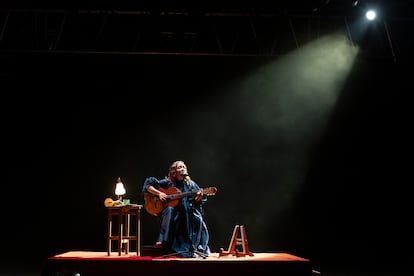
Now the artist is touring Spain with a gig at the Teatro Real in Madrid. “My desire was to share the intimacy that I experience with my songs in my room, my personal universe, even in my imagination, but now I am no longer alone,” she explains, pointing to her five-month pregnant belly.
This album is also a way to mark reaching 40 and a tribute to Lafourcade’s mother, Maricarmen Silva, pianist and music pedagogue, and creator of her own method with which she educated her daughter, and also to her father who was equally involved in music. “What’s going to happen then? I want to be clear about where I come from and what happens next. That’s why there are songs dedicated to my mother and father. A literal tribute to my lineage,” says Lafourcade.
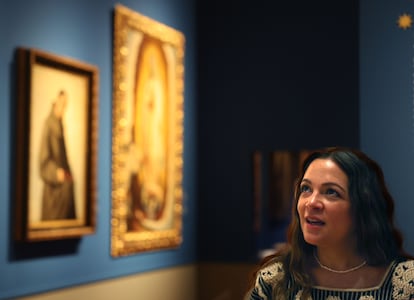
At the end of the Prado tour, Lafourcade explains that, somehow, she does not feel the barriers that grand museums sometimes seem to erect between the elite and the average person. “This is a celebration of the Guadalupe and there are no divisions,” she says. “Art can transcend everything,” she concludes about the ability of “the patron saint of America” to cross borders.
Sign up for our weekly newsletter to get more English-language news coverage from EL PAÍS USA Edition









































