
Two friends lost, dozens of shows canceled, and three serious surgeries: How R.E.M. survived its toughest tour
Thirty years ago, Michael Stipe’s band wrapped up the concert series for ‘Monster’ … almost by a miracle. This is the story of an experience that crowned them as the great rock band of the 1990s, despite countless tragedies and close calls
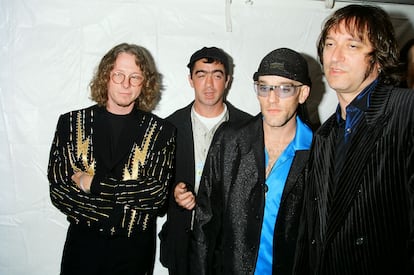
In 1995, R.E.M. was one of the biggest bands in the world. Their albums Out of Time (1991) and Automatic for the People (1992) had taken the quartet from Athens, Georgia (U.S.), to the height of their popularity — backed by 25 million records sold between the two, unanimous critical acclaim, and the admiration of their peers. But, surprisingly, Michael Stipe (vocals), Peter Buck (guitar), Mike Mills (bass), and Bill Berry (drums) decided not to tour with either of those two albums. After releasing Monster in 1994, things changed: they launched their first world tour in six years — also the first in their career to take them into major stadiums. Expectations for the tour were sky-high.
“We found ourselves in this position of being incredibly more famous than we had ever been before, and decided to head out on the first tour that we had done in five years on two albums that were really popular but filled with medium or slow-tempo songs – so we needed to do something really loud and raw. We turned to our love of glam-rock in the early ‘70s and the influence that it had on us as musicians and as fanboys. That was the beginning of Monster,” Michael Stipe explained to NME in 2019.
The album came with a change in image that broke with the seriousness the band — then considered the great bastion of alternative rock — had projected. With Out of Time and its singles Losing My Religion and Shiny Happy People all over MTV, R.E.M. became household faces, leaving behind the mystery and cult appeal that had defined them in the 1980s.
But with Monster, the band went a step further. “ it needed swagger, it needed humour and it needed irony. It was meta before the term existed. We were looking around at everything that was happening here [in the U.K.] for sure. You had Blur, you had Pulp, you had Jarvis Cocker, The Blue Aeroplanes,” Stipe said in the same interview.
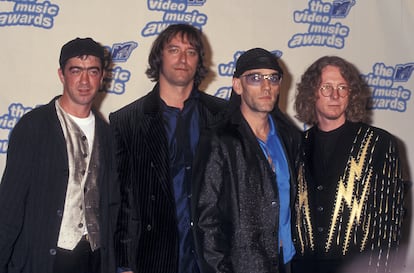
Along with the band’s surge in fame came Michael Stipe’s decision to speak openly about his sexuality, as well as persistent rumors — repeatedly denied — that the group had refused to tour in the early 1990s because their frontman had AIDS, speculation also fueled by the singer’s thin appearance. Stipe, meanwhile, crafted his most iconic image in videos like What’s the Frequency, Kenneth?, with his shaved head.
“Part of being myself was me speaking publicly about my sexuality for the first time. For me, that was just a privacy issue. As a public figure I had exposed myself so much, and I wanted to keep something for myself. It reached a point where that was ridiculous and I decided to speak publicly about it — which I’m happy I did of course. And I shaved my head, because my hair was thinning and I was a popstar and that’s just a bad look. I don’t think anyone had ever said that before in the history of fame and shaved heads,” the singer told NME.
Between life and death
Automatic for the People was a somber album, reflecting the band’s fascination with mortality. Monster was conceived as a reaction to that — a return to the electricity of their youth, a celebration of their indie rock roots. Yet from the very start, circumstances aligned in the opposite direction. Just as R.E.M. began recording sessions in October 1993, actor River Phoenix — a close friend of Stipe’s — died of a heroin and cocaine overdose at just 23. And in April 1994, as the album neared completion, another close friend of the band, Kurt Cobain, took his own life.
“River died before we started making the record and I went through a six month period where I just shut down and couldn’t write anything,” said Stipe. “That was really frustrating for me and the band, who were also grieving. We all knew him and loved him — but particularly for me, that friendship and relationship was like having a brother. It was the most profound loss that I’d had experienced at that point."
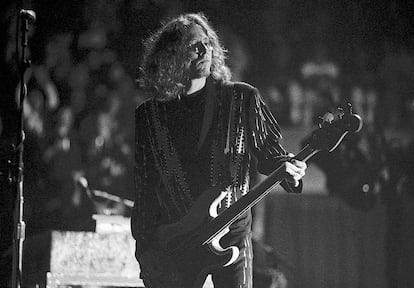
The album was dedicated to the memory of the actor, and his sister Rain was invited to sing backing vocals on Bang and Blame. The intense song Let Me In was dedicated to the leader of Nirvana. The band had become friends with Cobain and his wife, Courtney Love, after R.E.M. guitarist Peter Buck moved to Seattle, and Cobain’s death was equally traumatic for them.
In an interview with Rolling Stone in October 1994, Stipe revealed: “I had been talking to Kurt, and when he disappeared, I knew it. We all knew it. For seven days nobody knew where he was. I knew that a phone call was going to come, and I was just hoping that it was going to be a good one And it wasn’t. So we were a little prepared. But it was bad. Really bad.”
R.E.M.’s frontman had tried to act as a counselor to Cobain during his final days, and the two had even seriously discussed a future collaboration. “If Kurt were alive, he’d be touring with us,” Stipe said later during his visit to San Sebastián.
During the recording of Monster, both drummer Bill Berry and bassist Mike Mills fell ill — though no one took it as a sign of what was to come months later. In fact, Berry was the most enthusiastic about going on tour, completely unaware that it would later be dubbed by fans the “aneurysm tour.”
The first time in Spain
On January 13, 1995, the Monster Tour kicked off in grand fashion in Perth, Australia. The world tour would span four continents and wrap up on November 21 in Atlanta, in the United States. The lineup of opening acts included Radiohead, Oasis, The Cranberries, Sonic Youth, Belly, Grant Lee Buffalo, and Luscious Jackson, among others. PJ Harvey had also been scheduled for several European dates, though those were ultimately canceled.
“It was tough to start another world tour,” the singer told EL PAÍS journalist Fietta Jarque at the time, “but I decided to embrace the idea of spending a year performing all over the world, and I consider myself truly lucky to be able to do it.”
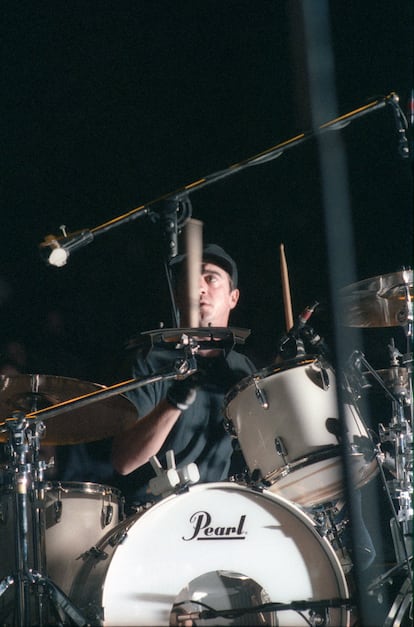
The band was relishing the adrenaline rush of being back on stage, and in that spirit they arrived in Spain for the first time in a career that had begun in 1981. Their European tour kicked off in San Sebastián and then continued through Madrid and Barcelona, all sold-out shows, with the cheapest tickets going for 3,500 pesetas — and an enthusiastic reception everywhere.
In San Sebastián, the group stayed six days rehearsing before the rest of their European dates, accompanied by a 50-person entourage. They were also spotted in some of the city’s classic bars in the historic center, with Stipe chatting casually and kindly with anyone who approached him — as music journalist Iñaki Zarata, then writing for El Diario Vasco, recalls. He remembers that first R.E.M. concert in Spain as “two glorious hours of rock music.”
Highway to Hell
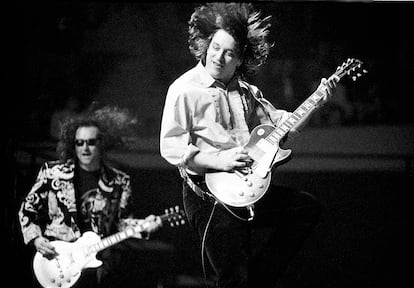
March 1, 1995 — Lausanne, Switzerland. R.E.M. had been on stage for an hour and a half when, during the performance of Tongue, drummer Bill Berry collapsed with a severe headache. “It felt like a bowling ball hit me in the head. There wasn’t any warning,” Berry told the Los Angeles Times.
Berry was dragged backstage, and the attending doctor initially diagnosed a severe migraine. But Berry’s wife insisted he be taken to a hospital for an X-ray. Two days later, after discovering he had suffered an aneurysm and another was imminent, he underwent brain surgery and spent three weeks in a hospital in Switzerland.
He survived miraculously because one of the best brain surgeons in the world was in Lausanne, and able to treat him. “[Bill] was a lot sicker than people knew,” Peter Buck told journalist Tony Fletcher for his book Perfect Circle: The Story of REM. “He was paralyzed for a few days.”
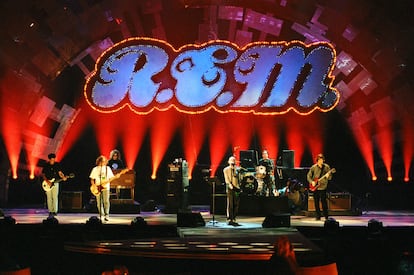
The band decided to halt the tour and stay by Berry’s side, despite intense pressure from promoters, insurers, and their record label to continue with a substitute drummer.
“Some promoters, insurance people and record company people would have liked us to keep going without him, but that’s not what we do,” said Buck. “I’m not going to go out and pretend that everything is cool with a drummer I don’t know. There’s a reason we were successful and that’s because it took the four of us together to do this. [...] So it wasn’t a hard decision.”
Thirty shows were canceled, resulting in significant financial losses. Meanwhile, Berry was reluctant to return to his instrument, fearing he might discover something was wrong. He tested his arms and hands by playing golf, and when he realized he was in shape, he resumed rehearsals with the band. Against all odds, the tour resumed on May 15, now in the U.S.
R.E.M. had just faced the most serious crisis of their career — not only confronting an uncertain future but also the very life of their drummer — and Berry had miraculously survived. Two months later, it was bassist Mike Mills who required urgent surgery for an intestinal condition. Six more shows were canceled, including the one they were scheduled to play in Zaragoza on July 17 and the Madrid show at Plaza de Las Ventas the next day, alongside Oasis and Faith No More. (Fortunately, the promoters found a last-minute solution and replaced the headliners with The Cure.)
Then came the third scare: Michael Stipe developed a hernia in his vocal cords from straining to hit high notes. “Mine was not serious, Stipe told NME. “It was not fun or easy to sing afterwards, but Mike’s was serious. He could have died but they caught his in time. Bill came close to death more than once. We downplayed the severity of his condition at the time, but it was brutal.”
New adventures (and a three-legged dog)
Despite everything, in that same interview Mike Mills said he enjoyed the tour. “When you come that close to losing a friend, of course it’s a big deal. When I think of the tour, I don’t think, ‘Oh my God! We survived it somehow!’ It’s not like that at all. It was a lot of fun. Other than the law of averages catching up with us and three of us falling ill on the same tour, it was a huge success. I enjoyed 95% of it.”
Another interesting detail is that during the tour, R.E.M. was recording songs for what would become their next album, New Adventures in Hi-Fi. Many of the tracks were played during soundchecks, and some were even debuted live at concerts — for example, Departure was heard for the first time on stage in Anoeta.
In 1996, the band’s label, Warner, renewed their contract for $80 million — the largest recording deal in history at the time — although the group downplayed the figure, saying it wasn’t actually that high. R.E.M.’s tenth album didn’t sell as much as its immediate predecessors, yet it still moved five million copies and reached number one in 12 countries — no small feat. The album has become a favorite among fans and critics alike, and Michael Stipe has even stated that it is his personal favorite in R.E.M.’s entire discography.
It was also the band’s last album with Bill Berry, who decided in 1997 to leave the music industry and become a farmer. R.E.M. did not tour for that album, but they did chose to continue without the drummer, describing themselves as a “three-legged dog.” Stipe explained: “Are we still R.E.M.? I guess a three-legged dog is still a dog. It just has to learn to run differently.”
But that, of course, is another story altogether.
Sign up for our weekly newsletter to get more English-language news coverage from EL PAÍS USA Edition









































