
Natalia Lafourcade prepares for motherhood without letting go of her music
The Mexican singer has just finished a 39-concert international tour, during which she confirmed her pregnancy. She spoke with EL PAÍS before stepping back from the stage for just a few months
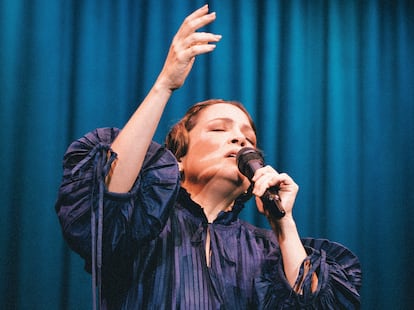

With her belly swollen and just weeks away from giving birth, Natalia Lafourcade assures that it doesn’t weigh heavily on her. The weight she speaks of is the bundle of fears and insecurities that a woman typically carries around when she becomes a mother for the first time. The Mexican singer, who has just finished a 39-concert international tour during which she confirmed her pregnancy, is stepping back for a few months to embark on motherhood without fear and with “an open heart.” “It was time to stop; I could be putting myself at risk. But I don’t even feel like stopping. It’s more like integrating the time of motherhood into a life that has been completely dedicated to my career,” she says via video call with EL PAÍS from Mexico City before moving to her refuge in the Veracruz countryside to build her nest. A new stage is beginning for the 41-year-old Mexican singer-songwriter.
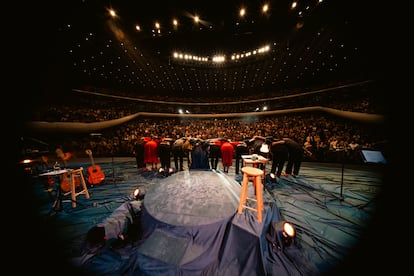
In late April, the female artist with the most Latin Grammys—she’s got 18 and is nominated for another nine this year— released Cancionera, her 10th solo album. In it, Lafourcade displays a heightened maturity and delves into the personal and creative exploration that has defined her career. The production process, which was recorded live and analogically with the accompaniment of her trusted producer, Adán Jodorowsky, also included for the first time the creation of visual material that accompanies a narrative featuring several of the singer’s alter egos. At the same time, she began a tour that had 35 sold-out shows, including the final three dates in September and October at the National Auditorium in Mexico City.
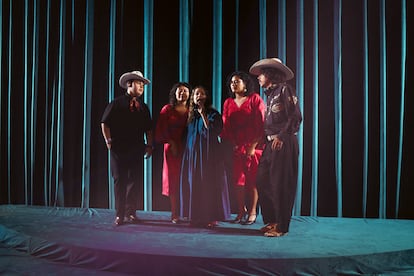
The surprise news of her pregnancy, however, redefined everything. “The spirit of this Cancionera season played into my hands. We’re talking about an album concept that speaks to transformation, to women in their different facets and possibilities,” says Lafourcade, before explaining herself with a crucial anecdote. “I was almost at the end of the European tour and I realized that a line from Cancionera, the song itself, evokes motherhood without me consciously doing so: ‘Be a woman, be the beautiful muse, be the star of a life that, seeing your steps, lights up, lighting up a heart.’ It clicked at a concert in Spain and I almost started to cry; I couldn’t keep singing. I was like, ‘It can’t be,’ this song, which is the anthem of my life as I entered my 40s, without realizing it or thinking about it, in a magical way, is what I’m living now. I already had the idea that I wasn’t going to be a mother. I wasn’t aware of how ready I was, even though I have no experience at all.”
She’s living every moment of the process intensely, grateful for her good fortune. The tour didn’t hinder her pregnancy, nor the other way around. “From the beginning, I made an internal pact with myself and my baby: ‘Hold on tight because a trip is coming. You chose to come at a time when we’re going to travel a lot, give a lot of concerts, and experience something beautiful.’ Now it’s time for me to go home and give 100% to my baby and my family.” After this experience, the artist is deeply impressed by her body’s capacity and eager to meet the person who has been closer to her than anyone else in recent months.
That doesn’t mean she’s thinking of taking a step back to focus solely on motherhood. “I’m also excited that next year we’ll be back on stage. But this will be at a different stage of my life that won’t be the same. I’m saying goodbye to a life cycle that’s ending, to begin something new, something completely unknown,” she says. She adds: “I believe there’s still a lot left to explore on my path. All this time is, in a way, a prelude to what’s to come. If I allow myself these transformations, this has only been a prelude.”
The singer, herself a daughter of a lineage of musicians, burst onto the scene in 2002 at the age of 18 with her self-titled debut album, emerging as the voice of a new generation of Latin American women. But her career has been a series of transformations. “I always want to return to the moment where I don’t know what I’m going to do and where I have to reinvent myself. I like reaching that moment where music humbles me. When I’ve managed to grasp an idea and build it, and I say, ‘Now we have to start over.’” The present represents this idea like never before.
She approaches it with the certainty that the key element for creation is freedom. “It’s hard to sustain yourself in a time like this, where the demands and requirements are so high, to be creating all the time. But I feel fortunate because I think I’ve achieved my own rhythm. You have to live with it. In the end, I think that’s the creative path and the path of life itself: being able to give yourself those freedoms of being able to create.”
Lafourcade utters these words precisely at a time when creative freedom is under debate in the Mexican music world. Throughout the year, the so-called war corridos, the latest take on classic narcocorridos, have caused enormous controversy for being perceived as glorifying violence and have been banned in several states. Recently, a government-sponsored contest was held to write corridos about love, not drug traffickers.
For the composer—who hasn’t integrated her political views as explicitly into her artistic identity as other past icons of Latin American song—the debate that has taken place is healthy and complex, and while she celebrates the promotion of music with a more positive message, she concedes that art will always reflect its own context. “For me, it’s difficult to say there shouldn’t be narcocorridos. Of course, I raise the flag and say that music that incites violence shouldn’t be made, but there are also contexts and realities. The sung and musicalized word stirs fibers in our hearts; it comforts us, it makes us happy, it moves us, it energizes us. So, for those of us who have the opportunity to create music in a certain direction toward a culture of peace, to do so responsibly, we have to do it.”
Now that she’s entering her forties dedicated to her baby and her family, Natalia Lafourcade turns to song, her eternal companion, as her guide for everything that lies ahead, both as a mother and as an artist.
Sign up for our weekly newsletter to get more English-language news coverage from EL PAÍS USA Edition









































