
‘Dora the Explorer’ turns 25: ‘Speaking Spanish in the United States is a superpower’
On the quarter-century anniversary of the animated series, broadcast in 150 countries, its creators highlight the importance of Latin culture amid Trump’s attacks
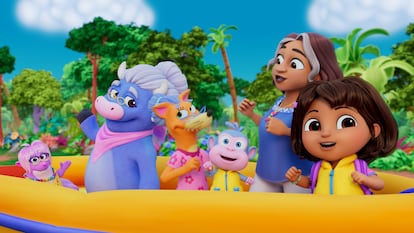

In the late 1990s, Chris Gifford and Valerie Walsh Valdes obsessively sought to create a cartoon series that would impact society and go down in history. They wanted to give it an interactive feel, something unheard of at the time, but they weren’t sure who the protagonist should be. They thought about cats and rabbits. Then the idea of a girl, Nina, carrying a backpack emerged. The final identity of the character was settled when Nickelodeon suggested that the girl be Latina, as a response to the underrepresentation of the community in American media. Thus, on August 14, 2000, Dora the Explorer was born, a series that celebrates its 25th anniversary this year and remains a global phenomenon: broadcast in over 150 countries, translated into 32 languages, and one of the most-watched programs among preschool audiences worldwide.
The creators then traveled to Latin America to immerse themselves in the culture and bring Dora to life. “We were really impressed by the connection Latinos have with family, and also with music and food, and we tried to integrate that into Dora, where her grandma, mommy, daddy, and cousin Diego are all present,” Walsh explains via video call. “It was difficult to show so much of the family aspect because Dora’s story is also the journey of an independent, adventurous, and extremely curious heroine,” Gifford clarifies.
To facilitate cultural immersion, the non-Spanish speakers hired a team of Latino writers, educators, composers, and cultural advisors, many of whom over the years went on to work on or create their own animations, in the same vein as Dora, like the PBS cartoons, including the Puerto Rican girl in Alma’s Way or the Mexican-American Rosie from Rosie’s Rules. They say that Latino animation creators in the United States are a community; rather than competing, they remain united. “In one of the episodes of Alma’s Way, I saw that the main character had a Dora the Explorer doll in her room,” Gifford cites as an example.
Dora not only became an icon for millions of children around the world — establishing herself as one of the most prominent children’s programs after eight seasons — but she also paved the way for productions with Latino protagonists. It’s no surprise, then, that the show has received a multitude of recognitions over the past quarter-century, including Emmy, NAACP, Alma, Latino Spirit, Gracie Allen, Parents’ Choice, Common Sense Media, and Television Critics Association awards. In 2005, Dora became the first Latina figure to be represented on one of the balloons in the traditional Macy’s Thanksgiving Day Parade in New York City, and she did not go unnoticed: the balloon measured almost 17 meters. Since then, she has been a regular at the parade, including the 2024 edition.
In the current political climate in the U.S., where Spanish translations have been removed from government websites by the Donald Trump administration, it’s inevitable to wonder if such a proposal would be accepted. “We’re going through a very difficult time, where fear prevails. If Dora the Explorer can help Latino children feel more comfortable and proud of their identity, instead of hiding it, that’s wonderful; we’ll be doing something very right,” Gifford emphasizes, assuring that, so far, they have not suffered any type of cuts or censorship.
Critics of the series point to its repetitive structure and that it doesn’t introduce many Spanish words. Gifford and Walsh clarify that they didn’t want to overwhelm preschoolers with more vocabulary than they could handle, and that their primary goal was never to teach the language. “Our goal from the beginning was for Latino children to feel comfortable speaking their language, not ashamed of it. We wanted to show that being bilingual is cool, that speaking Spanish in the United States is a superpower,” Walsh explains.
There was also speculation that Dora, originally a seven-year-old girl, could grow up. For a couple of seasons, she was made to be 10 or 11, but the experiment didn’t quite resonate with audiences, and it was decided to return her to her original age. However, in the two films released to date, Dora and the Lost City of Gold (2019) and Dora and the Search for Sol Dorado (2025), the protagonist is 16 years old.
Both productions have been box office hits: although there are no definitive figures yet for the second as it’s a recent release, the first grossed $120.6 million, more than double its production budget. The character remains unstoppable. Her creators confess not only that they never tire of her, but that they feel deeply attached to her as well. “She defines who we are in many ways,” says Gifford. “Dora is a character that moves us and the audience.”
Sign up for our weekly newsletter to get more English-language news coverage from EL PAÍS USA Edition









































