
Jamie Lee Curtis: ‘We’re going to have to take to the streets again to fight like we did for civil rights’
The actress reprises the role that made her a teen icon alongside Lindsay Lohan in the ‘Freaky Friday’ sequel
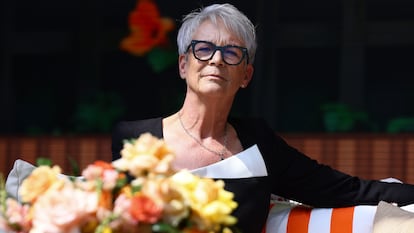

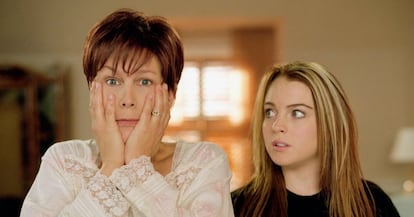
Jamie Lee Curtis is Hollywood royalty — and at the same time, the least likely star to lift a pinky finger in pretension. She won her first Oscar just two years ago, (for Everything Everywhere All at Once) despite a long and accomplished career, and she’s now diving into a comedy aimed at dominating the box office by reprising a role that cleverly reintroduced her to a new generation back in 2003. Two decades later, she is returning as Dr. Tess Coleman from Freaky Friday, the mother of Anna (Lindsay Lohan) and now also the grandmother of Harper (Julia Butters) in Freakier Friday, set to hit theaters on August 8. Warm and polite, she draws out her answers, generously gives more time than scheduled, and gives a hug at the end of the interview.
In her yellow suit, Curtis, 66, looks happy. She admits she is — half-jokingly — because she doesn’t have to endure another influencer interview: “Because you’re a journalist and you won’t ask to switch seats, or ask what I’m wearing, or what something means, and I won’t have to say things that mean nothing... so I’m very happy.”
Curtis’s honesty is legendary — no surprise, given that she’s been on film sets since she was a baby, the daughter of two screen legends, Tony Curtis and Janet Leigh, and has nearly a hundred credits to her name over a career spanning half a century. She’s done it all — from horror to action to comedy — and she excels at it all, including the beloved role she’s now revisiting: a mother who swaps bodies and lives with her teenage daughter.
And it was entirely her own decision. She’s the one who decided Freaky Friday should have a sequel — and also to produce it. She picked up the phone and brought Lindsay Lohan out of retirement — they’ve maintained a close friendship over the past two decades — and handed the project to Disney executives on a plate. A position completely opposite to that of the first film: back then, she found out she was joining the cast just a week before shooting began.
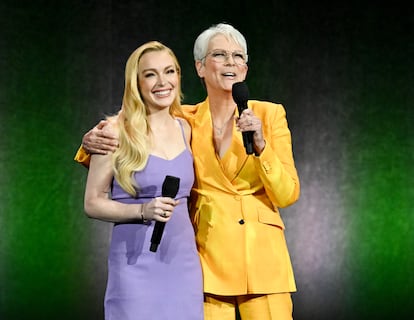
This time, Curtis has taken the reins. “It all started when I was promoting Halloween, the final film in the trilogy [Halloween Ends, in 2022],” she explains, sitting in a luxurious Los Angeles hotel early on a Sunday. “I was traveling around the world, and in every corner of the planet, the one question that kept coming back was about Freaky Friday, and it was clear that everyone loved it. My response was, ‘But Lindsay has to be old enough to be the mother of a teenager.’ And someone said, ‘She is.’ She said she was 35, and it was like, ‘Wait, 35? So I could have had a baby at 20! How fun, let’s go!’ Then I called Disney and said, ‘It’s time.’”
So, is all this fuss — this massive global marketing campaign, this revival of teen nostalgia, this new movie — her fault? “A little bit. A little tiny bit. Yes, I take full responsibility,” she laughs before clarifying. “I would love to take full responsibility, but there’s a very talented group of producers and our director, Nisha [Ganatra], and the writers and Disney themselves. It’s a family.”
But was it really necessary? Sure, there were fans asking for it — fans like Lohan herself, who are now closer to 40 than to high school age — but is that reason enough? Why bring it back? “Because it makes people happy,” says Curtis, with great expression. “Movies can challenge us. There are great dramas that bring incredibly important aspects of history, of human behavior, to light. [There are] brilliant dramas. But comedies make people happy. The world is a little unstable right now. Every corner of the planet feels like it’s in some turmoil, politically, socially, environmentally, spiritually. And what brings people together? Laughter, tears, joy, family, nostalgia, safety,” she says.
For her, the film can become a safe space; Curtis shares that viewers tell her that after watching it, they call their mothers or their daughters: “You can be sure that it will connect you with your family.”

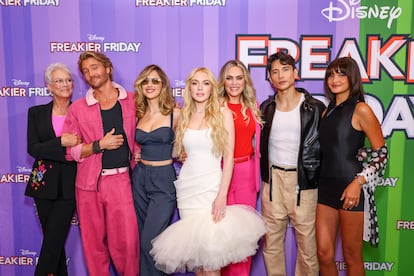
Feminism, which wasn’t as clearly present in the early 2000s, is more obvious in the sequel. If the first film already leaned in that direction with its two female leads, the new one strengthens that message with four women at the center. The movie presents Lohan as a single mother by choice, and Curtis as the grandmother who, also by choice, supports her.
“A lot of women make that choice, don’t have the support of their families. And a lot of women don’t make that choice because they don’t have the support of their family. So right away, that’s a feminist statement,” Curtis argues. “And it’s produced by women, written by women, directed by a woman, and acted primarily by women. Don’t tell Mark Harmon,” she jokes, referring to the actor — best known for NCIS — who returns to a film role for the first time in over 14 years.
The actress is pleased with the strong female presence in the production. “It conveys the feeling that a film centered on women can be made in the midst of an industry that is still clearly dominated by men,” she says.
Though Curtis acknowledges progress has been made since she began in the business half a century ago, back then, she says, “there were no women.” At most, some makeup artists, “maybe a few in wardrobe, but usually not in design,” she notes. “Few in the technical world, few producers, basically no directors. And that is changing. Slowly, gradually, not as quickly as I would like, but it’s changing.”
Born and raised in Los Angeles, Curtis was personally affected by the devastating wildfires this past January, which nearly destroyed her home. Freakier Friday is a true love letter to Los Angeles — her hometown and the heart of the film industry — which has suffered significantly since the pandemic: budget cuts, natural disasters, and skyrocketing costs have pushed many productions to move to other cities or countries. Curtis admits that being a producer gave her an advantage when it came to this decision.
“In one of the first conversations I had with Disney, I told them, ‘I’m not going to make this movie in Atlanta or Vancouver. If you want to make it, it has to be in California. The original was in California, and this one will be in California.’ That was crucial for me,” she says.
It was also key for her to return to the same house where the first film was shot. “It was the house we filmed in 22 years ago, in Pacific Palisades. We filmed in a lot of the same locations. Like you say, it’s a love letter to Los Angeles: we’re at the beach, in Hollywood, everywhere. But sadly, with the fires, that house in Pacific Palisades burned down on January 7,” she laments. “It doesn’t exist today; the house, the street, is a vacant lot,” she says.
A tennis court that appears in the film also burned down. “There were a lot of catastrophic losses, for the city and for a lot of people. Not for me. But the film will live on forever. In 25 years, maybe those streets will look a little similar again... It’s bittersweet, but I’m so glad that, being the boss, I insisted on shooting there.”
Curtis is a powerful advocate for the causes she believes in, speaking loudly and clearly in an industry that is often timid — afraid that one wrong word might cost its stars. But she’s not like that. That’s why she didn’t hesitate to raise her voice against Donald Trump from the very day he won. Back then, she said: “Wake up and fight.” That was months ago — does she still stand by that message? “Yes, but we should have stood up and fought a long time ago,” she reflects. “America was born out of standing up and fighting.”
So, is her country fighting enough, given the current circumstances? She takes a moment, thinks, and says: “No, no... probably not.” And then she expands on the thought: “But you can’t fight every day. You can disagree every day, but there’s a time for fighting, and we live in a country where you can fight politically. You can practice democracy simply by voting, supporting candidates, challenging authoritarian regimes.”
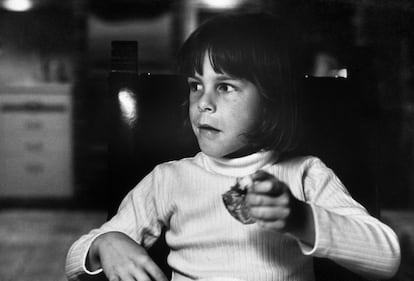
“But yes, we are going to need to take to the streets more and more as the time goes on, as they are all over the world. People are going to have to do the very thing that was done for the civil rights,” she continues. “In our country, we had to fight for civil rights, for women’s rights. We’re still fighting for women rights. We’re going to have to fight for trans rights. We’re going to have to fight back for gay marriage. We’re going to have to fight for it again. They’re going to try to take that away. We’re going to have to fight it,” says the actress, whose daughter is trans and, as she’s shared, constantly receives threats.
“Roe v. Wade,” she adds, referencing the controversial overturning of abortion rights in 2022, “we’re going to have to fight again. It’s the nature of what people do.” “I’m going to fight. I’m going to do it in the way that I get to do, and you’re going to the way you do it. So we’ll do it together?” she asks, her eyes wide open. Then she stands up to end with a hug: “And everything will be okay.”
Sign up for our weekly newsletter to get more English-language news coverage from EL PAÍS USA Edition









































