
‘Aztec Batman’: New superhero movie faces criticism that it is ‘spreading the black legend’
The launch of the movie’s trailer has led to debate between those who see it as Hispanophobic and those who say it’s only following its genre’s archetypes
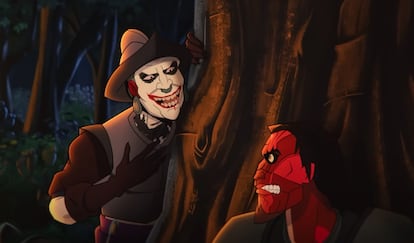

Batman has already been a samurai in feudal Japan, a knight in King Arthur’s court, and a Soviet anarchist in the USSR. What seemed like the umpteenth twist on the character’s universe — nothing less than a Mexican bat-man during the Conquest period in the animated film Aztec Batman: Clash of Empires, scheduled for release in September — has become the subject of debate about historical memory in cultural products. Following the release of the trailer last weekend, social media has been filled with comments and fierce criticism, calling the film Hispanophobic and accusing it of “spreading the black legend” for depicting Hernán Cortés and the conquistadors as villains. Mexican artists linked to the genre respond that “it should be taken as a caricature” and that it follows the unqualified protagonist-antagonist archetype typical of the superhero genre.
The film’s director is Mexican Juan José Meza-León, and the voice of Batman is his fellow countryman, actor Horacio García Rojas. The Mexican company Ánima, which is producing alongside Warner Bros., is involved. Following accusations of Hispanophobia, one of its executives came out to defend its intention, saying it does not seek to “educate, much less rewrite history, as it is, as such, an entertainment product.”
“To all those who have felt offended, I invite you to imagine an Asturian Batman in Arab-occupied Spain. The discussion would be quite similar,” Bernardo Fernández, “Bef,” who represented Mexico in the international comic Superman: The World, explains to EL PAÍS. The approximately five minutes of Aztec Batman that DC Comics previewed at San Diego Comic-Con show how the young Aztec Yohualli Coatl witnesses the murder of his father at the hands of Hernán Cortés for refusing to reveal the entrance to Tenochtitlán. He swears revenge and flees to become a vigilante and subversive leader, inspired by the bat-like Mesoamerican deity associated with the underworld, Camazotz.
“I don’t know what this infected Hispanophobic garbage is that embraces pro-British theses with the Batman seal, but from today I hope Warner and DC get screwed for being idiots,” reads one of the most interacted comments on the official publication of the trailer on the X social network. “Will the Aztec Batman sacrifice people with cannibalistic rituals in this anti-Spanish propaganda?” says another of the responses, referring to pre-Columbian practices. Critics seem to agree in demanding a more detailed context, showing the internal conflict between the peoples subjugated by Moctezuma’s empire. Although one scene in the trailer — where the Joker character appears as a possessed priest — suggests an approach to the alliances that existed between Indigenous peoples and the conquistadores.
“Tension has been generated by four minutes of the trailer,” Bef says, urging calm. Ger Lozano, a bookseller at the comic book store Los Muelles de Goon in Marbella, also hopes to see the entire film before passing judgment: “The criticism [of Hispanophobia] could be valid or not, depending on how the story is approached, how the characters are presented, and what the final message is. If the story is treated simply, without exploring the Spanish characters in depth — without presenting any nuances or humanity, all very negative — and if generalizations and stereotypes are resorted to, I would say the criticism is totally valid.” The main target of the attacks is the treatment of the character of Hernán Cortés, who becomes the villain Two-Face in the film. “Find the bat and dismember it!” he commands in the trailer.
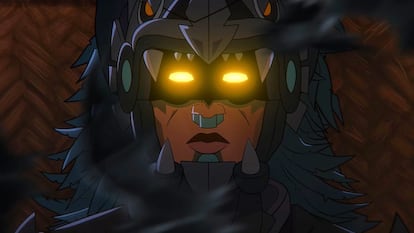
The interpretations of these historical figures don’t respond to an ideological vision, but rather to the archetype of generic villains and untainted heroes of superheroic narrative, according to Morelia-born cartoonist Jorge Magallón, winner of the 2022 Mexican national prize Pura Pinche Fortaleza Comics. “We’re talking about a popular culture product that seeks to bring attractive concepts. I think it also responds to the context of growing global interest in Mexico and Latin America. I don’t think it’s an attempt to rewrite history, but rather a cultural nod,” says the artist known as Heretto Dos. He recalls other recent appearances of the caped crusader in Mesoamerica, such as the episode of Batman: The World, set in Mexico City; or the Mayan Batman sculpture designed by Christian Pacheco.
Aztec Batman will be released in theaters on September 18, but the criticism it has already received is already influencing the Spanish public, according to Lozano. “A negative perception is being created about how the Spanish characters will be treated in the story; although there have also been those who, based on the trailer alone, have defended the plot as a way to explore history from a new perspective (even if it’s fiction). But of course, there are also those who complain about how offensive the way the conquistadors are presented is, which may be logical.”
There is growing sensitivity regarding how Spain is portrayed during the colonial period: the same complaints arose regarding a 2023 episode of Marvel’s What If...?, in which a young Mohawk woman flees the Spanish conquistadors.
Both Bef and Heretto Dos believe there is no naturalization of the black legend among Mexicans, nor do they believe the film alters that historical perception. “At least among the average Mexican, I don’t recall anyone feeling alienated from the Spanish heritage, because Mexican culture is Spanish, with a strong Indigenous influence and a host of ethnicities here. We are clear that the conquest took place within the framework of a series of specific situations, where the Aztecs subjugated the surrounding peoples, which strengthened the military offensives of Cortés and Pedro de Alvarado,” asserts Heretto Dos.
To achieve art faithful to the landscape of Tenochtitlán and truthfully convey the Aztec universe to the superhero, historian Alejandro Díaz was involved. This effort was made for a production initially intended for streaming, but which will ultimately make it to the big screen. In Bef’s words: “That the North turns to the Indigenous roots of the Global South to tell this version of one of the most important myths of our time, Batman, is valuable.”
Sign up for our weekly newsletter to get more English-language news coverage from EL PAÍS USA Edition









































