
Supreme Court setback on birthright citizenship is the exception in a string of victories for Trump’s immigration agenda
The US president is urging Congress to end the policy, which is a long-standing goal of the MAGA movement. The chances of succeeding through legislation, however, are slim
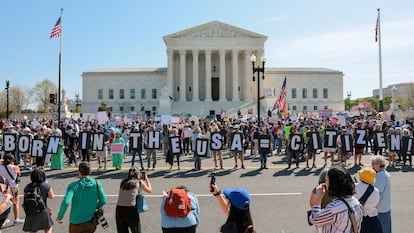

During the four years he spent in the political wilderness after leaving the White House in disgrace in 2021, Donald Trump surrounded himself with an army of loyal ideologues devoted to designing an ultraconservative revolution and a sweeping expansion of executive power for the day he returned to office. Prominent in that agenda was the goal of ending birthright citizenship — the right of anyone born in the United States to become a U.S. citizen regardless of whether their parents are undocumented immigrants, foreign workers or tourists.
That ambition ran into a wall at the Supreme Court on Tuesday. Not even the court’s most conservative lineup in nearly a century was willing to endorse an executive order that Trump signed on his first day back in the Oval Office, seeking to abolish a right derived from the 14th Amendment to the Constitution. Perhaps because the six justices who make up that conservative majority are committed originalists, proponents of a faithful reading of the documents that founded the United States nearly 250 years ago.
That does not mean, however, that the Supreme Court has reversed its broader tendency to support Trump’s policies. In July 2024, it granted him broad immunity for official acts undertaken while in office. At the time, Trump was a presidential candidate facing four major criminal cases and had already been convicted in one of them. The ruling helped clear his path back to power.
As recently as last Thursday, the conservative majority upheld two other elements of Trump’s immigration agenda in decisions favorable to the White House. One allows the administration to revoke humanitarian protections that had granted residency to 350,000 Haitians and about 6,000 Syrians, leaving them vulnerable to deportation. The other eliminates the ability of migrants arriving at the U.S.-Mexico border without authorization to present themselves to authorities and seek a hearing that could lead to asylum. Their removal can now be carried out immediately.
With the executive route effectively closed in his campaign against birthright citizenship, Trump says he will turn to Congress, as he wrote in a Truth Social post after Tuesday’s ruling. Since returning to office, he has governed largely through executive orders and has relied little on Capitol Hill. This time, however, he appears likely to need lawmakers. He called on Republicans in Congress to begin work “TODAY to work on ending expensive and unfair to our Country, Birthright Citizenship.” “They will have my Complete and Total Support!” he pledged in the post.
It is not clear that Congress can pass a law that, according to the Supreme Court, would contradict the Constitution. Moreover, it is highly unlikely that House Speaker Mike Johnson, the leader of the Republican majority, could push through a change of that magnitude. On Tuesday, he floated an even more ambitious idea: amending the Constitution itself. In the Senate, 60 of the chamber’s 100 votes would be needed to fulfill Trump’s wishes, and Republicans currently hold only 53 seats at most (and only for now; one-third of the Senate is up for election in November). There is always the option of doing away with the filibuster, the rule that has long hampered Congress’s legislative output, but that too appears an uphill battle.
The executive order struck down by the Supreme Court would never have applied retroactively. It would, however, have ended what Vice President J.D. Vance once described as “the dumbest immigration policy in the world,” and what Trump often portrays as a uniquely American practice — though that claim is false. Other countries grant similar birthright citizenship rights, including, in North America, Mexico and Canada.
Birth tourism
More than six million people born in the United States have one or both parents living in the country without legal status. In theory, those parents may seek legal status once their U.S.-citizen children — often referred to by immigration critics as “anchor babies” — turn 21. In practice, however, the process is highly complex, especially amid Trump’s immigration crackdown. The president also frequently inflates the number of undocumented immigrants in the United States; the most reliable estimates put the figure at about 14 million.
What Republicans are seeking is to close off any pathway to citizenship. They also want to end what John Sauer, the lawyer who represented the administration before the Supreme Court, described during oral arguments as “birth tourism,” also known as maternity tourism. Sauer argued that “uncounted thousands of foreigners from potentially hostile nations have flocked to give birth in the United States in recent decades.” But that characterization is also at odds with the available data. Fewer than 0.3% of births in the United States are to tourists, according to a University of Pennsylvania study.
Those facts did not stop Clarence Thomas, the Supreme Court’s most conservative justice, from writing in his dissent on Tuesday that “birth tourism companies reportedly collect large fees from wealthy foreigners to facilitate their trips to give birth in the United States.” He also asserted that “large numbers of children are born in the United States each year to parents who are temporarily present here in order to obtain citizenship for their children.”
Sign up for our weekly newsletter to get more English-language news coverage from EL PAÍS USA Edition









































