
Venezuela quake disaster tests Trump’s ‘Donroe Doctrine’ in Latin America
The United States has eased sanctions, pledged $150 million in aid and deployed military ships and aircraft after the back-to-back earthquakes


The United States, which, under Donald Trump, has sharply curtailed foreign aid, has now pulled out all the stops to assist Venezuela after it was struck by two earthquakes. The Trump administration — which has effectively placed the Caribbean country under its tutelage since the military operation that captured Nicolás Maduro on January 3, and which, through its so‑called “Donroe Doctrine,” casts Latin America as its primary sphere of influence — announced on Thursday a relief package of nearly $150 million, the deployment of forces including ships and aircraft from U.S. Southern Command (responsible for military operations in the region), and the easing of some sanctions to allow transactions related to disaster response.
An immediate and effective response in Venezuela is justified and necessary from a humanitarian standpoint, given the scale of the disaster. But from Washington’s perspective, it is also an absolute foreign policy priority. Turned into a de facto protectorate, the South American country has become central to U.S. geostrategy. Trump points to Caracas as a success story of his interventionist approach in his second term and has made it a cornerstone of his Donroe Doctrine — an updated version of the 19th-century Monroe Doctrine that ushered in an era of U.S. interference in Latin America, largely targeting left‑wing governments and their supporters. Trump’s version promises generous rewards for allied governments and figures in the region, and a far harsher approach — including military intervention — toward adversaries.
Expressions of solidarity from the United States came immediately and from the highest levels. Just hours after the first tremor, Trump pledged swift and substantial assistance. “We’re going to help them out,” he said on Thursday during remarks at a reception for farmers at the White House.
U.S. Secretary of State Marco Rubio also made similar commitments. “It’ll be big, it’ll be fast, and it’ll be effective,” he said on Thursday, in reference to the U.S. response to the disaster. Shortly afterward, the State Department, the Pentagon and the Treasury announced a wide array of resources to support the effort.
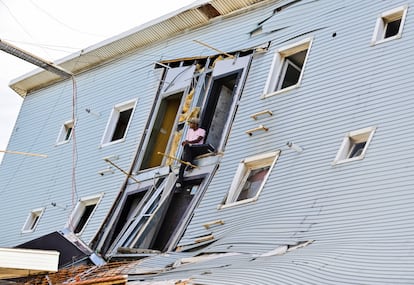
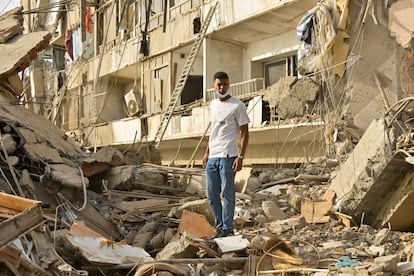
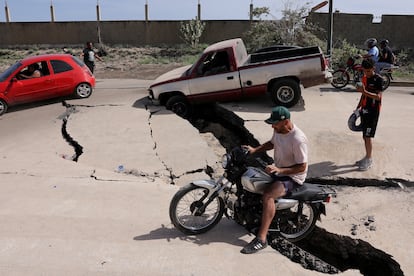
In a statement, the State Department outlined its initial contingency plans to respond to the disaster, which has left at least 236 people dead and more than 4,300 injured and which, according to the U.S. Geological Survey (USGS), could result in thousands more deaths. The department responsible for U.S. foreign policy has also taken on foreign aid duties since the Trump administration dismantled the U.S. Agency for International Development (USAID) last year and slashed the budget allocated to such efforts.
In total, $100 million will be channeled to the United Nations Office for the Coordination of Humanitarian Affairs (OCHA) in Venezuela, while another $50 million will be distributed among organizations operating on the ground. These include World Vision, Samaritan’s Purse, Catholic Relief Services, the International Medical Corps, the World Food Programme (WFP), and the International Organization for Migration.
The U.S. government has also deployed a Disaster Assistance Response Team (DART) and two highly specialized urban search-and-rescue units from the Fairfax County Fire Department in Virginia and the Los Angeles Fire Department in California. Both teams include firefighters, medical personnel, engineers, and canine search experts. They also have recent experience in the Caribbean, having been deployed to Jamaica last year after Hurricane Melissa. The State Department stressed that it is working closely with the Pentagon on logistics and transport operations, given the closure of Maiquetía airport near Caracas due to earthquake damage.
In a statement, the U.S. Southern Command — which is responsible for U.S. forces in Latin America — said its units are “moving quickly to bring the unmatched airlift, logistics and lifesaving capabilities of the U.S. military to help save lives and support the Government of Venezuela during this crisis.” It added that it is also coordinating “with other partners and allies in the region who have pledged to join the international assistance underway to aid the people of Venezuela in their time of need.” Its commander, General Francis L. Donovan, announced the deployment of an amphibious transport ship, a combat ship, transport aircraft, reconnaissance platforms and helicopters.
Meanwhile, as human‑rights groups and governments such as that of outgoing Colombian President Gustavo Petro called on Washington to lift sanctions on Venezuela, given the scale of the disaster, the Treasury Department announced the suspension, until October 23, of some U.S. sanctions on Venezuela to allow it to make payments and other financial transactions, provided they are related to relief missions. Otherwise, the department said, the government led by Delcy Rodríguez would have been prohibited from completing them.
The Treasury made clear that the general license authorizing these operations does not include the unfreezing of sanctioned assets, nor does it apply to other transactions or activities prohibited under Washington’s punitive measures against the Venezuelan government. Despite effectively taking control of the country and installing Rodríguez — Maduro’s number two — as president, the United States has maintained most of those restrictions. It has, however, granted permits and licenses for the production and sale of oil, the engine of the Venezuelan economy, which the Republican administration has put under U.S. oversight.
The speed of the response and the scale of the commitments announced by the State Department, the Pentagon and the Treasury stand in contrast to Washington’s handling of other disasters during Trump’s presidency. When Myanmar — one of Southeast Asia’s poorest countries, where an estimated 20 million people were already in need of humanitarian aid — was hit in March last year by a magnitude 7.7 earthquake similar to the quakes in Venezuela, and the most severe in the region in decades, the United States pledged just $9 million. Days before that quake, officials who would have led the humanitarian response had been dismissed.
Several months later, in November 2025, the response to Hurricane Melissa in the Caribbean was more robust. Washington again deployed Marines, along with a coordinating DART team and rescue units. Even so, the funding allocated to the affected countries amounted to $37 million — just a quarter of the amount pledged this Thursday.
“Given the United States’ close involvement with Rodríguez and the Trump administration’s focus on the Western Hemisphere via its so-called Donroe Doctrine [...], the stakes are high for U.S. response actors,” said Sam Vigersky, a former coordinator of disaster response teams at USAID and now an analyst at the Council on Foreign Relations, writing on the think tank’s website. Following the dismantling of the aid agency, “the world is watching closely whether the State Department retains operational capability formerly housed at the U.S. Agency for International Development,” he added.
Vigersky noted that “the scale of this disaster is on par with the 2021 southern Haiti earthquake and the 2023 Turkey-Syria earthquake, both of which resulted in massive loss of life, structural destruction, and economic damage.”
In a grim coincidence, these promises of swift and substantial aid came on the same day that the U.S. Supreme Court sided with the Trump administration in ruling that the government can revoke Temporary Protected Status (TPS) — and therefore deport — Syrian and Haitian migrants covered by the program, which grants temporary work and residence permits to nationals of countries affected by conflict or natural disasters. Kristi Noem, former Homeland Security secretary, had canceled TPS last year for 13 countries, including Venezuela, Afghanistan, Nicaragua and Honduras, whose nationals could now be affected by the court’s decision.
Sign up for our weekly newsletter to get more English-language news coverage from EL PAÍS USA Edition









































