
‘The largest frying pan in Europe’ ignites tempers in Brussels
The failed renovation of a public square in the heart of the EU quarter calls current urban planning into question amid climate change
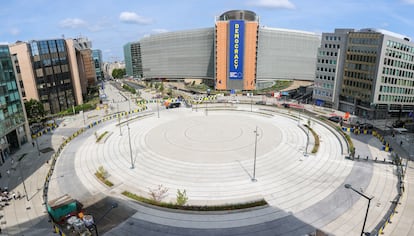

Brussels boasts iconic monuments such as Manneken Pis and the Atomium, not to mention its spectacular Grand Place. Since this summer, it has acquired another landmark — though hardly a source of pride for a city so given to surrealism as the Belgian capital. The city’s new addition has already been dubbed the ‘largest frying pan in Europe’ by locals, with their characteristic zwanze or sardonic humor, referring to the Schuman roundabout in the heart of the European quarter.
After a long renovation that is still unfinished but already deemed a failure, the square — flanked by the European Commission, the European Council and the EU External Action Service and therefore a route all visitors and workers at EU institutions must use — has become an absurd expanse of concrete, with no seating or shelter from the elements in a part of the city that is already gray and harsh, with more EU flags than trees on its streets. Rather than becoming the planned humanist meeting place at the heart of the EU, it has turned into a symbol of failed urban planning and environmental policy in the face of runaway climate change, both locally and across Europe. Especially during a summer in which Belgium, like much of Europe, has already endured several record heat waves that exposed cities’ lack of preparedness for extreme temperatures.
The square ‘will be used as a symbol of the city’s failure, of the nation’s failure and, to some extent, of Europe’s failure,’ warned the project’s lead architect, Francis De Wolf.
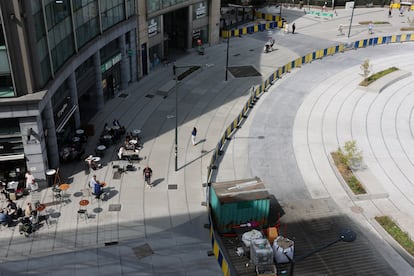
His frustration is understandable: the original project was literally decapitated after local authorities decided not to install the futuristic oval steel canopy covered in grass that was meant to crown the square, giving it character and, above all, meaning. The idea was to transform Schuman Square— until then a desolate space surrounded by heavy traffic — into a broad pedestrian area where people could gather to talk or rest, or simply shelter from the summer sun. Or from the rain that, on average, hits the Belgian capital 200 days a year.
‘We have become the laughingstock of Europe,’ Brussels Socialist deputy Pascal Smet laments by phone. Schuman Square, explains this former head of the city’s urban planning department who launched the original project, is Belgium’s ‘calling card,’ since every head of state and government, minister and senior official passes through it when they meet in Brussels. ‘It is probably the most filmed square in Europe,’ he says. And now, he fears, the most ridiculed.
Problems began shortly after work started, at the end of 2023, following a long project selection process that was difficult in any case: there is a tunnel and a train and metro station beneath the square, which complicates construction and makes planting large trees impossible. After the June 2024 European elections — which in Belgium were also national and regional elections — Brussels went without a government for 600 days. While a cabinet was being negotiated, work at Schuman ran over the original €32 million budget. But without a government, additional funds could not be unlocked.
Europe’s biggest frying pan was never the plan.
— PES Group | European Committee of the Regions (@PES_CoR) July 8, 2026
The original Schuman design included a central canopy for shade, shelter and life.@SmetPascal and @Vooruitbrussels want it built.
👉 Sign the petition : https://t.co/fwDoXRj136 pic.twitter.com/SA60XOMTzS
In a desperate move, the caretaker local authorities sent a request last year for a ‘joint financial contribution’ to the European institutions, which those institutions interpreted as an attempt at extortion: according to sources familiar with the letter, it threatened to leave unfinished works that obstructed access to the EU’s main buildings. After a categorical no from the EU, authorities chose to take the drastic step of finishing the project without its main and most expensive element, the canopy. But then protests began, especially this summer, which has shown how unlivable this poorly redesigned space is.
Among the loudest critics is Smet, who launched an online petition calling for the original canopy to be reinstalled ‘because it gives this square its symbolic dimension as a place of encounter and dialogue at the heart of Europe.’ Aware of growing public and media pressure — the mockery over the ‘European frying pan’ has been recurring in local and international press — officials have just announced that in the fall they will review proposals for a new ‘canopy plan’ for Brussels. ‘It is a concrete response to the lessons learned from the Schuman roundabout project,’ said Audrey Henry, the current head of urban planning in Brussels. There are, however, no details yet and politicians such as Smet fear the works could be further delayed. In the meantime, the EU square will remain a gray wasteland that even the most euro-enthusiastic find off-putting.
Sign up for our weekly newsletter to get more English-language news coverage from EL PAÍS USA Edition









































