
Belgium fears becoming the new departure point for migrants to reach the UK
The strengthening of surveillance on French Atlantic beaches, the point closest to the British coast, is leading more and more people to depart from Belgium, an even more dangerous crossing

The thousands of migrants camped in precarious, unsanitary conditions in the “Jungle” of the French port city of Calais while waiting to cross to the United Kingdom became, in 2016, the image of the shame and failure of European migration policies. A decade after the dismantling of the controversial camp, and amid a tightening of EU migration rules, the problem of illegal crossings of the English Channel has not only not been resolved but, following recent agreements to step up surveillance of the French coast with British funding, now threatens to shift to neighboring Belgium.
The sharp increase in Belgian seizures of small boats loaded with migrants in the early months of the year has set off alarm bells for national authorities. And for European ones as well, which have just presented an “action plan” for the Channel route in an attempt to offer new (and not-so-new) solutions to a puzzle nobody seems able to solve.
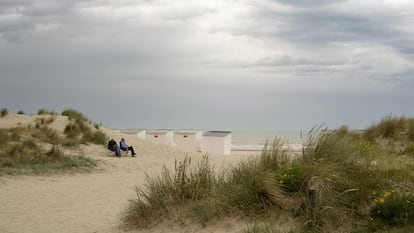
At the end of the long beach of the Belgian resort of De Panne, marking the border with France, stands Westpunt, a monumental geometric concrete staircase that begins and ends at the same point, forming an arch through which the neighboring French city of Dunkirk can be seen. Farther away, somewhere on a cloud-heavy horizon, rises the British coast that so many undocumented migrants yearn to reach at any cost, even risking their lives by boarding flimsy inflatable boats with nothing but the clothes on their backs and a lifejacket that will do little for them if they sink in the always cold waters of the English Channel, one of the busiest shipping lanes in the world.
Tens of thousands have tried in recent years, especially since the land route through the Channel Tunnel from Calais became practically impossible due to increased checks on the trucks migrants hid in. In 2025 alone, 49,966 people aboard 795 fragile boats — usually inflatable dinghies — attempted to cross the English Channel from France’s northern coast, whose forces rescued 6,177 migrants at sea, according to the annual report of the Maritime Prefecture of the English Channel and the North Sea. The EU puts the total number of Channel crossing attempts in 2025 at nearly 64,000. Many succeeded: London has acknowledged that more than 41,000 people reached UK shores that year, the second-highest figure since the British government began counting arrivals in 2018. At least 25 people died attempting the crossing.
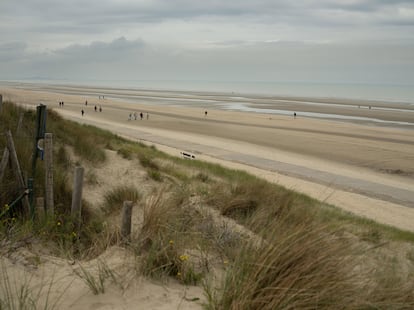
If the crossing is already risky from Calais, the point closest to the British coast, the risk multiplies from the Belgian beaches, which are even farther away. Yet more people are attempting it: while in 2024 and 2025 few boats were detected leaving Belgian beaches, so far in 2026 authorities have intercepted at least 30 vessels.
Police operations were especially intense in the last weeks of April and the beginning of May, when on the roughly 18 miles of coast between De Panne and Middelkerke nearly 200 migrants were detained, either in vans that had taken them to the beach or while they were hiding among the dunes that stretch along the long Belgian Atlantic coast, waiting for the human smuggling gangs that were supposed to help them reach the British shore.
In total, according to police figures cited by the Belgian press, more than 400 people have been intercepted so far this year. Fifty-five suspects believed to belong to the gangs that facilitate illegal crossings have also been arrested.
In addition to boats that depart directly from Belgian beaches with up to 60 or 80 people aboard, Vluchtelingenwerk Vlaanderen, an umbrella organization of Flemish NGOs that work with migrants, has detected a new phenomenon: so-called “taxi boats.” According to Joost Depotter, Vluchtelingenwerk’s policy coordinator, “they leave from the Belgian coast, mostly inflatable boats in poor condition with improvised engines, and try to reach the coast opposite Calais and Dunkirk,” picking up migrants at various points.
Catherine, a secondary-school teacher who retired a couple of years ago and settled in De Panne, is a witness to the new migration trend. She walks the beach daily with her dog and, on more than one occasion this year, has seen, especially early in the morning, small groups of migrants among the dunes. The last time was a few weeks ago.
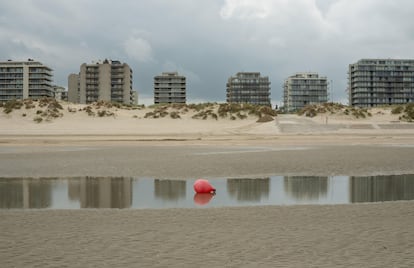
“They were there, three men, huddled under a blanket, waiting in front of the dunes,” she says, at a spot on the beach where seaside apartment buildings — mostly empty out of season — become sparser and a nature reserve begins. “They looked exhausted,” she recalls sadly.
The migration phenomenon, according to Belgium’s Justice Minister Annelies Verlinden, has slowed since the beginning of the month. But with the return of good weather there are fears it could pick up again. In fact, the United Kingdom, which tallies arrivals weekly, recorded on Monday, June 15, after more than a week without incidents, the arrival of 11 boats carrying over 700 migrants. It does not, however, seem to affect life in this popular Belgian coastal area full of bars, restaurants, and boutiques. Emmanuel runs a brasserie on the beachfront in Nieuwpoort, another popular resort located between De Panne and Middelkerke. He lives in Ostend and takes the tram every day along the 41-mile Belgian coast to the French border. He has often seen migrants seeking the departure points for illegal boats, but he says they do not affect the day-to-day life of the tourist coast. “They are not a problem for us,” he says. “They are not vandals,” Catherine also insists.
The Belgian press has reported how some local residents have come across lifejackets or even abandoned boats in the sand since the start of the year. Still, these cases are not yet as recurrent a phenomenon as they are on the beaches of neighboring France.
Paris and London have just signed a multimillion-pound agreement to reinforce surveillance of the French coast, which foresees doubling security forces to about 1,400 officers by 2029 and will allow “strengthening patrols and intelligence operations in France to reduce illegal crossings,” according to the British government.
What residents to the south celebrate as a success worries local Belgian authorities, who fear suffering the consequences. “Traffickers look for the path of least resistance. It’s like a water mattress: when you press one side, it bulges on the other,” said West Flanders Governor Carl Decaluwé, who, like local police officials, is calling for more resources to confront a phenomenon they say is overwhelming them.
In early June, federal Interior Minister Bernard Quintin announced the deployment of 25 officers to reinforce the 45 police already stationed along Belgium’s lengthy coast. They will, however, receive support from French and Dutch security forces over the summer. A group including France, the United Kingdom, the Netherlands, and even Denmark will also be created to improve cross-border cooperation.
Brussels is also gearing up. The European Commission on Tuesday presented an “action plan” to “strengthen operational capacity at the borders between the United Kingdom and the most exposed member states, in order to improve situational awareness, information sharing and operational cooperation.” It foresees, among other measures, the deployment of Frontex personnel and equipment (such as surveillance assets) along the borders of the English Channel and the North Sea, as well as the joint development of a “map of illegal trafficking networks along the English Channel” to facilitate their detection and dismantling.
“Migration pressure has increased in the English Channel, which requires a structured response,” European Commission President Ursula von der Leyen said in March.
The new plan arrives after the full entry into force last Friday of the EU Asylum and Migration Pact, to which the European Parliament gave final approval on Wednesday, which will allow the creation of deportation centers in third countries.
Humanitarian organizations are concerned by the approach: “A policy that is based mainly on deterrence and interception only pushes people further into the arms of people smugglers,” Depotter warns. “It makes them more dependent on criminal networks, increases risks, and produces a greater number of deadly crossings.”
Sign up for our weekly newsletter to get more English-language news coverage from EL PAÍS USA Edition









































