
The Iran war and the billion‑dollar fund for Trump’s allies are eroding the president’s grip on Republicans in Congress
The stalemate in Middle East negotiations is testing Capitol Hill’s patience and triggering a revolt among lawmakers who aren’t seeking re‑election in November — and therefore no longer fear the president’s wrath


The vote in the House of Representatives on Wednesday to limit Donald Trump’s authority to continue his war in Iran will not bring that conflict to an end. But it does represent a symbolic setback for the U.S. president on an issue — the Middle East — that has become, both domestically and in foreign policy, the most painful stone in the shoe of his return to the White House. Meanwhile, the weeks go by and, with the peace deal with Tehran stalled, it seems clear that Washington has no idea how to extract itself from a quagmire of its own making.
The resolution on the war came the same day the White House canceled the creation of a $1.776 billion fund to compensate Trump’s allies, after an unusual Republican revolt. Even if it cleared that first hurdle in the lower chamber, it would still have to pass the Senate — a highly unlikely prospect — and be signed by the president of the United States, an impossible outcome.
At the very least, the move has deepened the crisis of Trump’s waning influence on Capitol Hill and served as a reminder that the war is illegal, since he never sought congressional authorization to declare it — not even when, as required by the 1973 War Powers Act, it passed the 60‑day threshold. It also prompted four Republican lawmakers to join the small group of conservative politicians willing to defy the administration in Washington.
It’s a high‑risk sport: the political life expectancy of anyone who practices it is short these days, as one of the four rebels, Thomas Massie, knows well. The Kentucky representative recently lost his primary despite being one of the most popular and well‑liked politicians in his state. The reason? Trump turned his supporters against Massie as part of a campaign to bring him down, after the congressman opposed the powerful president on issues such as the Epstein documents and his military ventures abroad.
The other three are Brian Fitzpatrick (Pennsylvania), Tom Barrett (Michigan) and Warren Davidson (Ohio). Both Fitzpatrick and Davidson already cleared their primaries last month, so they are not exposed to the wrath of Trump — who in recent months has proved almost infallible at punishing his enemies at the ballot box by throwing his support behind another candidate. Barrett, however, may still pay a price for his decision to vote against Trump in August, when Michigan voters choose the Republican nominee for November’s legislative elections.
The U.S. president reacted to the House vote on Thursday morning. He dismissed it as “meaningless” and referred to the “four bad Republicans” who sided with the “Dumocrats,” a freshly minted neologism of his own invention that he seems particularly pleased with, judging by how often he repeats it.
‘Unpatriotic’
“Who would do such an unpatriotic thing?” Trump asked on Truth Social, criticizing that the vote took place “in the middle of [the] final negotiations to end the war with the Islamic Republic of Iran,” despite there being no evidence that those talks, which began on April 11, are in their final phase or close to it.
In his post, he argued that the Democrats “would rather have our Country fail than give me another, of many, victories.” “The four Republicans, that’s a whole other story — they’re grandstanders! They should be ashamed of themselves,” Trump wrote.
Polls indicate that the war with Iran is testing the patience of the U.S. public. It is also cracking Republican unity on Capitol Hill, after more than a year in which the party had operated like a perfectly tuned machine to carry out Trump’s agenda and his efforts to expand executive power at the expense of the legislative branch — with the acquiescence of the judiciary, represented by the Supreme Court’s conservative supermajority.
In this city obsessed with labels, some of those lawmakers have already grouped themselves under the acronym YOLO — You Only Live Once. It includes those who know they won’t be on the ballot in November but will keep their seats until January. Some are retiring (like Senators Thom Tillis and Mitch McConnell), while others, like Massie, have effectively been retired by Trump. The latest to join this unofficial club are two senators, Bill Cassidy of Louisiana and John Cornyn of Texas, both of whom also failed to clear their primaries against rivals backed by the president.
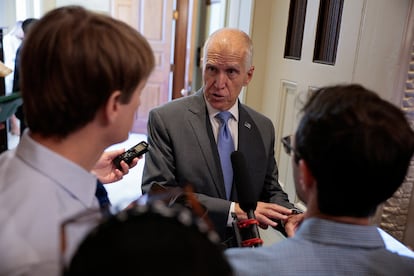
Two other members of the upper chamber can also be added to that caucus: Susan Collins of Maine and Lisa Murkowski of Alaska, whose long record of clashes with Trump seems to confirm their immunity to friendly fire from the White House. If, as analysts expect, those six senators vote their conscience rather than simply pleasing the administration during the seven months left before the next turnover on Capitol Hill in January (when every member of the House and one‑third of the Senate will change), Trump’s outlook will darken even further. The same polls show he is extraordinarily unpopular and point to a likely defeat in the midterm elections.
On Thursday, Washington spent the day watching the Senate’s vote on an amendment proposed by Chuck Schumer, the Democratic minority leader. His aim was to bar the government from ever again creating a fund like the recently canceled one, which could have been used to compensate the Capitol rioters. In a move designed to heighten political tension, Schumer attached his proposal as an add‑on to a funding bill ($70 billion through 2029) for federal immigration agencies. By early afternoon, it was still unclear how the YOLO Republicans would vote.
In the end, only Susan Collins joined the opposition, along with two GOP colleagues facing re‑election: Jon Husted of Ohio and Dan Sullivan of Alaska. Their three votes left the tally at 49 in favor and 50 against, meaning the amendment failed — adding extra spice to a marathon Senate session, a Washington classic.
If Trump loses control of Congress at the November midterm elections, the second half of his second presidency would become more complicated and he would become what Washington calls a lame duck: a politician with days numbered and little room to maneuver.
The president, who will turn 80 on June 14 and increasingly seems unconcerned with the rules of decorum, is also behaving as if none of that worried him. Especially when it comes to the war in Iran, about which he has said several times that he doesn’t care about its impact on Americans’ wallets — even with gas prices soaring — because the priority, he insists, is preventing Tehran from getting ”the nuclear bomb.”
On Wednesday, just days after news broke of Trump’s profanity‑laden phone call with Israeli prime minister Benjamin Netanyahu over his offensive in Lebanon, the Republican delivered yet another surreal appearance before the White House press corps. He again went after one of the reporters — Kaitlan Collins of CNN, claiming she “never smiles” — pulled out a diagram comparing the length of the Lincoln Memorial Reflecting Pool, currently under renovation, with the height of famous skyscrapers, and defended the ceasefire in the Middle East despite the recent cross‑fire between Iran and the United States and the bombing of an airport in Kuwait, a Washington ally in the region.
“In that part of the world, ceasefire is when you’re shooting in a more moderate manner,” said Trump, when asked to define ceasefire. And when asked when a deal with Iran may be reached, Trump replied: “Who knows,” but said that negotiations could bear fruit “over the weekend.”
The press has lost count of how many times Trump has declared the war — launched by him and Israel on February 28 — to be over or on the verge of ending.
Sign up for our weekly newsletter to get more English-language news coverage from EL PAÍS USA Edition









































