
Trump fans feud with Senate Republicans and puts November majority at risk
John Cornyn of Texas is the latest victim of a president bent on showing control over his own even at the risk of paying a political price in the midterms


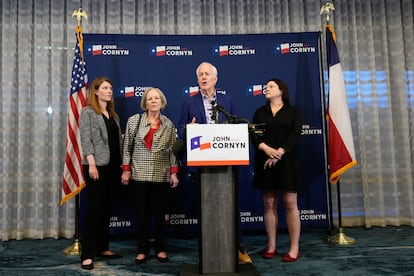
Washington politics can be very cruel at times. Senator John Cornyn found that out on Tuesday: after nearly a quarter-century on Capitol Hill, he will have to go home next January following a crushing defeat in the runoff of Texas’s Republican primary. His rival, the controversial state attorney general Ken Paxton, won with 63% of the vote.
Cornyn was the logical Republican candidate for one of Texas’s two Senate seats (the other one is held by Ted Cruz), the only one up in next month’s midterm elections. But logic is not always the path chosen by the president of the United States who, after weeks of weighing his options, decided a few days ago to back Paxton’s campaign — even at the risk of deepening his clashes with Republican senators in the Capitol and of costing the party in the midterms.
Adding to the humiliation of being felled by friendly fire and leaving through the back door after four terms in Washington is the fact that Cornyn’s defeat is not an isolated incident: he joins a growing list of lawmakers Trump has easily toppled. Sometimes because, as with Kentucky representative Thomas Massie, he sees them as enemies. Other times because, as with Cornyn, he considers them insufficiently loyal.
The bloodletting has been especially harsh for a type of candidate for whom primaries used to be a mild formality: incumbent senators seeking re-election. The first to fall was Bill Cassidy in Louisiana. His sin? Voting in 2021 to impeach Trump after the Capitol attack. Republicans still have to choose between two contenders in a runoff for his seat: Representative Julia Letlow, who has Trump’s backing, and state treasurer John Fleming. Both will face voters on June 27.
Trump’s pick in Texas is somewhat puzzling (Cornyn never voted to disqualify Trump, though he did err in 2023 by saying “his time” had “passed”). Paxton, whom the president has recently called “the best attorney general in the United States,” has a record marred by scandals: from corruption and bribery suspicions that led to a state impeachment he survived in the state senate, to an ugly split with his wife, who filed for divorce “for biblical reasons” (whatever that means).
Talarico, rising star
Trump’s choice will also face an opponent who promises to fight: James Talarico, a rising Democratic star who rubbed his hands on Tuesday when he learned who his challenger would be. “He is the most corrupt politician in the United States,” Talarico said of Paxton in a video posted after the count. Cornyn himself used that line, casting Texas’s conservative voters as having to choose between a “strong” candidate (him) or a “weak” one [Paxton], who, he warned, would put “everything that matters” at risk.
Analysts agree that Talarico would have had a tougher time against the ousted senator in a country where senators tend to entrench themselves — as shown by former president Joe Biden’s 39 years or Mitch McConnell’s 42 years, which he will have served when he retires next January. Texas is also a state that, election after election, flirts with becoming a swing or purple state, a hue produced by mixing conservative red and Democratic blue.
A more unbridled Trump than ever seems unconcerned about whether his decisions will harm the party in November or whether, as has already begun to happen, they will provoke a certain rebellion among his senators, who suddenly find they have much to lose and that no one is safe from the leader’s whims. Not even those who, like Cassidy and Cornyn, have voted with the White House’s agenda almost 100% of the time in the Capitol.
These two have set a record: no sitting senator running for re-election had been defeated in the primaries since 2010. Senator Susan Collins, a Maine Republican seeking re-election in November, called it “sad and troubling” on Wednesday, though she will not have an easy race either. Most of her Republican colleagues have remained silent after the Texas debacle.
It also remains to be seen whether Cornyn will join the group of Senate Republicans who oppose the president in the seven months he has left on Capitol Hill: waiting for him are the likes of Thom Tillis (North Carolina), who is not running for re-election, and Lisa Murkowski (Alaska).
Trump also appears unconcerned that his moves have opened a scenario that was unthinkable a year ago for Democrats: the possibility of retaking the Senate (now controlled by Republicans 53 to 47) combined with the not-unreasonable chance of winning the House as well. In November all Senate seats up for election and one-third of House seats will be contested. Losing one or both chambers would be a disaster for the second half of a Trump presidency, which is otherwise breaking records for unpopularity amid rising prices, the Iran war and his administration’s steadfast support for Israel.
Still, there are more than five months to go until Election Day. That leaves plenty of time for one of Washington’s most common habits: underestimating Trump’s ability to show his rivals that reports of their political deaths were, like Mark Twain’s, premature.
Sign up for our weekly newsletter to get more English-language news coverage from EL PAÍS USA Edition









































