
The battle to redraw electoral districts ahead of the midterms: Where changes have been confirmed and where they are awaiting approval
After the gerrymandering race, Republicans hope to gain up to 14 seats, while Democrats expect to win six new seats in the House of Representatives
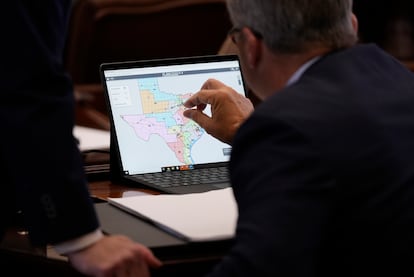

The redrawing of electoral districts, or gerrymandering, in the United States is reaching unprecedented levels. After the Supreme Court’s late-April ruling changed electoral rules and curtailed minority rights, Republicans have stepped up efforts to dismantle majority-Black districts, especially in the South, though the strategy extends to states beyond that region.
So far, the governing party hopes the new maps approved in states it controls will give it at least 14 additional seats in the November midterm elections. But Democrats have not remained idle and are on track to gain six seats from the revised districts in California and Utah; they had expected to gain 10 until Virginia’s state supreme court ordered current maps to remain in effect after an attempt to redraw them so Democrats would pick up four more seats. In all, eight states have taken formal steps toward new maps, although not all have been finalized just months before the decisive November midterms, when the entire House is up for election.
With the narrowest possible margin (the current balance is 218 Republicans and 212 Democrats, with five vacancies), Trump fears that if he loses the elections he could be removed from the White House. “You gotta win the midterms because, if we don’t win the midterms, they’ll find a reason to impeach me,” the president told Republican lawmakers earlier this year.
It was the magnate himself who launched this battle after asking Texas Republicans last year to change electoral districts to give the party an advantage in upcoming elections. The opposition’s response was swift, and California Democrats advanced their own electoral maneuver, called Proposition 50. Since then, the contest has been replayed in other jurisdictions.
Historically, the Republicans usually lose seats in midterm elections, and the president’s falling popularity — 63% of the public disapprove of Trump’s handling of his duties, according to NBC News Decision Desk’s April poll — suggests that trend could be repeated this time, though the outlook remains uncertain.

New electoral maps confirmed
Of the eight states that have changed their congressional districts, six did so voluntarily, one did so under a provision of its state Constitution, and another by court order.
Texas
Republican Governor Greg Abbott signed an overhaul of the electoral map in August 2025 that could help Republicans win five additional seats. In December, the Supreme Court authorized use of the new districts in this year’s elections. Currently, Texas has 25 Republicans and 13 Democrats in the House of Representatives.
California
In November voters approved Proposition 50, which could help Democrats pick up five additional seats in Congress — the same number Republicans are aiming for in Texas. It was upheld by the state Supreme Court in February of this year. Currently, California has 43 Democratic and nine Republican representatives.
Missouri
Republican governor Mike Kehoe signed a revision of the House map in September 2025 that could help Republicans gain an extra seat. The state Supreme Court validated it and it will be used in the November elections, but litigation remains that could derail it, though that becomes less likely as Election Day approaches. The state’s current delegation is two Democrats and six Republicans.
North Carolina
In October 2025 the Republican-controlled state legislature approved a redrawing of districts. The resulting design could help Republicans gain an additional seat by eliminating a majority-Black district. The state currently has four Democratic and 10 Republican representatives.
Tennessee
Republican Governor Bill Lee signed a map revision on May 7 prompted directly by the federal Supreme Court’s late-April ruling, which opened the door to partisan-based redistricting. The map splits Memphis — which until then had its own Democratic seat — into three Republican-leaning districts. The state’s current delegation is eight Republicans and one Democrat.
Ohio
The state Constitution required new maps to be drawn before the November elections, so a bipartisan panel with a Republican majority voted in October 2025 to revise the districts. The approved map would add two seats to the governing party out of the state’s 15. The current map gives five seats to Democrats and 10 to Republicans.
Utah
In November last year, a judge ordered a redrawing of the districts. The redistribution that followed the court order is projected to give Democrats one additional seat. The court had ruled that local lawmakers bypassed voter-approved anti-gerrymandering rules when adopting the previous map, which had awarded all four of the state’s seats to Republicans.
Florida
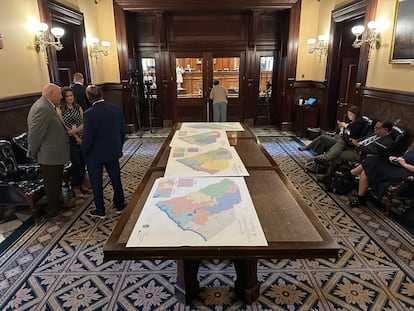
Republican governor Ron DeSantis signed the state’s new congressional maps on May 4 aiming to give the Republican Party four more seats. An ongoing lawsuit sought to overturn them, arguing the state Constitution prohibits drawing districts with the intent to favor or harm a political party. But a judge dismissed the lawsuit this Tuesday. The state’s current delegation includes eight Democrats and 20 Republicans.
New districts pending approval
Legislators in at least three states are working to reconfigure their electoral maps. That is the case in Louisiana, where governor Jeff Landry canceled primaries scheduled for May 16 to allow the state legislature to review current districts.
Another jurisdiction doing the same is Alabama, where lawmakers hope to revive a map approved in 2023 (but later discarded) to help Republicans pick up a seat. The state’s current map stems from a court order that requires it to be used until after the 2030 census.
In Georgia there have also been moves, though the state has not voluntarily pushed through a congressional redistribution ahead of November; its electoral maps have long been the subject of litigation. The federal Supreme Court’s late-April decision has complicated matters, as state Republicans now consider how to use that ruling to consolidate their advantage, though any legislative action is already pointing toward the 2028 elections. Republican Governor Brian Kemp has called a special session beginning June 17 to address redistricting. The state’s current delegation includes nine Republican and five Democratic representatives.
Meanwhile, the Republican effort to redraw South Carolina’s congressional districts will not proceed in time for November. In mid-May the state Senate rejected an initial resolution to extend the legislative session and address redistricting, with five Republican senators voting against it. On Tuesday, May 26, the state Senate voted to postpone redistricting until the next legislative session. That result means the state’s current map — six Republicans and one Democrat — will remain in place for the November elections.
Sign up for our weekly newsletter to get more English-language news coverage from EL PAÍS USA Edition









































