
Without a license, without a livelihood: Texas’ economic blow to thousands of immigrant truckers
Since September, a rule has begun to cancel commercial driver’s licenses for asylum seekers, refugees and DACA recipients, who have been losing their jobs
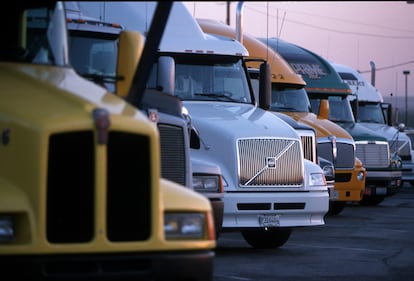
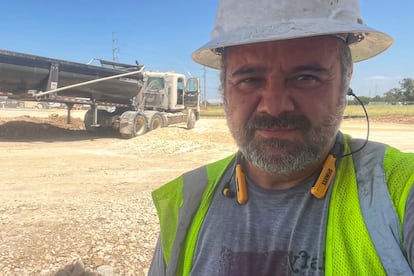
Juan Espinoza spent nearly eight years rebuilding his life in the United States. When he arrived in Austin, he knew he had left behind in Caracas his position as manager, which he had held for 20 years, and that now he would have to take any job that would allow him to support his family. That job was driving trucks. In February 2020, he legally obtained his commercial driver’s license in Texas.
Two months later, he bought his first truck. With it, he transported materials to construction sites, saving up for a down payment on his house and a car. By 2025, his business was still growing, and he decided to buy a second truck. In December, he also won his asylum case; the good news kept coming: “I felt calm and secure… I saw a world of opportunities in this business. My dream was to own a fleet of trucks,” he says over the phone.
But when the 49-year-old Venezuelan went to the Texas Department of Motor Vehicles (DMV) to update his immigration status on his driver’s license, he learned that his permit had been downgraded by a new state law. Thus, unexpectedly and without receiving any notification from the state, he found out a few months ago that he could no longer drive his trucks.
“It has been a very difficult situation. With all the financial commitments I have, everything fell apart,” he says.
In accordance with a federal government regulation — following a series of traffic accidents involving foreign drivers, some with commercial driver’s licenses forged in Mexico — the Texas Department of Public Safety (DPS) suspended the issuance of commercial driver’s licenses on September 29, 2025 to non-citizens with refugee and asylum status, as well as to beneficiaries of Deferred Action for Childhood Arrivals (DACA, which protects individuals who arrived with their immigrant parents as children) and other humanitarian permits. In Texas alone, more than 6,400 asylum seekers, refugees, and DACA recipients are affected, according to DPS figures.
The regulation has been replicated in more states across the country, under the argument of keeping roads and highways safe. Documents from a national lawsuit filed in February in Washington, D.C., estimate that approximately 200,000 people with permits to remain in the country will lose their jobs as a result, and claim that the federal government has not provided data proving that drivers whose commercial licenses have been suspended have been involved in more traffic accidents.
“Money doesn’t go as far”
When his commercial driver’s license was downgraded due to his asylum status, Juan Espinoza had to use the money for his mortgage payments to hire a second driver, a task made more difficult by the new rule: there are fewer drivers available, and those that are can be more expensive. His income has also been reduced by inflation, rising fuel prices, and the decline in the value of the cargo he transports to construction sites. He feels that the state has left him practically unemployed, despite owning his own business. “It barely covers the cost of keeping the trucks running,” he said.
To pay off the mortgage, Espinoza and his wife decided to rent out three rooms in their house to other workers by the week, in addition to working hours as Uber drivers and food delivery drivers through apps: “It’s not much, but it helps.”
The family says they live in “complete economic hardship”: they don’t spend money on entertainment, vacations or restaurant meals; only on groceries and utility bills. “We’ve tightened our belts.”
The suspension of commercial licenses in Texas came after an additional “zero tolerance” order from Governor Greg Abbott to the DPS requiring any trucker traveling in the state to be “able to communicate in English,” something that was already required when taking the tests to obtain licenses.
The Texas Department of Public Safety, the governor’s office, and two state congressmembers were queried about the suspension of these licenses, but there was no response.

The rule affected truck drivers who carry construction materials, like Espinoza, but also school bus drivers who require a commercial license, like Rina Flores from El Salvador.
This asylum seeker spent seven months preparing for her driving test and then for the test that would allow her to transport passengers on school buses. She had to study traffic laws and practice, but she also worked to improve her English. She said that passing both exams in 2023 made her feel “proud” as an immigrant and represented “a dignified support,” “greater economic stability” for her family.
At her job in a Houston school district, Flores had a good salary, life insurance, a retirement fund, and access to loans, like the one she used to buy her car. She said she used her income to build a future for her two daughters, ages seven and 10, but especially for her older daughter, who was diagnosed with autism.
When DPS downgraded his commercial driver’s license in January 2026, she lost her job with the school district. “I had to give up something I fought for.”
Now, working as a building janitor, she earns half her former salary, lost her health insurance, is unable to contribute to her retirement fund again, and can no longer save money for her daughters. “Every paycheck I earn goes toward paying bills, debts, and credit card expenses,” she says.

In addition to downgrading business licenses for certain immigrants, Republicans in Texas have pushed measures that limit the ability of non-citizens to buy a car or qualify for state aid to study at universities.
Alain Cisneros, spokesperson for FIEL, an immigrant support organization in Houston, asserts that these regulations are pushing people with legal status and work permits “to the economic brink.” He adds that, with these policies, the Texas government “is disrespecting the rule of law.”
Cisneros — like some Democratic congressmembers from the state have claimed— believes that rules like the one that downgraded the commercial driver’s licenses of thousands of immigrants should have been decided in Congress so that the possible effects on the economy could be evaluated.
The psychological damage
Since December, Espinoza hasn’t been sleeping well. He gets up and checks his bank accounts to figure out how to cover every daily expense. He says one of his eyes and one of his cheeks tremble regularly. These are symptoms he already experienced in 2024, when stress paralyzed half of his face. “What’s the crime here? Working?” he asks. “I came in with so many hopes, and suddenly I was dealt a blow.”
This Venezuelan citizen hopes this downgrade to his commercial driver’s license is temporary and that one day he’ll be told the measure has been lifted. He says that when he passes through one of the communities built with materials he transported, he feels happy to have been part of that development.
Rina Flores also hopes the rule will be repealed. She says she was happy driving children to their schools: “It was a very nice job because I saw the children grow up and it helped parents go to work with peace of mind while I picked up their kids and took them safely to school.”
Sign up for our weekly newsletter to get more English-language news coverage from EL PAÍS USA Edition









































