
Trump’s border wall on the Rio Grande threatens the water supply of millions: ‘It’s not a question of if, but when’
Dozens of Texans are fighting against the ‘Operation River Wall’ project, while scientists warn of its potential social and environmental damage
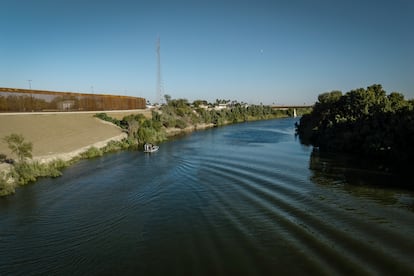
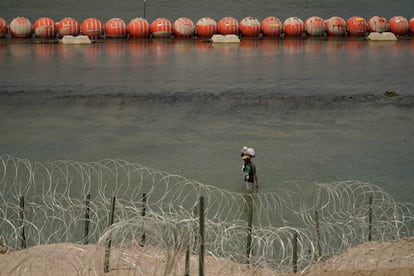
“I’m sorry, I’m dealing with the border wall surveyors and can’t get back to you until later. I have to make sure they don’t trespass on my property.” That was Elsa Hull’s response early Sunday morning to EL PAÍS’ interview request. Hull owns three acres of land in San Ygnacio, Zapata County, in South Texas. She has lived in the area, near the Rio Grande, or Rio Bravo as it’s known in Latin America, for more than 25 years. There she raised her family and built a bird sanctuary. However, the Trump Administration intends to build a steel wall “along the riverbank next to my property, with the surveillance zone extending into my front yard and possibly even my house.” Dozens of people in Texas are fighting this situation caused by the Operation River Wall project, which also plans to install around 500 miles of floating buoys in the riverbed.
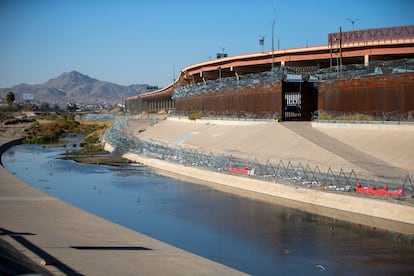
In Webb and Zapata counties alone, the federal government’s plans include over 107 miles of wall and 152 miles of buoys, all funded by the $46.5 billion that Congress approved last year in the president’s “big beautiful” tax reform. This infrastructure, according to experts, threatens to turn the only source of drinking water for some 15 million people into an area of irreversible risk, in addition to affecting the property and daily lives of people like Hull.
“Even if my house is saved, I’ll be living under a wall. My privacy would be destroyed with all the cameras and sensors monitoring my every move. I’d never feel safe again,” she says.
Ricardo De Anda has been practicing law in Laredo, Webb County, for 50 years. He owns a ranch near the Rio Grande. Less than a month ago, he received a notice from the Trump administration. According to him, they want part of his land to build the wall. “I’m willing to talk to them so they can make me an offer,” he says. “And if we don’t reach an agreement, let them sue me. I’m waiting for them.” De Anda has watched the river rise for decades and knows what could happen if the plan goes ahead. “We’re talking about a metropolis of 800,000 people with a river running right through the middle of us,” he points out. “When you go against nature, nature always wins.”
According to Martín Castro, director of Basin Sciences at the Rio Grande International Studies Center (RGISC), the river is already under extreme pressure, as the two dams that regulate the flow in the area have been at critical levels for years due to the drought. “If the region continues to not receive enough rain to replenish the dam levels, we are going to have situations like the one we saw in Monterrey in 2022,” warns the expert, alluding to the year the Mexican city had to ration water by neighborhood due to the depletion of its dams. “That could happen here in Laredo.”
Suspended laws and a real risk
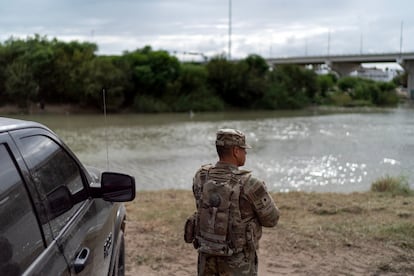
To begin its project, the White House needed to remove legal obstacles. Last July, the Department of Homeland Security signed an initial waiver for the Brownsville section. Five months later, it signed another one that suspended more than 30 federal laws along a 100-mile stretch between Brownsville and Rio Grande City. Among the suspended regulations are the National Environmental Policy Act, the Endangered Species Act, the Federal Water Pollution Control Act, and the Safe Drinking Water Act.
Castro, from RGISC, asserts that these laws were not repealed anywhere else in the country. “They only did it in a specific region, which is the border with Mexico,” he says.
The suspensions mean the federal government is not required to publish its design plans or conduct the studies that normally precede any project of this kind. “Without the data, without those studies, we don’t know what the impacts will be,” Castro points out. “The communities on the border are flying blind.”
Mark Tompkins, a civil engineer and fluvial geomorphologist with nearly 30 years of experience on river projects in the United States, conducted a technical analysis of the project’s impact on Webb and Zapata counties, which he shared with the RGISC last March. “Given that there is no publicly available record documenting the design of the proposed system, it is entirely possible that it will cause even greater risks than my analysis indicates,” he notes.
According to the report, when the river overflows under normal conditions, the water disperses across the plains bordering its channel. However, the border wall acts like a straitjacket, preventing this dispersion, concentrating the flow, and increasing the water’s height and speed.
Furthermore, the buoys obstruct up to 8% of the channel’s width and act as a trap for debris typically carried by floods. This debris—tree fragments, trash, and sediment—accumulates on the buoy chains until the pressure dislodges them. The torn-off sections travel downstream and become entangled in bridge piers.
Laredo has five international bridges located in flood zones. All are listed in the report as infrastructure at direct risk. The drinking water treatment plants on both sides of the river are also included.
“It’s not a question of if it will fail. It’s a question of when,” Tompkins states in his study. “The problem is that we don’t know where it will happen, creating this enormous vulnerability. This is truly unprecedented in my experience.”
In September 2023, the U.S. Government Accountability Office released a report on the impact of the first wave of Trump’s wall construction, between 2017 and 2021. The document states that the border barrier system had already disrupted the natural flow of water during heavy rains. It also documented erosion so severe that, according to the report, it was “threatening the integrity of the barrier system.”
Furthermore, in July 2023, the Texas government installed approximately 186 miles of spherical buoys in the Rio Grande near Eagle Pass. What has happened since then, according to scientists, may offer some insight into what could be coming.
Hull participated in a field study of these buoys last December. He explains that they are made of plastic, which poses a risk of contamination. “Microplastics will be released into the water as the buoys deteriorate due to sun exposure and erosion,” he warns. “These materials are linked to cancer and organ damage in living organisms, so they will affect the food chain and our drinking water.”
According to Hull, the impact will have international dimensions, since “the Rio Grande Valley is one of the largest agricultural areas in Texas and its products reach all of the United States, Canada and Mexico.”
Adriana Martínez, a river geomorphologist at Southern Illinois University who has been studying the impact of the buoys for years, confirmed in her research that the flow is being diverted toward the American side of the river. “Any movement of sediment in the river affects the water quality downstream,” she told local media. “The entire region uses that water for drinking.”
“Second-class citizens”
Elsa Hull has been fighting Trump’s wall since 2019, when she was one of the original plaintiffs in Earthjustice’s lawsuit against the project. Two years later, the Biden administration canceled the contracts in Laredo. Now, Hull has taken up the fight again. “It’s very discouraging and frustrating, and it makes you angry to think you gain some ground on one level and then get caught out because you have to start all over again.”
Her property, where she has documented more than 150 species of birds and wildlife, including endangered turtles and snakes, appears on the Customs and Border Protection map, along the proposed wall’s route. However, the federal government has not notified her of anything. “I haven’t even received any correspondence from the government about their intentions regarding my property,” she says.
Meanwhile, the attorney De Anda and a group of affected individuals are preparing to challenge the process. Their legal strategy appeals directly to the Constitution. “Even though they have taken away the laws used in modern times to protect public health, they cannot take away our constitutional rights,” says De Anda. “The government cannot take arbitrary or capricious action that affects our lives and property.”
For them, the wall is not just an immigration issue. “With Border Patrol arrests at historic lows along the entire southern border, and with Laredo ranked as one of the safest cities in Texas, it makes no sense to force a multi-billion-dollar barrier system on our area,” Hull asserts.
“This isn’t about border security,” she adds. According to her, “this is about a government seizing our land and our river to award construction contracts and line the pockets of its political donors. This is about a government taking control of our only source of drinking water. This is about a government treating border residents as second-class citizens who don’t deserve the same rights and protections as the rest of the country.”
Sign up for our weekly newsletter to get more English-language news coverage from EL PAÍS USA Edition









































