
US administration struggles to present coherent narrative on why it went to war with Iran
Secretary of State Marco Rubio now maintains that the president decided they weren’t going to let Tehran attack first. Nearly six out of 10 citizens disapprove of the operation, according to a CNN poll
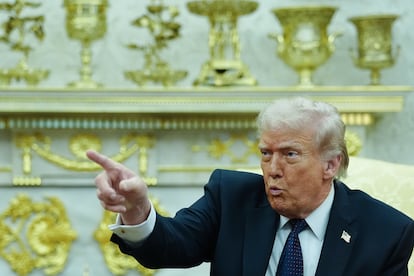

First, it was the need to eliminate Iran’s nuclear program. Then, to overthrow the regime. Later, it was the need to neutralize the missile program. Then, it was the belief that Tehran would attack first and that they had to preempt it. Later, it was the belief that Israel would attack first and Iran would retaliate against American targets. On Tuesday, Donald Trump offered yet another explanation for launching the offensive against the Islamic Republic: that he thought Iran was about to attack; if anything, he says, it was he who drew Israel into the fight.
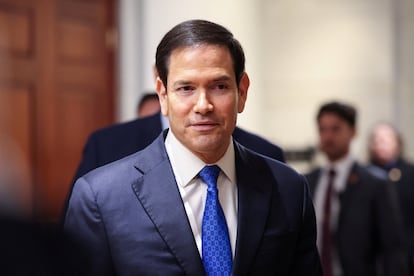
Attacking Iran was something that had to be done, Trump maintained in remarks delivered in the Oval Office. In subsequent statements, Secretary of State Marco Rubio backtracked on Monday’s statements and insisted to reporters at the Capitol: “The bottom line is this: The president determined we were not going to get hit first. It’s that simple,” A day earlier, Rubio had unleashed a wave of indignation among Democrats and some on the right by declaring that the offensive was launched because Israel was going to attack its great enemy and the United States feared retaliatory attacks from Iran.
With public opinion strongly against the operation, the Trump movement divided over support for the war, the first combat casualties, and hasty evacuations of U.S. citizens in the region, the administration is finding it difficult to present a coherent narrative about why it is launching into a conflict whose deadlines the president keeps extending, and which Democratic opposition lawmakers, analysts, and Iran itself denounce as a “war of choice.“
Polls indicate strong opposition among voters to a conflict with the potential to become yet another one of the United States’ “forever wars” in the Middle East — something that Trump promised to avoid during his election campaign. Nearly six out of 10 citizens disapprove of the decision to launch a military operation, according to a CNN poll. Another poll for The Washington Post shows that 52% oppose the intervention, while 39% support it. Among Democrats, 90% condemn the military operation. Among independents, the figure is 60%. Eighty percent of Republicans support the offensive.
“The disparity between the successes of the operation we are seeing on the ground and the lack of clarity about what we want to achieve is striking,” Elise Ewers of the Council on Foreign Relations told reporters. “Do we want to eliminate Iran’s ability to project power beyond its borders? Regime change? Minimize its naval capabilities? All of that is possible, but not necessarily all of it is possible in the time available, when this is having real economic costs, especially in the Gulf. And this can only be sustained for a limited time until those impacts are felt, not only in oil prices but also in shipping insurance and other things.”
After weeks of failing to present a clear argument while amassing military might in the Middle East, the administration has come out to present a narrative about the reasons for going to war. The Pentagon, which had not held a single press conference this year, convened two this week. The White House will also hold one on Wednesday. The entire White House national security team traveled to Congress on Tuesday for closed-door meetings with members of Congress and the Senate, led by Rubio, who is also the National Security Advisor.
Trump himself has also been very active. On Tuesday, he answered questions from the press in the Oval Office during a meeting with German Chancellor Friedrich Merz, a format that had fallen out of favor this year. The day before, he made a statement about the offensive during a ceremony in the White House. Since the attacks began on Saturday, he has given a barrage of phone interviews — nearly 20 to as many media outlets — making statements that were often contradictory.
The message was supposed to be that the offensive was justified by the threat posed by Iran, that it was limited in its objectives and duration, and that it did not conflict with Trump’s “America First” platform. But a comment by Rubio exposed the contradictions. In an appearance before leading lawmakers from both parties in Congress on Monday, the Secretary of State made an unprecedented statement: “We knew that there was going to be an Israeli action. We knew that that would precipitate an attack against American forces, and we knew that if we didn’t preemptively go after them before they launched those attacks, we would suffer higher casualties.”

The opposition went for the throat. “There was a threat to Israel. If we equate a threat to Israel as the equivalent of an imminent threat to the United States, then we are in uncharted territory,” declared Democratic Senator Mark Warner. “I think Secretary Rubio inadvertently spoke the truth, that this was orchestrated by Benjamin Netanyahu and now we are embroiled in a major conflict,” added his Senate colleague Angus King.
Even among Trump’s most ardent supporters in the MAGA movement, criticism was rife: “So he’s flat out telling us that we’re in a war with Iran because Israel forced our hand,” tweeted Matt Walsh, a commentator from the far right. “This is basically the worst possible thing he could have said.”
Even Iranian Foreign Minister Abbas Araghchi reacted on social media: “Mr. Rubio admitted what we all knew: US has entered a war of choice on behalf of Israel. There was never any so-called Iranian ‘threat,’” he wrote.
A wary Trump — who launched a tirade against two European allies, Spain and the United Kingdom — corrected his top diplomat on Tuesday: “It was my opinion that they were going to attack first and I didn’t want that to happen. So if anything, I might have forced Israel’s hand.”

In his latest appearance before the media at the Capitol, Rubio attempted to quell the controversy, without apparent success, and denied having attributed the decision to attack to Israel.
In a midday call with reporters, two senior Trump administration officials described the events on the eve of the launch of Operation Epic Fury, including the rounds of talks on the Iranian nuclear program held in Geneva between Araghchi and U.S. envoys Steve Witkoff and Jared Kushner, under the mediation of Oman.
These sources indicated that the two U.S. representatives continually pressured Iran to abandon uranium enrichment. But Tehran’s offer allowed the country to enrich uranium at a facility near the capital. “They were unwilling to give up the building blocks of what they needed to preserve in order to get to a bomb,” said one of the senior officials.
The two envoys informed Trump on Thursday, the same day as the last round of talks, that a deal similar to the one brokered by the Barack Obama administration in 2015, known as the Joint Comprehensive Plan of Action, would still be possible, but would take months. The president gave the green light to the offensive the following day, Friday. The attacks began on Saturday.
Sign up for our weekly newsletter to get more English-language news coverage from EL PAÍS USA Edition









































