
Gil Kerlikowske: ‘Border Patrol has no business being in cities like Minneapolis’
The former Customs and Border Protection commissioner during the Obama administration criticizes Trump’s crackdown in Minnesota, where immigration agents have killed two citizens in less than a month
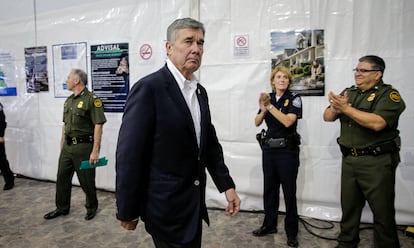
Gil Kerlikowske joins the video call exactly one hour after agreeing to the interview. Behind him, a portrait of Abraham Lincoln hangs on the wall, the “savior” of the American Union that is said to be in such danger these days. Next to him, several police badges attest to a long career in law enforcement. One of them bears the insignia of U.S. Customs and Border Protection (CBP), where he served as commissioner during Barack Obama’s presidency. The same agency that made national and international headlines this week after two of its agents shot and killed a man in Minneapolis.
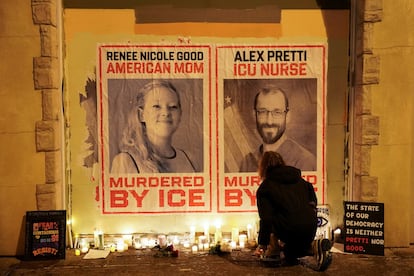
Following the deaths of Alex Pretti and Renee Good, both U.S. citizens killed by federal agents just over two weeks apart in the same city, Kerlikowske’s phone has been ringing nonstop. More than 40 media outlets have contacted him with the same question: What is happening in Minneapolis? The answer, he says, is “chaos.” Kerlikowske, who was CBP commissioner from 2014 to 2017, is a vocal critic of Donald Trump’s offensive in Minnesota’s most populous city, where his administration has deployed a large number of immigration agents amid mass protests and brutal police repression.
At 76 years old, Kerlikowske has a deep understanding of how these agencies should operate, and he says that what is happening now bears no resemblance to how the law should be enforced. “The world is actually watching what is going on,” he says of the situation in Minneapolis. “If it wasn’t for those videos that came out, people would say, ‘Well, this is what the president said, this is what Secretary Noem or the vice president said.’ But now that people have looked at those videos, they’ve made their own judgment, and they say, ‘You know what, what we’re being told by these officials is not what happened.’”
Currently a professor of criminology and criminal justice at Northeastern University, Kerlikowske has spent more than 40 years in law enforcement. Before leading CBP, he served as director of Obama’s Office of National Drug Control Policy, chief of police in Seattle, and police commissioner in Buffalo.
Question. What was your reaction when you saw the videos of Alex Pretti’s killing?
Answer. The reaction, not only mine, but the reaction across the country and, frankly, worldwide, has been one of shock. They can’t quite understand how this person that was attempting to help this woman that the Border Patrol had shoved into the snow would be pepper-sprayed, and then six or seven agents and CBP personnel could not seem to get him handcuffed and secured.
Q. How should the agents have handled that situation?
A. There are a couple of things that people need to realize. We certainly have the right to protest, observe, and record. We don’t have the right to obstruct or interfere with law enforcement conducting their work. But they should have told him, “If you interfere, you’ll be arrested.” That would have been the proper course of action. What we’re seeing over and over again is ICE and Border Patrol immediately turning to their less lethal tools, although they’re dangerous tools, such as pepper spray, pepper balls, tear gas, etc., rather than making an arrest.
Q. Are Border Patrol agents trained to handle situations like the one in Minneapolis?
A. No, the Border Patrol, CBP and ICE are not trained, not experienced, and certainly not well led or well supervised in how to police an urban environment, whether it be Seattle, where I worked, or Buffalo, or any of these other large cities, including Minneapolis. Policing in a city takes a certain level of skill, experience, knowledge, and training, and unfortunately we don’t see that with CBP or with ICE.
Q. What can be expected from the investigation into the shooting?
A. I would be very skeptical of the investigation. The FBI is skilled in investigating use of force and should have opened, as they often did when I was commissioner, a criminal civil rights investigation. There should also be an internal investigation by Customs and Border Protection’s Office of Professional Responsibility. But what concerns me is that after the killing of Renee Good and then the shooting of Alex Pretti, there’s been this back-and-forth over who was investigating and the exclusion of the state and local authorities from being involved, in which they always were when I was there, because that’s what you want. You want that trust, you want the relationship, you want the communication, and you want the transparency. Those local chiefs and sheriffs and mayors have to answer to their local constituents. If they are left out of the mix in information, that only works further to erode trust.
Q. President Trump blames Governor Tim Walz and the mayor of Minneapolis for the escalation of violence, while local authorities blame the federal government.
A. People in Minneapolis have every right to protest what they’re seeing and to do it in a way, as the governor and the mayor have said repeatedly, that’s peaceful. Make your points known, do your recording, shout, use obscenities; that’s our right in this country. To blame the mayor and the governor for the actions of protesters is not appropriate.
Q. You’ve worked with Tom Homan before. What do you think he can do, now that he’s on the ground, to deal with the situation in Minneapolis?
A. Replacing Gregory Bovino, sidelining Secretary Kristi Noem and her adviser Corey Lewandowski makes a lot of sense. Tom [Homan] has been around a long time, and he understands the system. So I think you can see a bit of a turndown in the heat. But you can also see that this administration, rather than following the usual playbook, which is to double down when there’s criticism, they look like they’re very much interested in trying to figure out how to back out of this situation, save face, and do it gracefully, particularly after eight Republican senators on Thursday voted not to fund the Department of Homeland Security.
Q. What is your opinion on the possible withholding of funds for this department, on which ICE and CBP depend?
A. What they’re asking for are really, really basic things that any professional law enforcement agency already does. These senators know the police departments in their own state. They know that they operate with body cameras, without wearing masks. They know that they don’t do roving patrols trying to apprehend people out on the street or inside Walmart or in the Kmart parking lot. And so they look at this and say: Why can’t you, ICE and CBP, operate in the same manner?
Q. How would you categorize the Trump administration’s crackdown in Minneapolis and other Democratic-led cities? Is this about immigration, or is it about politics?
A. It’s more about chaos, about spreading fear and intimidation. When they marched into MacArthur Park in Los Angeles to rock music, they said, “This is the new normal. Get used to it.” They challenged the mayor. They challenged the governor. They did the same in Chicago and made it clear that [local authorities] had no use. These mayors and governors are elected by the people. Whether you agree with them or not on policy, they deserve a certain amount of respect. The other part that’s so disturbing is that state and local law enforcement worked with ICE and Customs and Border Protection in the past on a variety of different programs and projects. Now you’ve seen this disdain that ICE and CBP have for state and local authorities. One thing people forget is that immigration is the sole, complete responsibility of the federal government. It is not the responsibility of the states and locals.
Q. What is Border Patrol doing in cities like Minneapolis, so far from the border?
A. Border Patrol has no business being in the cities. They’re called the Border Patrol for a reason. They operate best on the border. They operate best within 25 miles of the border at the checkpoints, such as the ones in Texas. I heard Commander Bovino say that they really know how to police in the city because they have offices in Buffalo and Detroit. Let me tell you, I was police commissioner in Buffalo for five years. I never saw a Border Patrol agent in the city. Policing the city is a difficult challenge, just as policing the border is a difficult challenge for them.
Q. If you were to compare how things were done in your tenure with how they are done now, what are the biggest changes?
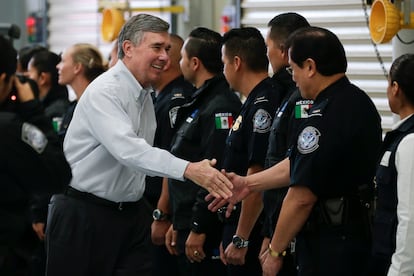
A. There’s no comparison to what had been done under the Obama administration or the Biden administration. I’m a huge defender and supporter of the Border Patrol. In the summer of 2014, we had 68,000 unaccompanied children crossing, mostly in McAllen, in the Rio Grande Valley. I saw those Border Patrol agents treat those kids and those families humanely. I saw them offer water and first aid. The Border Patrol’s morale right now is in the dumpster. And if you ask them, they would be more than happy to go back to the border, to doing what they are trained to do and what they’re pretty effective at doing.
Sign up for our weekly newsletter to get more English-language news coverage from EL PAÍS USA Edition









































