
Four migrants have died in ICE custody so far this year: ‘I never imagined my father would come out like that’
The family of one of the deceased says no one informed them he was in hospital, or even that he was sick. Now they are demanding justice
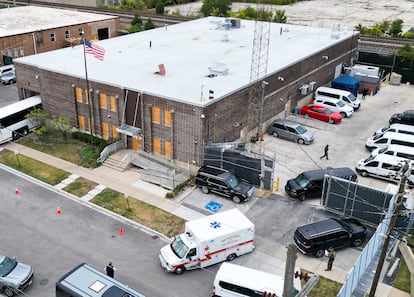

At noon on Tuesday, January 6, when she was hoping 2026 would be a better year, Josselyn Yáñez received a call from an officer with the Department of Homeland Security (DHS). The officer, politely, asked who she was — if she was the daughter of Mr. Luis Beltrán Yáñez-Cruz. “I told him, ‘Yes, I am his daughter.’” Then the officer said he was sorry to inform her that her father, a 68-year-old Honduran migrant who was in the custody of U.S. Immigration and Customs Enforcement (ICE), had died in the early morning. From one day to the next, her father was no longer just her father, but one of the four migrants who died during the first 10 days of the year after being detained by immigration authorities.
“I asked him how, why... I had a thousand questions. I couldn’t believe it,” Josselyn tells EL PAÍS, visibly affected by a death the family never saw coming. “We are devastated. I had hoped my beloved father would get out of there, but I never imagined he would come out like that. I just hope justice is served for my father, because when they arrested him, he wasn’t sick; he got sick while he was in custody.”
Yáñez-Cruz’s last call to his family was on Sunday, January 4, when he spoke with his granddaughters. According to his daughter’s social media post, he was “happy and calm.” The day before, he had called her from the Imperial Regional Detention Center in Calexico, California, where he was being held after being transferred from Delaney Hall, New Jersey. On November 16 of last year, ICE agents arrested him. “For no reason, just for being Latino,” his daughter told her followers online. Her father was returning from breakfast at a place he frequented when the agents stopped him. “That’s when the nightmare began for my dad.”
In downtown Calexico, Yáñez-Cruz complained of stomach pains. “They just gave him pills, without knowing the cause of the pain, every time he ate,” his daughter recounted. He was also experiencing extreme fatigue. “He told me that he was short of breath when he walked. He complained, and they didn’t provide him with medical help.” The family never knew that Yáñez-Cruz had been transferred to hospital, his daughter told this newspaper.
A statement from the DHS reported that he had been taken to the Regional Medical Center two days before his death “to evaluate chest pain,” and was later airlifted to John F. Kennedy Memorial Hospital “for a higher level of medical care.” The official version maintains that, “despite medical intervention,” Yáñez-Cruz was pronounced dead in the early morning, at 1:18 a.m. Pacific Time. However, his daughter asserts that it was that same day that she learned not only that her father had arrived at the hospital “with heart problems,” but that he was ill. “He had no medical history, or at least he never told me that he suffered from any kind of illness.”
Yáñez-Cruz had arrived in the United States through the border at Eagle Pass, Texas, in June 1993. According to the DHS, he was deported, but later “re-entered the country without authorization” on an unknown date. “Between 1999 and 2012, he filed multiple applications for Temporary Protected Status, all of which were denied,” authorities stated. The Honduran’s offense was entering the country “without inspection, admission, or parole by an immigration officer.”
Today, the family can’t understand how a man who wasn’t “a criminal,” a “hard-working person,” could have ended up like this, with such a “strange” death, as his daughter said. “My heart still can’t grasp what they did to my dad, because he was a healthy man, without any medical conditions. He just arrived at that cursed place and started getting sick.”

Although the DHS publicly reaffirms its commitment to the people in its custody — to whom, it says, it “provides comprehensive medical care from the moment of arrival and throughout their stay,” in addition to other services such as “24-hour emergency care” — the truth is that these facilities have been the focus of complaints from the detainees themselves. They complain about the lack of medical services, standardized medicine, and the appalling conditions of a population that — at least until last December — reached the official figure of 68,440 people in custody.
A strengthened agency
Although the figures are inconsistent — ICE reports 18 deaths, while some media outlets such as The Guardian mention 35 — fiscal year 2025 ended up registering the highest number of deaths in detention in more than two decades.
In 2026, ICE is much stronger: it has doubled its staff from 10,000 to 22,000 agents and gained power with the economic boost provided under the so-called “Big, Beautiful Bill,” which increased its budget by more than $100 billion, making it the best-funded agency in U.S. history. Its agents have been given free rein to intimidate, arrest, and even attempt to kill citizens. The shooting death of Renee Good in Minneapolis last Wednesday has become a stark example of the deliberate way in which immigration agents — in this case, the officer who pulled the trigger belongs to Customs and Border Protection (CBP) — act with the backing of those in power. But ICE is also responsible for the deaths of four migrants in custody this year, some under unclear circumstances.
Among the deceased is Geraldo Lunas Campos, a 55-year-old Cuban national who arrived in the United States in 1996 and had been convicted of multiple crimes, some of them serious. He had been arrested by ICE on July 14, 2025, during a police operation in Rochester, New York.
Information released by the DHS states that Lunas Campos was pronounced dead at 10:16 p.m. on January 3 at the Camp East Montana detention center in Texas, after experiencing medical issues. On the same day he died, the Cuban national exhibited disruptive behavior while waiting in line for his medication, according to authorities. When he refused to return to his dormitory, he was placed in solitary confinement. Center staff observed him in distress and contacted medical personnel. “Medical personnel responded, implemented life-saving measures, and requested emergency medical services. Lunas was pronounced deceased by EMS,” they stated. Currently, “the cause of his death is under investigation.”
Luis Gustavo Núñez Cáceres, 42, a Honduran national, also died from cardiac complications on January 5 at HCA Houston Healthcare in Conroe, Texas. He had been transferred there from the Joe Corley Processing Center. ICE arrested him on November 17 during an operation in Houston. His recorded offense was entering the country illegally.
The official statement reports that Cáceres, 42, had been admitted on December 23 due to complications from congenital heart failure. On January 5, at approximately 4:31 a.m. Central Time, he died in the hospital. His brother, Marvis Núñez, told Telemundo that at the detention center, the Honduran man “did not have access to medication” to manage his condition. “He wasn’t treated in a timely manner, and his condition worsened,” he said. The family was able to see him for the last time through the glass of the emergency room.
The fourth person on the list of those who have died this year while in ICE custody is Parady La, a Cambodian migrant who arrived in the United States in 1981 as a refugee. Despite receiving legal permanent resident status, he lost it “after committing a long list of crimes over two decades,” according to authorities.
DHS reported that, following his arrest on January 6, La was receiving treatment for severe drug withdrawal at the Federal Detention Center (FDC) in Philadelphia. The next day, he was found unresponsive in his cell. “Local emergency medical services arrived and performed resuscitation efforts,” the DHS reported. He had been diagnosed with anoxic brain injury, post-cardiac arrest, shock, and multiple organ failure. La ultimately died on January 9 at Thomas Jefferson University Hospital. His body collapsed: doctors reported complete kidney failure and no brain activity.
Sign up for our weekly newsletter to get more English-language news coverage from EL PAÍS USA Edition









































