
The final days of a self-deportation: Deivy Alemán returns to Cuba as his daughter awaits open-heart surgery
The migrant was forced to leave after seven years in the US, during which he was unable to regularize his status. EL PAÍS joined the family in their farewell
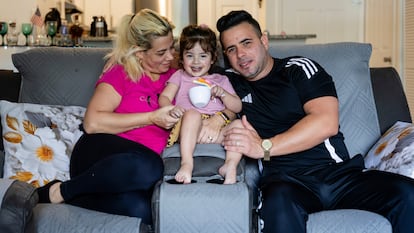

If you ask Deivy Alemán — now that he’s about to leave — what the most precious thing he wants to carry in the 23-kilo black suitcase that he’s having so much trouble packing is, he’ll answer without thinking, or rather, like someone who has been thinking about it for a long time: “My daughter!”
An awkward silence falls in the bedroom of the first-floor apartment in a modest building in Orlando, central Florida, and then someone jokes that Keira, his two-year-old daughter, would fit perfectly in the suitcase he’ll check in at American Airlines on Sunday, boarding a flight that will depart Miami at noon and arrive in less than an hour at Santa Clara Airport, Cuba. Deivy is self-deporting.
Not because they want to. No one voluntarily deports themselves anywhere. Deivy, 41, is being expelled from the United States by Immigration and Customs Enforcement (ICE). “It’s the only option ICE gave me,” he says, calm on the outside, but as if a volcano of anguish were erupting inside him. “They warned me: either I leave voluntarily, or they’ll detain me. But the only thing I want is to stay here, with my family, with my little girl.”
What does a migrant forced to return to their country of origin take with them, what do they choose from the many things accumulated over the years? A self-deporting Cuban doesn’t pack the same things as everyone else, nor does he return to the same place as everyone else.
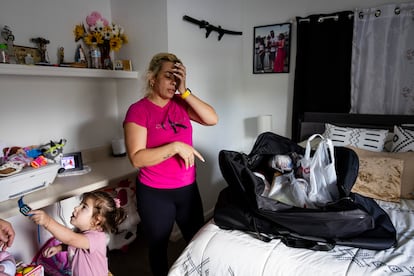
So the week before the flight, the family went shopping: they bought a box of light bulbs and a rechargeable fan to get through the island’s long blackouts, grabbed packs of La Llave coffee, toothpaste and toothbrushes, soap, and all kinds of medications. The rest of the suitcase will be filled with Deivy’s shoes and clothes, leaving enough space in the closet for his wife, Yisel Miguel, to fill as she sees fit.
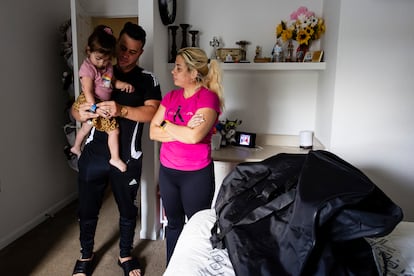
Keira wants to play with the box of rechargeable light bulbs, but someone takes it from her hands. The little girl doesn’t know her father is leaving. Nobody can, or dares to, translate the departure into a language she can understand.
Yisel, 38, skilled and resourceful, who even learned to insert Keira’s feeding tube during the months in the hospital after she underwent her first open-heart surgery, feels unable to explain to her daughter what the house will be like starting Monday. It will be spotless, fragrant, meticulously tidy, and decorated with family portraits and bouquets of flowers. Nothing will be the same, they are aware of that.
Midmorning, Keira heard the front door open and ran out, throwing herself into her father’s arms. He does the same thing every day, as a ritual, when he finishes his job as an Uber driver, retracing the hours of Orlando’s quiet early morning, traveling without a GPS, as if he’s known this place his whole life. Sometimes, when Deivy goes to take a bath, Keira sneaks in to play underwater. She makes him take the toys out of the living room drawer, scatter them on the floor, and put them back in order. Deivy, who has a 15-year-old son, Alex, in Cuba, was afraid of becoming father to a girl.
But Yisel can confirm that, besides her own, Deivy is the best dad she’s ever known. He’s also been that way for Adriana, her other daughter, now 13, whose biological father never acknowledged her. Yisel has seen Deivy crying only twice in their five years together: during the first birthday he spent away from Alex when he arrived in the United States, and at AdventHealth Children’s Hospital in Orlando, when they found Keira’s chest open. They looked and couldn’t believe what they were seeing: the five-month-old baby’s heart, beating, surrounded by tubes and wires, while she slept soundly through her parents’ nightmare.

A girl who has been sick since birth
Yisel received a Facebook friend request in 2020. She hardly accepted anyone, but Deivy was Cuban like her, from Cienfuegos. Yisel worked at a Youth Computer Club; Deivy worked at a meat processing plant in Palmira. They had arrived in the United States the year before. She was on a family bond, he was traveling through Central America until they reached the Mexican border. He seemed trustworthy, so she accepted him as a friend. Then, every time she posted a photo with Adriana, Deivy was the first to leave her a heart. “One day I thought to myself: who could this guy be?” Yisel says. She checked his profile in detail. “I saw him and thought: oh no, wait, I have to write to this guy.”
What comes next is easy to summarize: Yisel, who never wanted to assign a father to Adriana, saw that they had “great chemistry.” So much so that the girl, who arrived home from school a little while ago and sat down at the table for dinner, wants to go with Deivy when he leaves for Cuba on Sunday. “I’m sad,” she says, her voice cracking as she cries, pained. “The first time I met him, I thought it would be weird, but the years went by, and I saw that he cared for me, that he supported me, that’s why I love him so much.”

They moved together to Orlando. Keira was born. In 2023, Deivy was a worker at Zaza’s restaurant and Yisel was a saleswoman at a tobacco kiosk, both located at Orlando International Airport, the largest in the state, which that year welcomed more than 57 million passengers, most of them excited to live out their Disney fantasy under the sweltering Florida sun. They were okay. They were, they say, fighting for a better future. Until they had to quit their jobs and take up residence at AdventHealth Children’s Hospital. He would give Uber rides, stop by the house, pick up groceries, and catch up with Yisel so they could sleep together on the hospital ward couches where they lived for two months next to Keira.
The girl was born with a serious congenital heart condition, consisting of an absent tricuspid valve. According to the diagnosis made by cardiologist Kelvin Lee, who has been treating her since birth, “half of her heart didn’t develop when she was born,” according to a document provided by the girl’s mother.
At 5:00 a.m. on June 27, 2023, the parents arrived with their daughter at the hospital. They were about to perform a procedure called Bidirectional Glenn surgery to connect the heart’s superior vena cava to the pulmonary artery. Yisel heard a nurse in the waiting room say that her daughter still tested positive for Covid, having been infected a few weeks earlier at that very hospital. The mother, dismayed, asked if they were still going to operate on her. A doctor told her yes, that it wouldn’t be a problem if she was asymptomatic.
“We handed her over, laughing and happy,” says the mother of her daughter. The operation began at 7:00 a.m. Deivy, who has difficulty speaking, sums it up quickly: “That was the hardest day of my life.” Hours passed, and no one said anything to them. If they asked, they were told the doctors “were working.” At 6:00 p.m., the surgeon informed them that there had been a “complication,” that the girl was in “intensive care” after developing pulmonary hypertension.
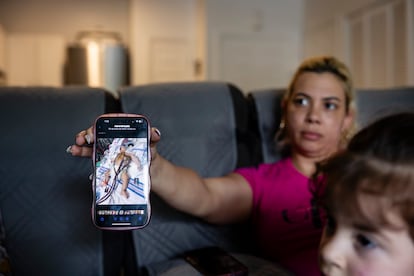
The parents collapsed when they were allowed into the room. “I never imagined we would see my daughter the way we did,” Yisel says. “I still wonder where I got the strength to be by my daughter’s side.” She later asserts that Deivy provided her with it. “If he hadn’t been with me during those two months in the hospital, I don’t know if I would have made it. There were days when I was strong, and he was broken, but other times he lifted me up.”
Over 10 days, Keira had eight emergency surgeries. Sometimes the red alarm would go off and the surgeons would rush in. Her parents would stay by Keira’s side, whose heart would race if they got too close to her bed, but who would still delight in having someone speak in her ear.
Two months later, the family returned home. Deivy worked while Yisel took care of Keira’s oxygen, the feeding tube she still had connected, and her 18 daily medications. The girl recovered. In February 2024, she underwent a second surgery at Johns Hopkins All Children’s Hospital in Tampa to continue the procedure they were never able to complete. According to the document issued by Dr. Lee, Keira will need “at least one more complex heart surgery in the coming years, as well as multiple additional procedures.”
Now that he’s about to leave, that’s Deivy’s biggest fear: that something might happen to his daughter and he wouldn’t be there to hold her, take her to the hospital, or spend the night together. He says this while looking at Keira, who climbs on top of him to watch television, or gets upset if he doesn’t pay attention to her right away. “If I’m not watching her, she starts screaming,” says Deivy, who drops everything to do his little girl’s bidding.
The farewell
This has been a tough week. Immigration authorities asked Deivy to appear at their offices on September 8. “They told me I had to bring them something or get a ticket and leave.” That “something” turned out to be a deportation stay. Deivy has been in the United States for seven years under I-220B status, an Order of Supervision for immigrants who, like him, have received a deportation order. It was the decision of U.S. authorities after he had crossed the border illegally during Donald Trump’s first term, a status many received during that time.
He was also detained for nine months. “I got out and thought that once they gave me my license and work permit, I’d never leave,” he says. “I thought if they didn’t deport me in that time, I wouldn’t leave. But when Trump got in again, I knew things were going to get complicated. I came in with him as president, and I’m going to leave with him.”
On September 8, outside the Orlando immigration office, Yisel sensed something was wrong: her husband was taking too long. The officers had rejected Deivy’s deportation suspension request, disregarding his I-130 petition, filed by his U.S. citizen wife, or the other documents proving he is the sole supporter of the family and carer for his ailing daughter.
The authorities put another option on the table: detaining him, like the nearly 60,000 migrants who have been held in centers across the country for months. “But I told him I’d rather see him in Cuba than in a detention center; he’s not a criminal,” Yisel says. The last option was a ticket, which he had to buy for $428. The officers also asked him to send a photo as proof that he was in Cuba. “That’s the hardest thing you can hear,” Deivy says, sadly. “It’s hard to leave them practically alone. The worst part is the girl.”
The days fly by. On Tuesday, already informed that Deivy was leaving, the couple went to renew their lease. Yisel asked to move to a smaller, more affordable one-bedroom apartment. “I explained the situation to them, but they told me that if I’m not working and don’t have any money, how am I going to make a downpayment for another apartment? And if I’m alone, they’re even less likely to approve it.”
The most likely outcome, Yisel thinks, is that she’ll end up leaving for Cuba, given that she won’t be able to pay for rent, food, electricity, or a car. She’s thought about putting her important things in storage and leaving with her daughters to return to where she came from. “If I stay here, where are we going to live? On the streets?” she asks. She also knows it would be dangerous to take Keira to a country experiencing a major health crisis, from where people are emigrating to save their lives. “But in Cuba, at least we have a home. I’d be praying that the girl doesn’t have an emergency, because there’s nothing in the hospitals there.”
Keira likes to sleep with her parents at noon. She loves it when Deivy feeds her. The three of them always do the shopping together. At home, they divide the kitchen duties: she makes the rice dishes and he makes the meats. Yisel is exhausted. She keeps turning her face away and wiping her eyes so Deivy doesn’t see her. “She spends the nights crying, she barely sleeps. I ask her to calm down, but she’s worried about everything,” he says. Keira has her appointment with the cardiologist on October 14.
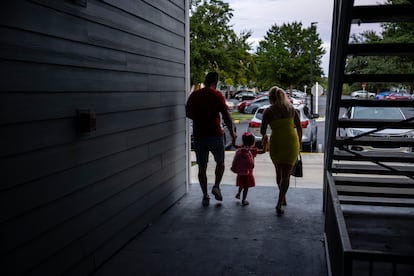
In Cuba, Deivy will be met by his parents, who are both over 80 years old, and Alex, the son he lost sight of as a child, when he left, believing it was forever. Alex is happy and nervous, he said in a video call. He too will meet him at the airport.
In the days he had left in the United States, Deivy worked as many hours as he could to leave money for his family. On Saturday, he parked his car, and they drove in Yisel’s to Miami, where they spent the night. How do self-deported people and their families prepare for the moment of departure? They both look at each other, unsure of what to say. Yisel interrupts the moment and asks, “Does anyone want some coffee?”
Last Sunday, they arrived at the airport early. They all hugged. Keira saw her father walking away. She shouted to him. Her father waved goodbye. Then Yisel and the girls returned to Orlando. At home, Keira asked her mother to open the door. Her mother explained that her father wasn’t there. The girl insisted. Her mother assured her that her father was at work. The girl burst into tears, as if she knew. There would be no one to wait for in the middle of the morning.
Sign up for our weekly newsletter to get more English-language news coverage from EL PAÍS USA Edition









































