
Jessica Ruiz’s life since her husband was detained by ICE: The weight of business, home, and three children
It is presumed that among the nearly 60,000 people in immigration custody, the majority are men, which complicates life for many women who must now deal alone with work that was previously shared
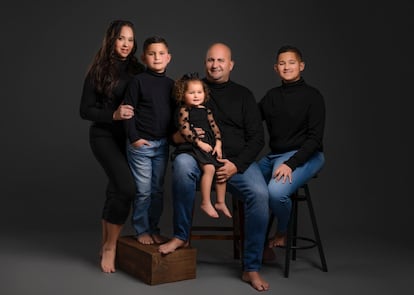

The client’s confession came days after Immigration and Customs Enforcement (ICE) arrested her husband. “I’m going to tell you the truth,” the client said. “No one wants to give you trucks because everyone knows Tony is in custody, and they’re afraid you’ll keep the money from what we do and not pay us.” Things have changed lately: now she, Jessica Ruiz, a 35-year-old woman, is at the helm of the family trucking business, All Coast Express, responsible for shipping all the vegetables from California to Miami that locals buy at Publix markets, or that vacationers eat on cruise ships departing from South Florida, or that are served in the county’s many schools.
One morning, Jessica received another devastating piece of news from her best client. “He told me, ‘I’m sorry, I understand the situation, but I’d rather continue when Tony gets out.’” Another client let her know he would give her “a vote of confidence,” but only if she made a prompt payment. Jessica agreed. “I needed him to trust me, in the good work I’m going to do.” In a business geared toward strong men, capable of spending days on the road, dealing with sleep deprivation, transactions, and dollars, Jessica is almost an outsider. “In the trucking industry, unfortunately, we women are labeled as not capable, we’re not well-regarded, they think we’re not going to do things well. This is supposedly a job for men.”
In addition to raising their three children, working for a car export company, and pursuing her psychology studies, Jessica now also handles the duties that usually fell to her partner, Antonio Lopetegui. “In the business, he was a key player,” she says. He was in charge of coordinating drivers, checking routes, communicating with clients, supervising trucks, and performing maintenance work. “It’s a very stressful job. Finding myself like this, leading a company where I didn’t even know how to make an appointment to pick up some asparagus, has been frustrating. Sometimes I feel like my head is giving out,” Jessica admits. “Now everything has fallen on me. I’m the one who has to organize the routes, talk to brokers, resolve mechanical issues, manage the accounting, and keep the company afloat to support the family.”

Clients’ suspicions arose the day in July when The Miami Herald published a list of more than 700 people detained or on their way to the Alligator Alcatraz immigration detention center, which was built in Florida in just eight days and has a two-month deadline to close following a judge’s decision and the many accusations of inhumane conditions and environmental violations. People immediately began searching for their relatives and acquaintances on the list. And they found Antonio, whom they hadn’t heard from for days, among the many names. He was detainee number 664, and arrived at Alcatraz on July 10.
Seven days earlier, Jessica had accompanied Antonio to an appointment at Customs and Border Protection (CBP) near Miami International Airport. “It’s very sad to go with someone and return alone,” she says. Without any explanation, they told her they were going to detain him. It was the same office they both went to, year after year, seeking a definitive answer from the authorities to the problem Antonio found himself in when he was 21.
He had arrived in the U.S. with his parents in 2005, as beneficiaries of the visa lottery. At 16, Antonio was already working for McDonald’s and as a plumber. The incident that haunts him to this day occurred in 2008, when he was charged with two crimes, for stealing a total of $1,018 from a credit card. He never went to jail. “The judge saw him as so immature, so childish, that he gave him three months of probation and ordered him to do community service,” Jessica says. Six months later, the judge was satisfied and his case was closed.
Three years later, Antonio met Jessica. He was 25, she was 21. In 2014, they planned a trip to Cuba, wanting to bring their first child, barely one year old, home to the family. Upon his return from the island, he was detained by CBP at the Miami airport and notified that he had a pending case with immigration. “That’s how we learned he had to request a pardon from immigration for the crime he had committed.”
Since then, they’ve visited the same CBP offices every year. “They always told us that something would arrive in three months, that everything would be solved, but we spent eleven years waiting. Until today,” Jessica says. In all this time, they’ve hired six lawyers, but none of them could help them regularize their situation. Amid the detentions and deportations carried out by the Donald Trump administration, they sought one last lawyer to guide them through the process. They presented themselves to CBP. Wanting to play fair with the authorities, Antonio ended up in the hands of ICE, and Jessica was left with the burden of the house, the children, and the business.
Although there is no official figure for how many men and women the Republican administration has detained amid its anti-immigrant crusade, it is presumed that the majority of the nearly 60,000 people in ICE custody are men. The Mexican consulate in Los Angeles, for example, revealed that 85% of those detained in that city are men. Life then becomes complicated for many women, who are bearing a burden that was once shared.
“I feel like so much of this on my shoulders is going to take its toll,” says Jessica, who has lost about 22 kilos (50 pounds) in just over a month. “It’s not just the physical exhaustion, but the mental strain of facing alone the problems we used to solve as a couple, or that he solved by himself because it was his job. I miss him so much, especially with every decision, every sleepless night. I’ve never known since then what it’s like to get a full night’s sleep. It’s hard to wake up and find the other side of the bed still empty.”

Now Jessica is simultaneously the one who cleans the pool at their Homestead home, pumps air into the car tires, and takes care of the three children. She gets up in the morning, gets them ready, takes them to school, picks them up. “My oldest child came home from school and said to me, ‘Mom, our lives aren’t the same anymore, my dad’s missing,’” says the mother. “Antonio was always my perfect complement. He’s cheerier, more talkative, and I’m more earnest. We shared everything. One day he’d go to the market, another day I’d go, and so on. Now I have to be both mother and father at the same time. Guiding, correcting, comforting, and providing security even when I feel heartbroken myself.”
But the worst part has been explaining to the children why their dad isn’t home. Telling them he won’t be home for the night, or why he wasn’t there for the first day of school on August 14th. Telling them why their dad couldn’t leave the country for a trip, or why he couldn’t go on the Disney cruise they love. “The children don’t know anything about the problem. We always told them their dad couldn’t travel because of work, or because his passport hadn’t arrived.”
A few days ago, on Jessica’s birthday, Antonio asked his mother to buy flowers, a cake, and a card. “He always made breakfast every year and bought balloons for the kids to give me.” But this time she received a call from the Glades County Detention Center, where Antonio is being held awaiting his court date on September 11. “He said, ‘Jessi, this is really hard. I never thought I’d go through what I’m going through, and I don’t think I deserve it.’”
Jessica says Antonio always focused on raising his children so they wouldn’t make “the same mistake he made 16 years ago.” Together, they donate almost every month to St. Jude Children’s Research Hospital or to churches in Miami, or prepare food to distribute to the homeless, or donate supplies to schools. “We’re trying to raise them to be good children, to understand the sacrifices we make, to not make mistakes like their father did,” she says. “But if we make a mistake, don’t we have the right to second chances? We’re trying to do things right, but they won’t let us.”
Sign up for our weekly newsletter to get more English-language news coverage from EL PAÍS USA Edition









































