
No ICE in the Cup: Citizens at the forefront for rights and community at the World Cup
Grassroots groups across the United States have united in response to the potential presence of immigration agents at the tournament

The success of the World Cup depends on who you ask. Jennifer Li, director of the coalition Dignity 2026, which brings together dozens of national and international groups to advocate for a tournament that accounts for the communities that sustain it, knows this well. “I think that FIFA will call it a success. I think for soccer fans it’s going to be excellent: when the matches start and until the last whistle’s blown, we’re all going to experience a huge dopamine hit. But we can’t forget the people who actually live here because this World Cup is happening on the backs of these people,” she says over a video call a week before the ball starts rolling. Li coordinates and leads civil-society organizations working to ensure that the planet’s biggest sporting event guarantees the rights of workers and attendees, both now and in the future.
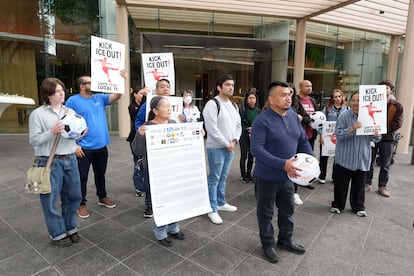
The fronts are varied, from public health issues to labor and housing rights. But perhaps the most talked-about has been the possible presence of U.S. Immigration and Customs Enforcement (ICE) agents at matches and, more broadly, at events surrounding the World Cup. Groups across the country have stepped up efforts after mobilizing since the start of Donald Trump’s second presidency in response to an unprecedented immigration offensive.
The script is similar everywhere. In Dallas, the group El Movimiento DFW has intensified training courses so people know their immigration rights, reinforced its hotline for support in the event of a detention, and distributed kits with whistles and information throughout the community. “While governments are preparing security plans, immigrant communities are also preparing emergency plans. Across the country, families are attending know your rights trainings. Parents are creating emergency contact lists. Volunteers are building rapid response networks. Attorneys are also organizing legal support. Community members are learning who to call if a loved one is detained or disappears into the immigration system,” says Azael Álvarez, an organizer with El Movimiento, who works in one of the areas of the country with the highest number of immigration detentions.
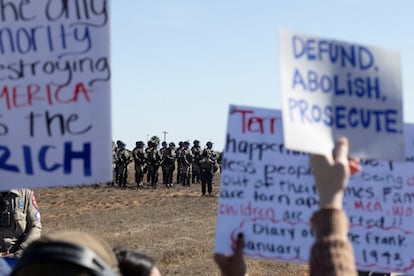
Texas has served as a kind of testing ground for immigration policies later applied at the federal level, says Jennefer Canales-Pelaez, an attorney with the Immigrant Legal Resource Center in Houston. In recent days, state law SB4 took effect after years of legal uncertainty, allowing so-called “peace officers,” who can range from a park ranger to a sheriff, to arrest anyone they deem to be in Texas without authorization. “In other words, it sanctions racial profiling,” Canales-Pelaez notes. “Our residents and visitors must exercise caution when driving in our city and state. So, please remember that everyone in the United States, regardless of immigration status, has rights under the Constitution. The most important being the right to remain silent,” the attorney warns, predicting a heavy law-enforcement presence.
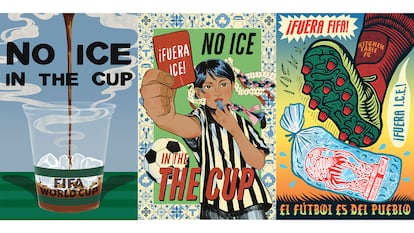
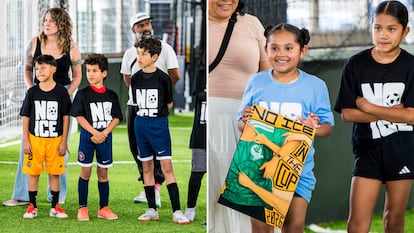
The “No ICE in the Cup” coalition, which brings together another 70 groups nationwide, combines the same community rights training agenda with strengthening support teams. But it also runs parallel, more positive initiatives focused on building community ties. “We just had a youth soccer tournament in Brooklyn where we partnered with a local New York City immigration organization. These small community events have large impact in the communities. What allowed the push back and the fight against ICE in Minneapolis to be successful, if we can call it that, was small intricate connections between neighbors. That is what we’re building here,” explains Paola Mendoza, an artist and coalition organizer who has been involved in these efforts since the Women’s March during Trump’s first term. On its website, posters made by artists can be downloaded and people can join the coalition in various ways or organize an open-to-the-public watch party.
Community preparation for potential immigration raids during the World Cup is, to some extent, preventive. Authorities have sent contradictory messages month after month about ICE’s presence in stadiums and their surroundings. While one member of the administration insists ICE will definitely be present, another denies it or backtracks, saying agents will only perform security-support roles. Some local officials in host cities have assured that local law enforcement will not collaborate in immigration enforcement, but elsewhere, such as in Texas, the opposite may be true. A recent Washington Post poll found that most Americans oppose ICE being present in stadiums. In any case, communities are preparing for the worst.
Organizations are also fighting for the labor rights of those who sustain the event. The most publicized case has been in Los Angeles, where SoFi Stadium has become the epicenter of union resistance. Yolanda Fierro, a hospitality worker at the stadium and a member of Unite Here Local 11, says that after more than a year trying to negotiate a fair contract, workers’ patience has run out. “The stadium does not want to give us fair, equitable wages for the jobs that we all do. We want fair monetary compensation so that we can take care of our families. As you know, everything in California is extremely expensive,” Fierro says.
Last Friday, 96% of union members voted in favor of striking during the World Cup, including during the U.S. national team’s opening match on June 12 at SoFi Stadium. The union also refuses to set aside the immigration issue: it demands a commitment that ICE agents will not enter the venue, a guarantee for both employees and attendees.
In Miami, Kat Passley, co-director of labor and formerly incarcerated persons rights group Beyond the Bars, denounces a more opaque structure of exploitation: the proliferation of temporary staffing agencies and subcontracting chains that dilute employer responsibility. “This system opens the door to wage theft, unsafe conditions, and, at worse, labor trafficking,” Passley says, drawing a direct parallel with rights violations documented during construction on the Qatar World Cup.
The contradiction between massive tournament investment and the neglect of residents’ basic needs is another recurring complaint. Nowhere is this more evident than in Kansas City, which has become a symbol of that disconnect with the construction of a new jail explicitly justified by the World Cup. Amaia Cook, director of Decarcerate KC, highlights the irony: “The city is rolling out the red carpet for visiting teams and tourists while rolling out fares [until recently public transport had been free], permits, and jail for the people who live here.”
In Atlanta, the memory of the 1996 Olympic Games acts as a living trauma shaping the current response. Michael Collins, director of PlayFair ATL, recalls how thousands of homeless people were arrested or bussed out to present a “clean” image to the world. Today, activists denounce that infrastructure improvements are designed exclusively for the spectacle, while residents suffer recurrent crises from collapsed pipes or lack of basic maintenance. Collins singles out what he calls the World Cup’s “original sin”: planning driven by corporations — such as Coca-Cola or Home Depot, both headquartered in Atlanta — that prioritize economic gain over residents’ well-being.
In an effort to measure each host city’s performance, Dignity 2026 has developed a scorecard together with Georgetown University. This system does not rate sporting performance; instead it uses 20 indicators — based on FIFA’s own human-rights standards — to measure whether host cities meet criteria such as living wages, access to housing, and protection from discrimination, drawing on the direct experience of local people.
The scorecard, Jennifer Li explains, will live long after the final in New Jersey ends to reflect that the real success of this World Cup will not be measured in FIFA’s ledgers but in the social and infrastructure legacy it leaves in the cities. Likewise, leaders of the coalitions and civil-society organizations involved at various levels emphasize that July 19 will not mark the end of their work. On the contrary, they all agree, the World Cup has been the perfect excuse to organize, strengthen unions, protect the right to housing, and improve public health over the long term.
The goal goes beyond this World Cup or other upcoming sporting events, such as the 2028 Los Angeles Olympic Games. In fact, much closer on the horizon are the November midterm elections, when they hope these community — and national — networks and connections will help reinforce grassroots resistance to the Trump administration.
Sign up for our weekly newsletter to get more English-language news coverage from EL PAÍS USA Edition









































