
The Orion spacecraft’s daring mission: Traveling to the Moon on its first crewed flight
Having never been tested with astronauts, the space capsule’s heat shield and life support system are raising concerns after problems were detected in the unmanned Artemis 1 mission
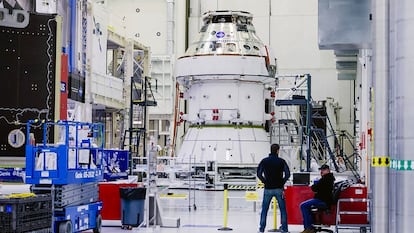

Reid Wiseman, Victor Glover, Christina Koch, and Jeremy Hansen are about to become the first humans to travel to the Moon in more than half a century. But this feat of the Artemis 2 mission comes shrouded in uncertainty: the spacecraft that will transport them has never carried astronauts before, and certain technical problems on its previous flight have raised concerns among some experts.
Orion is currently the only spacecraft capable of carrying humans into deep space and returning them safely to Earth. Its design meets the extreme demands of a lunar mission: protection from solar radiation, the ability to re-enter Earth’s atmosphere at speeds of up to 25,000 miles per hour, and life support systems that must function for nearly 10 days in a vacuum. It is composed of 355,056 individual parts that must work flawlessly. And therein lies the problem: many of these critical systems have never been tested with humans on board.
The biggest concern is the spacecraft’s heat shield, the barrier that will protect the astronauts when — in the final stage of their return to Earth — the capsule plunges into the atmosphere at breakneck speeds. During reentry, the exterior of the spacecraft will reach temperatures exceeding 2,700 degrees Celsius.
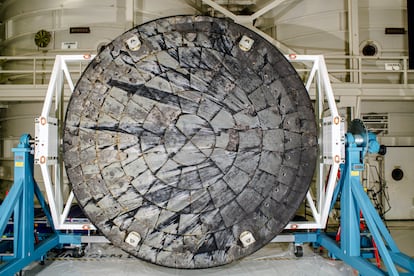
The Artemis 1 mission, launched in November 2022 without a crew, revealed that the heat shield coating had deteriorated more than anticipated. NASA’s simulation models had underestimated the damage. Two years later, the agency’s inspector general again raised concerns about this issue and its potential impact on astronaut safety on a crewed flight, such as this one. NASA identified the cause of the problem in December 2024: the unexpected loss of charred material on the heat shield was due to a buildup of gases. But the agency asserted that subsequent testing demonstrated that “the issue was not a general design flaw or a risk to the crew”: sensors indicated that even if astronauts had been on board, “they would have been safe and temperatures inside the cabin remained well below critical limits.” A few days later, NASA determined it was safe to proceed with the crewed flight.
The agency had another option: to install the improved coating designed for Artemis 3 on Artemis 2. But the tight schedule prevented it. So it opted to modify the spacecraft’s entry angle into the atmosphere to minimize wear. It’s a decision that doesn’t convince everyone. Astronaut Charles Camarda, a member of the first space shuttle flight after the Columbia disaster and a heat shield specialist, sees in this decision “the exact behaviors” that caused the Challenger accident in 1986 and the Columbia tragedy in 2003. Camarda participated in the meeting where the decision was made to proceed with the launch, but maintains that Artemis 2 “should not fly as it is currently designed.”
The heat shield isn’t the only unknown. Orion’s Environmental Life Support System (ECLSS) also hasn’t been fully tested under real flight conditions. This system — part of the service module designed by the European Space Agency (ESA) — will provide breathable oxygen, drinking water, and nitrogen to the four crew members during their nearly 10-day mission. Without it, the crew wouldn’t survive even minutes.
Life on Orion
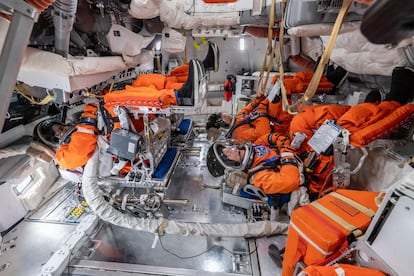
Inside Orion’s cabin, with a habitable volume of just nine cubic meters — roughly the equivalent of two minivans — the astronauts will be completely dependent on these systems functioning. The service module includes a water dispenser and a food heater for the pre-packaged meals the crew will have selected before launch.
It also incorporates a new waste system: a space toilet that separates urine and feces. Urine will be discharged into space; feces will be stored in sealed containers for disposal upon return. And it will be the first time a spacecraft toilet features a door.
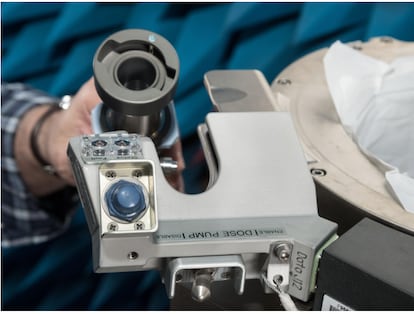
To keep the crew fit during the journey — the absence of gravity causes muscle and bone loss — Orion carries a flywheel, a small 13.6-kilogram device installed under the side hatch that allows for resistance and aerobic exercises. Each astronaut will dedicate 30 minutes a day to exercise.
The Artemis 2 mission will also be the first opportunity for astronauts to take manual control. Wiseman and Glover, as commander and pilot, will be able to fly the Orion spacecraft periodically during the journey, a critical capability in case of automatic systems failure. Their seats will remain in position throughout the mission, while Koch and Hansen’s seats will be stowed after launch to free up space in the cabin.
The pressure on NASA is immense. The Trump administration wanted to move the launch up to February 6, several months earlier than planned, partly to deflect attention from the delays plaguing the Artemis program and the risk that China could land astronauts on the Moon before the United States, but fuel leaks during a crucial test forced a postponement to April.
Sign up for our weekly newsletter to get more English-language news coverage from EL PAÍS USA Edition









































