
US begins countdown to return to the Moon amid doubts over the risks faced by its astronauts
NASA will start the process to launch the first crewed mission to the moon in half a century next month in a new space race with China
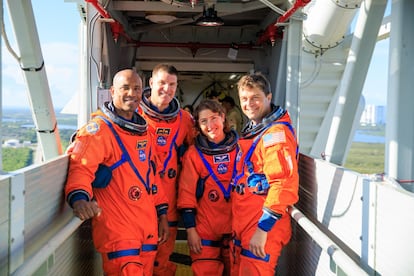

NASA has begun the process of launching the first crewed mission to the Moon in half a century. The decision coincides with an unprecedented crisis: an unspecified medical problem will force the evacuation of the International Space Station (ISS) crew in the coming days. This change of plans coincides with preparations to send the four crew members of the Artemis II mission to the Moon, while some astronauts are warning of alleged safety flaws in the Orion space capsule, raising the specter of a repeat of the worst fatal accidents in NASA’s history, such as those of Challenger, Columbia, or Apollo 1.
“We are moving closer to Artemis II, with rollout just around the corner,” said Lori Glaze, NASA’s acting associate administrator. “We have important steps remaining on our path to launch and crew safety will remain our top priority at every turn, as we near humanity’s return to the Moon.”
Artemis II is a test mission that will take the four selected crew members — Reid Wiseman (commander), Victor Glover (pilot), Christina Koch (mission specialist), and Jeremy Hansen of the Canadian Space Agency, also a mission specialist — on a round trip, orbiting the Moon once before returning to Earth about 10 days later. It will be the first crewed mission to test the SLS rocket, the largest built by NASA since the Apollo missions half a century ago, and the Orion spacecraft.
NASA has been working under enormous pressure since the Trump administration decided to move up the mission’s launch to February 6, several months earlier than planned. This is partly an attempt to deflect attention from the delay of Artemis III until at least 2028, with the risk that China could land astronauts on the satellite before Trump’s America.
In Artemis II, the main cause of concern is the Orion capsule’s heat shield, which protects the spacecraft and its crew during reentry into Earth’s atmosphere, when temperatures outside reach over 2,700 degrees Celsius.
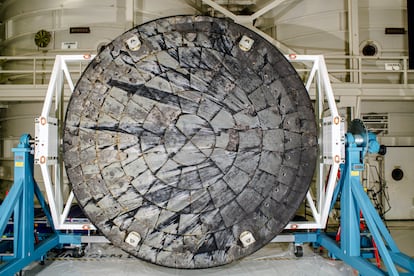
The unmanned Artemis I mission, launched in 2022, revealed that the spacecraft’s thermal coating deteriorated more than NASA’s simulation models had predicted. Two years later, an analysis by the agency’s inspector general again drew attention to this problem and its potential impact on crew safety.
The agency has decided to move forward after a meeting last week between NASA’s new administrator, Jared Isaacman, and specialists from both inside and outside the organization. One of the most vocal critics present at that meeting was astronaut Charles Camarda, who continues to believe that Artemis II should not fly in its current design.
Camarda was one of the crew members on the first shuttle flight after the Columbia accident, which disintegrated during reentry into the atmosphere in 2003, killing all seven crew members. That disaster was due precisely to failures in the heat shield, a component in which Camarda specializes. The astronaut sees in NASA today “the exact behaviors used to construct risk and flight rationale which caused both Challenger (1986) and Columbia (2003) Accidents. Using ‘tools’ inappropriately and then claiming results to be ‘Conservative,’” he wrote on LinkedIn.
NASA had the option of replacing the current coating with the one that will fly on the Artemis III mission, which will take four astronauts to the Moon in 2028, and which is different from the current one. But the configuration of Artemis II and the established timeline influenced the decision: to change the spacecraft’s entry angle into the atmosphere to minimize the possibility of the shield detaching and endangering the crew.
Another major unknown is the behavior of the Orion capsule’s environmental system, which, among other functions, provides oxygen to the crew during the journey. This system is part of the Service Module that the European Space Agency designed in collaboration with European companies for the Orion capsule. This environmental and life support system (ECLSS) has not been fully flight-tested, especially the system responsible for providing breathable air, which adds another layer of complexity to the potential risks of this mission.
On Friday, Isaacman, recently confirmed in his position after being removed by Trump for his ties to Elon Musk, announced that the agency will prematurely remove the current crew from the ISS because one of the astronauts is suffering from a health problem.
The agency has not revealed the identity of the person or their medical condition, although it has confirmed that they are in stable condition. This is the first time such a situation has occurred, increasing the pressure on the agency to coordinate the evacuation and replacement flights to prevent the space station from being left unoccupied, which would set a dangerous historical precedent since its inauguration a quarter of a century ago. Isaacman stated that this situation does not affect the current launch schedule for Artemis II, which could take place in just three weeks.
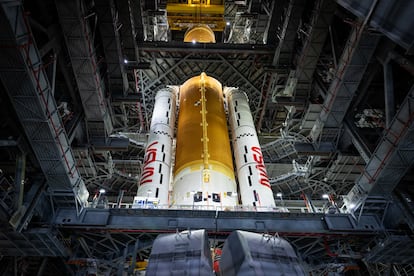
To meet its initial launch date, NASA will begin positioning the SLS rocket on the launch pad this Saturday. This colossal machine is nearly 100 meters long and weighs over 2,500 tons. Although slightly smaller than the legendary Saturn V that first carried astronauts to the Moon half a century ago, its power is greater. The journey of this behemoth from the assembly bays to launch pad 39B, a distance of about 4,000 meters, will take up to 12 hours.
Artemis II presents daunting technical challenges. The Orion capsule alone has more than 300,000 components that must be in perfect working order. Just this past weekend, NASA had to inspect two parts that were not in suitable condition. The slightest malfunction could halt the countdown and delay the mission. If all systems are in working order, the first test of the fully fueled rocket will take place at the end of the month. There will be several simulated countdown tests, and finally, the mission management team will meet to determine if all components are ready for flight. The first launch opportunity is fast approaching: February 6, in less than a month.
Sign up for our weekly newsletter to get more English-language news coverage from EL PAÍS USA Edition









































