
What wild honey bees in the forest can teach us
Scientists are increasingly drawn to unmanaged colonies of this species, which use a variety of strategies to protect themselves when left to live on their own
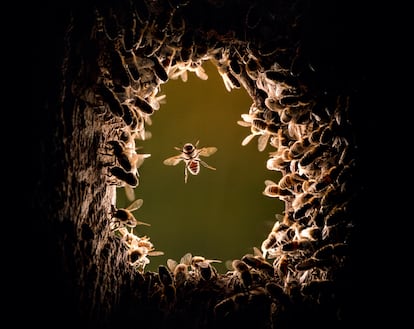

Of the more than 20,000 bee species that are estimated to exist in the world, none is as well-known as the honeybee, Apis mellifera, which was domesticated by humans millennia ago alongside goats, cows and horses. When we talk about bees, the majority of us think automatically of insects that live in hives that are tended by beekeepers wearing special suits that protect them from stings.
However, colonies of wild honeybees can also be found producing honey in tree holes and other cavities located in nature. This is one revelation from the book Wild Honey Bees: An Intimate Portrait by photographer Ingo Arndt and scientist Jürgen Tautz. The authors delve into the nests of these incredibly social insects in German forests in order to highlight the great importance of wild bee populations.
The first surprise for researchers studying these wild honeybee colonies in Europe is that there are far more of them than previously thought. Thomas D. Seeley, a pioneer in the field, had estimated that in the Arnot Forest in New York state, there was one tree inhabited by these pollinators per square kilometer. But what’s even more astonishing is their behavior and the fascinating defense mechanisms they employ when living independently.
For example, unlike what happens in beekeepers’ hives, bees in tree nests coexist with other species with which they form positive associations — such as pseudoscorpions, which feed on Varroa mites, one of the main parasites threatening pollinators. Although conservation efforts have long overlooked these insects — partly due to the overabundance of honeybees from beekeeping, a sector often regarded more as livestock farming — interest in wild colonies has grown significantly in recent years in both the United States and Europe. Especially so, given the rise in mortality among managed hives and the broader decline of many pollinator species.
“Honeybees that are kept by humans are under tremendous pressure from disease and parasites. Wild bees, apparently, can survive these challenges. By studying what contributes to the success of wild bees, we hope to learn how we can better support managed bees,” says Tautz, who is a professor emeritus at the University of Würzburg in Germany. “A second important aspect is that wild bee populations are shaped by natural selection, not human selection. Because of this, wild bees harbor a genetic wealth that could one day prove essential.”
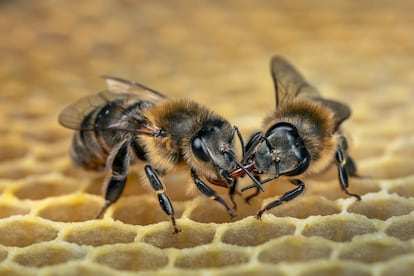
After moving to Spain, beekeeper Alejandro Machado — who was raised in Germany by a Spanish mother — read online that German researchers were looking for help in finding colonies of wild honeybees that nest in trees. “I wrote to them and said, ‘I’m in [the Spanish region of] Galicia and here, there are honeybees that live in trees, walls, utility poles…’” That’s how two of Tautz’s collaborators from the University of Würzburg, Benjamin Rutschmann and Patrick Kohl, began monitoring populations of the pollinators in Xinzo de Limia, in the Spanish province of Ourense.
The insects require cavities to nest, but are unable to make them on their own, so they often use holes that have been drilled into trees by woodpeckers. Bees select cavities high off the ground, which can protect them from bears. That makes it very difficult to locate and study nests that are scattered throughout forests. But in Galicia, German researchers discovered that it is easier to research wild bees that live inside hollow concrete utility poles, which are very accessible and easy to locate.
“In agricultural landscapes without natural nesting habitats, these poles act as artificial hollow trees,” says Rutschmann. According to a study published in Biological Conservation, after checking 214 poles, scientists found that 29 were home to colonies of Apis mellifera iberiensis. This darker-hued subspecies of bee is native to the Iberian Peninsula and, despite the growing popularity of higher-yield species in modern beekeeping, is still used in many beehives by the country’s beekeepers.
Concepción Ornosa, an entomologist who specializes in pollinators at the Complutense University of Madrid, distinguishes between two types of colonies that can be found in nature: truly wild bees, which have nothing to do with domesticated populations, “which are very difficult to find in Spain, but you never know,” and feral bees from swarms that have left beekeepers’ hives, which are, “very common here.”
Escapes of this second type are inherent to the species’ very nature: when colonies reach a certain population size, half of the bees leave the nest with a queen to search for a new settlement. In managed hives, beekeepers usually monitor the colonies and move them to a new box before this happens — but that doesn’t always occur.
“Finding resources in the area, such as certain flowers, bushes, grasses and nesting sites, honeybees can definitely thrive on their own, as they are very versatile,” says Ornosa. “In my classes, I always tell my students that the best conservation is non-intervention, that nature works better if we don’t interfere. Of course, sometimes you have to intervene to restore a landscape, but the more natural the environment, the better the species that live there will thrive.”
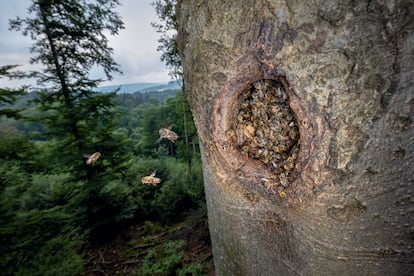
For Kohl, another German researcher who monitors forest colonies in utility poles in Xinzo de Limia, it’s still too soon to draw conclusions about these populations. “In general, you can’t tell forest bees from farmed bees based on their genetics or morphology in most parts of Europe,” he says.
“Therefore, a crucial question in our research is whether cohorts of wild colonies can form self-sustaining populations. That is, we study whether they would be stable over time based on their own survival and reproduction,” he continues. “What is generally accepted as a ‘truly wild’ population is one that does not depend on immigration of swarms from apiaries. For example, in the region we study in Galicia, based on observed survival rates, wild colonies would need to produce two to three swarms per year to maintain their population.”
Machado says that for several years, he has been seeing bees emerge from holes in utility poles. For him, this discovery, along with the work of Seeley and Tautz, has changed the way he looks at bees and hive management. Machado is against the use of bee species that are highly distinct from native breeds, such as the Buckfast, which are supposedly more docile and sting less. He is also against constant intervention in hives, whether it be feeding the insects or providing them with medical treatment. Instead, he tries to step in as little as possible so that his bees can live in a way that is more akin to their wild peers. “What I do is leave the honey for them,” he says. “There is a conflict of interest here, because the more honey you take, the more money you make. I don’t live off of honey and I don’t want to, for exactly that reason.”
One of the biggest surprises that can be found in Arndt and Tautz’s book is how, despite the many breeds and hybrids present in modern-day beekeeping, honeybees haven’t lost their wildness. “Why, after so many millennia of human beekeeping, are honeybees still not so different from their original form, like a Dachshund is from a wolf?” asks Tautz.
“Two factors explain this fact. In the first place, the bees’ reproductive biology and their mating behavior enormously complicates their breeding, as compared to livestock or pigs,” says the German professor. “In the second place, genetic distribution within a population and haplodiploidy as the basis for sex determination result in a system that is highly resistant to change. And when changes do occur, they happen very slowly. All of this prevents rapid evolution in bees.”
Sign up for our weekly newsletter to get more English-language news coverage from EL PAÍS USA Edition









































