
Rodents spread across the globe thanks to their thumbnails, study finds
Most ‘Rodentia’ have a nail on their thumb instead of a claw, which allows them to manipulate food
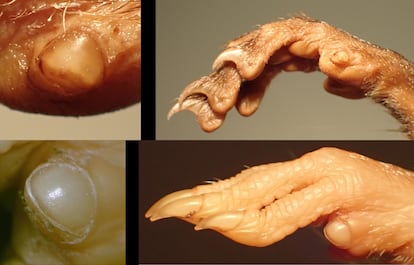

Tetrapods, living beings with four limbs — a group that includes humans — use their arms and legs to interact with their environment. They use their limbs to move, chase or escape, feed or fight, and reproduce. In mammals, reptiles, birds, and to a much lesser extent amphibians, their extremities end in keratin-rich structures. These take the form of claws, hooves, or nails. It had long been assumed that rodents had claws. But no: a large study published in Science shows that this is true for only four of their digits. On the fifth — the thumb —most have a nail very similar to that of humans. For the authors, this different big digit helped them conquer the planet.
Mice and rats belong to the order Rodentia, along with beavers, moles, and hamsters. With just under 2,500 species, they make up 40% of all mammals. They are found on every continent except Antarctica. They have adapted to every environment: terrestrial, like capybaras; aquatic, like the muskrat; arboreal, like squirrels; or subterranean, like the naked mole rat. Scientists have always pointed to their powerful incisors — which never stop growing — as the key to their success: they allowed rodents to occupy a dietary niche that other mammals either ignored or could not exploit, namely hard-shelled fruits and seeds. But something was missing in that explanation — and it turned out to be the nails.
A group of biologists hypothesized that, along with the incisors, the thumbnail may have enabled rodents to handle these small, hard foods. To test this, they scoured some of the world’s leading natural history museums — such as those in London, New York, and Chicago — searching through drawers for rodent specimens. They found representatives of 433 genera out of the 522 that exist within Rodentia. (The genus is a taxonomic category above species; in the case of humans, we are the only surviving species of the genus Homo.) When examining the feet, they discovered that 86% of rodents have nails — but with a peculiarity: only on the thumb.
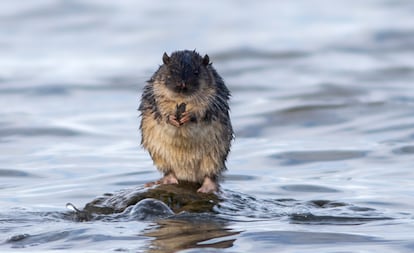
“Among the species analyzed, all those with a thumbnail have claws on the other fingers,” says Rafaela Missagia, an evolutionary biologist from the Laboratory of Functional Morphology and Macroevolution at the University of São Paulo in Brazil and first author of the study. “This pattern appears to be characteristic of rodents, unlike other groups of mammals, where species typically have nails on all fingers [like primates] or claws on all fingers [like rabbits, colugos, and tree shrews],” she explains in an email.
The key lies in how they eat. Researchers reviewed whether rodents feed using only their mouths or both mouths and paws (oromanual feeding). Most species that eat only orally turn out to have either a claw or nothing at all on the thumb. “Often, the thumb appears as a rounded protrusion. In some species, it may be completely absent, as in capybaras and guinea pigs,” explains Missagia. But all those with nails on their thumbs use both hands and mouth to feed.
Everything suggests that a thumbnail gives rodents manual dexterity in much the same way that an opposable thumb gives it to humans and other primates. “Unlike claws, which are long and curve over the fingertips, nails are shorter and broader, resting on the sensitive, vascularized pads of the fingertips. This probably allows them to grip better and manipulate objects more precisely,” says the Brazilian scientist, also a researcher at the Field Museum in Chicago, which houses one of the world’s largest collections of living and extinct rodents. As it happens, only primates and rodents have nails.
For rodent specialists, their success in diversification and global spread is due to their ability to exploit resources that faced little to no competition, such as seeds and nuts. “These foods, like acorns, are difficult to obtain, and rodents are known to manipulate them thanks to their strong incisors and jaw muscles,” says Missagia. “But we believe that’s not the only reason. The presence of the thumbnail may improve grip, working together with the incisors to give rodents better access to these difficult resources.”
It’s just a hypothesis, but the fact that the researchers discovered that species without thumbnails don’t handle food points to a functional connection between having this appendage and manual dexterity. Furthermore, when examining fossil rodent specimens, they found that the oldest examples already had this distinctive big digit. In fact, everything indicates that in their evolution, thumbnails came first, followed by claws.
Gordon Shepherd, a neuroscientist at Northwestern University in the United States and senior author of the Science study, acknowledges that before this research, it was known that some had nails, others claws, and some lacked thumbs altogether. But what they did not expect was for the thumbnail to be almost the norm. “My lab studies how mice manipulate food, and I became interested in the structure-function relationships of hands and thumbs,” he says in an email.
That intimate connection between anatomical form and function — a key factor in the evolution of humans and great apes — brings primates and rodents closer together, but only to a point.
“Primates, and especially humans, possess exceptional manual dexterity to manipulate objects with the fingers of one hand, thanks to the opposable thumb,” he notes. But, he adds, “rodents are quite different: their manual dexterity, such as food handling, involves grasping and manipulating objects with both hands, mainly using the thumbs.” In fact, he concludes, “recent studies of the motor cortex reveal both similarities and differences in the brain circuits related to dexterity in mice and primates.”
Sign up for our weekly newsletter to get more English-language news coverage from EL PAÍS USA Edition









































