
Killer whales hunt following ‘a geometrical pattern’: They divide roles to stun their prey
A team of scientists has documented for the first time how a pod of orcas in Norway work in pairs to enjoy a feast of herring
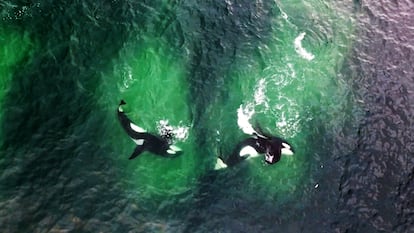

North of the Norwegian fjords, a pod of orcas has perfected the art of hunting Atlantic herring. Every spring, when ocean currents carry the fish into these waters, the killer whales seize the opportunity to feed intensively in a true underwater feast. Although they are skilled at catching prey on their own, their real strength emerges when they hunt in pairs — coordinating their movements with mathematical precision and stunning their slippery victims with tail slaps. This is revealed in a study showing how orcas have developed cooperative bonds that go beyond caring for their young, increasing their feeding success — and, by extension, their chances of survival.
During the “strikers” phase, the orcas adopt a position that follows a “geometrical pattern,” according to research published in the journal Current Biology. As if performing a choreographed dance, the pairs swim together in alignment. Their snouts are pointed in the same direction, tracing a distinct triangular shape in the water. The larger individuals take the lead and, with a powerful thrust, drive their rear ends forward, delivering a tail strike that reverberates through the water. The blow is not random — it is aimed at dense schools of herring, compact masses of thousands of fish that move as a single entity.
The impact breaks the cohesion of the school, as many of the fish are left stunned. At that moment, the smaller orcas take on the role of helpers, moving in to corral the weakened prey, thereby making the hunt easier. Males, in fact, tend to participate in these roles more than females. “We need more observations to confirm this trend. It’s an open question,” Paolo Domenici, lead author and researcher at the Institute of Biophysics (IBF), told EL PAÍS when asked why this gender difference exists. This formation, which shows precise coordination between the orcas, dissolves once the herring have been trapped.
The division of tasks is linked to feeding efficiency, as those executing the tail slaps tend to be more successful at stunning the herring, according to the study by the IBF of Italy’s National Research Council, in collaboration with the NGO Norwegian Orca Survey in Norway and the University of Hawaii. These cooperative hunting mechanisms observed in orcas around the islands of Andøya — part of the Vesterålen archipelago— and Vengsøya had not been documented before. Scientists, using drone footage captured between 2016 and 2017, found that this cooperative hunting is defined by complex spatial and social organization.
The aerial footage allowed the researchers to witness the hunt almost as if they were watching a volleyball game from the stands of a sports arena. “There is very close cooperation between them, but they don’t do it with all the orcas in the group — it’s two at a time. They position themselves at a very precise distance,” says Domenici.
This division of roles allows for repetition and refinement of the technique, which ultimately improves hunting efficiency. The study suggests that the orcas involved in the tail slaps tend to maintain stable and long-lasting social bonds that can extend for decades.
Bruno Díaz, a PhD in Ecology and founder of the Bottlenose Dolphin Research Institute, believes that although the discovery of cooperative hunting isn’t entirely new, it is a significant confirmation of orcas’ social behavior. “Orcas live in groups for various reasons, and among these is cooperation when it comes to capturing food, which results in success for the group members,” says the expert, who was not involved in the study.
Carousel feeding
Since the 1980s, the study of these orcas through photo-identification has made it possible to document their feeding patterns and techniques. Among them stands out the technique of “carousel feeding,” in which orcas cooperate to herd herring into a dense ball within the first 20 meters of the water column. The exact way in which they coordinate these actions had long been a mystery to scientists.
To keep the fish together and make them easier to catch, the pairs use tail slaps underwater. In general, orcas employ “different hunting techniques,” notes Bruno Díaz. “They are highly specialized and will use different strategies,” he adds. Similar behavior has been observed in humpback whales, which maintain long-term pair bonds, with a complex social structure and consistent patterns in their hunting strategies and feeding behavior.
Another recent drone-based study shows that common porpoises also hunt in groups with a division of roles. At least, this is what researchers observed in each recorded hunting event. The authors argue that, along with their findings and earlier research on humpback whales, social relationships play a more important role in feeding behavior than previously thought.
Sign up for our weekly newsletter to get more English-language news coverage from EL PAÍS USA Edition









































