
How USAID cuts left Nepal’s children exposed to deadly floods
The country is searching for thousands of missing people as criticism mounts over the cancellation of Washington-funded programs that helped the country both prevent and respond to extreme events
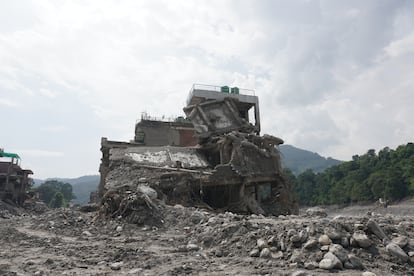
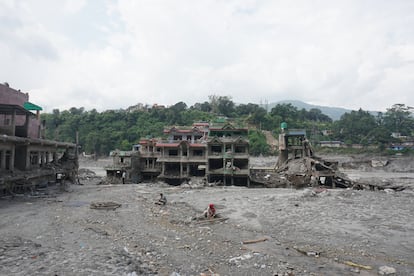
At an emergency shelter in central Nepal, Chhiring Mhendo Tamang stares at a photograph of her six-year-old daughter. She fears she will never see her again after the school bus she was on was swept away by a flash flood. A glacier collapsed on August 26, causing an avalanche of mud, rocks and water to rush into a river on the border between Nepal and Tibet. The flood has so far caused 1,451 deaths with 5,745 people missing, mainly in the districts of Rasuwa, Nuwakot, and Dhading, where homes, schools, electrical infrastructure and roads have been decimated, according to Nepal’s National Authority for Disaster Risk Reduction and Management (NDRRMA).
Seven members of Chhiring’s family went missing that day, including her husband, 30, and her youngest daughter. Her eldest daughter, 14, survived, as did Chhiring’s son, who had stayed home because he was ill. “I carry with me the weight of thinking that I could have saved them if only I had been by their side. My heart refuses to stop waiting for them to come back,” says the 30-year-old, who was working as a domestic maid in Kuwait when the tragedy struck. She came home as soon as she received the news.
“I carry with me the weight of thinking that I could have saved them if only I had been by their side”Chhiring Mhendo Tamang, a mother who lost her youngest daughter and her husband in the flood
Chhiring’s youngest daughter was one of more than 17,000 children affected to various degrees by flooding in the three districts, according to UNICEF. Authorities say they could have been better protected from the scale of loss and damage if foreign funding for climate change mitigation and adaptation had not been cut, especially given that researchers say global warming likely contributed to this latest catastrophe.
Since 2010, SERVIR–Hindu Kush Himalaya, a joint NASA-USAID initiative managed by the International Centre for Integrated Mountain Development (ICIMOD), based in Kathmandu, Nepal’s capital, had funded critical early warning systems across the region. These included tools that could forecast river flow up to 10 days in advance, warn of flash floods in smaller tributaries up to 54 hours in advance, map flooded areas in near real-time, and track land cover in Nepal.
Other U.S.-funded projects complemented this work. These included the $30 million USAID Biodiversity project, dubbed Jal Jangal, which protected river basins and carbon-storing forests. Also included was the $18.75 million USAID Urja Nepal Project, which supported clean energy and ecotourism to develop more resilient livelihoods for locals.
Together, these programs funded long-term climate change mitigation and adaptation measures across the country. But they came to an abrupt end in January 2025, when U.S. President Donald Trump paralyzed foreign aid and issued stop-work orders on USAID-funded projects around the world, as part of a broader withdrawal of U.S. climate and development spending overseas.
These programs directly supported Nepal’s climate policies and its National Adaptation Plan, the country’s official roadmap for preparing for the effects of climate change, according to Maheshwar Dhakal, a spokesman for the Ministry of Agriculture, Forestry, and Environment. While the projects could not have completely stopped the floods, they could have limited the destruction through the development of community-led adaptation measures, increased climate awareness, and funding for key research.
Scarce national funding
An assessment by the World Weather Attribution (WWA) group of researchers, which quantifies to what extent global warming is a factor in extreme weather events, shows that rapid warming in the region during the years before the floods had reduced the depth of glaciers, thereby melting the ice and permafrost buried deep in the Himalayan rock.
“Addressing adaptation needs, loss, and damage depends on financing channels working together while mobilizing international solidarity finance at a scale and speed that responds to the needs of vulnerable countries,” say the WWA researchers.
Without foreign funding, Nepal will struggle to pay for its own climate change mitigation and adaptation measures. The government’s preliminary damage assessment estimated the economic impact of the disaster and reconstruction needs at between $2.7 billion and $4.8 billion, about one-tenth of Nepal’s annual GDP.
Nepal’s public debt rose from around 25% of GDP in 2016 to about 48% in 2024-2025. Debt servicing alone absorbs about a fifth of the national budget. This means that the money is used to repay previous loans rather than rebuilding roads, restoring electricity supplies, or financing the kind of early warning systems and adaptation measures that were previously supported by foreign donors.
“Trump’s decision to withdraw funding from USAID encourages other major economies to think that international commitments are purely optional,” says Abiral Khatri, a Kathmandu-based climate finance researcher. “The ripple effect reaches markets like Nepal, which were counting on that capital eventually reaching climate-related infrastructure.”
When international funding is abruptly cut, ongoing projects come to a standstill, destroying years of accumulated momentum and significantly rolling back Nepal’s developmentRamesh Chandra Paudel, professor of economics at Tribhuvan University in Kathmandu
The loss of predictive data provided by SERVIR–Hindu Kush Himalaya proved catastrophic when the flood water hit, says Binod Parajuli, a senior hydrologist at Nepal’s Department of Hydrology and Meteorology. “The early warning was delayed because we didn’t detect the flood in time,” he explains. “Without an active system to track these types of high-altitude threats, any continuous monitoring program would have helped save lives.”
Dr. Ramesh Chandra Paudel, a professor of economics at Tribhuvan University in Kathmandu, believes that developing countries such as Nepal have become highly dependent on USAID over the past few decades and have outsourced significant public investment to foreign donors. “This long-term dependence eroded domestic investment capacity, and meant the country’s tax revenues were insufficient to finance large-scale climate adaptation measures. When international funding is abruptly cut, ongoing projects come to a standstill, destroying years of accumulated momentum and significantly rolling back Nepal’s development,” he says, adding that China is likely to fill the financing gap.
“Children are paying the price”
The U.S. has emitted about a quarter of all the CO₂ released in the world since the start of the industrial age, the largest cumulative contribution of any country. By contrast, Nepal has contributed only a tiny fraction of global CO₂ emissions: a mere 0.01 percent, according to data from the Global Carbon Project.
“We did not create this crisis. However, we are paying a huge price for it,” Nepalese Prime Minister Balendra Shah told the United Nations General Assembly on September 24, calling for grant-based rather than loan-based support to help his country recover from the floods. Shah put the costs of recovery and reconstruction at around 10% of GDP and said current mechanisms, such as the United Nations Fund for Loss and Damage, were “totally insufficient.”
“All I ask is to be able to start over in a safer place”Chhiring Mhendo Tamang.
No one is more familiar with this reality than Chhiring. During the devastating earthquakes of 2015, she lost her six-month-old son and eight other relatives while living in a village in Rasuwa district. In search of safety, she descended from the highlands into the valley and built a makeshift house before moving to Nuwakot in 2016. Now she is displaced again.
“We are not safe anywhere. We have nowhere to go anymore,” Chhiring says tearfully. The tragedy has struck both ways, leaving parents without their children and separating children from their parents. To help children who have been orphaned, local authorities are mobilizing emergency aid. In Bidur, in the Nuwakot district, the municipal president, Dipak Kayastha, is setting up an emergency shelter at a local school.
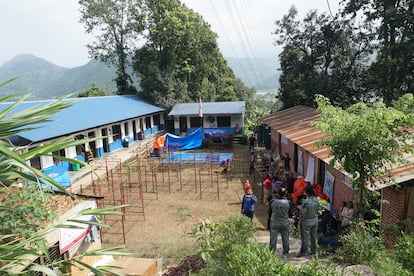
“So far we have identified 26 orphaned children,” says Kayastha, who adds that her “teams are actively moving them to the center to ensure they have safe accommodation, food, and care.” UNICEF has helped set up 48 temporary education centers after the disaster disrupted classes in at least 62 schools in flood-affected areas, where around 440 students and education staff have been reported dead or missing; 414 of these were children.
“We need more resilient schools that can withstand disasters,” says climate change and environmental expert Batu Krishna Upreti, who warns that Nepal severely lacks the resources needed for disaster readiness, response, and recovery. “Children are paying the price for emissions that they have not generated,” he says.
Economics professor Paudel urges the United Nations to rethink how it distributes sovereign wealth funds, rewarding countries that have kept their emissions low over time and not just those that rapidly reduce high emissions. This change that would be critical for countries like Nepal, he says.
Back in Bidur, Chhiring knows that the shelter she is in is a temporary solution. Returning to Kuwait, where she was working, is no longer possible without her husband, who took care of their children. The riverside where her home once stood now scares her. “All I ask is to be able to start again in a safer place. A modest house built by the government, away from the river; an opportunity to work, and a school where my children can study,” she says.
Sign up for our weekly newsletter to get more English-language news coverage from EL PAÍS USA Edition









































