
Inmates claiming their innocence, serial killers and parricides are among the 563 prisoners who could avoid the death penalty in California
Millions of residents of that state have voted to abolish capital punishment, a measure now under consideration by Governor Gavin Newsom

Eliminate the death penalty for 563 inmates in California and replace it with life imprisonment without the possibility of parole. The proposal now being considered by Governor Gavin Newsom has been put to a statewide vote twice and came very close to passing.
In 2016, about 6.3 million Californians voted in favor of abolishing the death penalty for inmates, representing 46% of ballots cast. Four years earlier, in 2012, supporters came even closer: 5.9 million voters, or 48% of the total, backed abolition.
Newsom says the death penalty is “ineffective, irreversible and immoral” and argues it has been imposed disproportionately on Hispanic people, Black people and low-income defendants who could not afford expensive legal defenses. There has been no execution in the state since the last one in 2006.
Advocates have warned that the system has led to wrongful convictions. Between 1973 and 2019, five people sentenced to death in California and another 159 elsewhere in the country were exonerated while they remained on death row.
For decades, several inmates sentenced to death were housed in a section of San Quentin State Prison, in the San Francisco Bay area in northern California. Heavily armed guards watched their cells because authorities considered them high-risk prisoners. One fear was that, with nothing left to lose, some might become hit men for gangs operating inside the prisons. In 2021, Newsom ordered the death row section dismantled and corrections officials distributed those condemned to different prisons across the state.
The case of Kevin Cooper
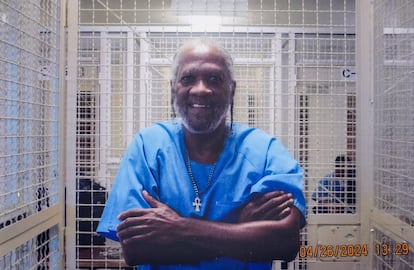
Older inmates and those with chronic illnesses were moved to facilities specialized in medical care. That is the case of Kevin Cooper, 68, who arrived on San Quentin’s death row in May 1985. He is now shuttled between two medical prison facilities in Los Angeles and San Diego.
Cooper, a Black man who maintains he is paying for a crime he did not commit, is one of California’s best-known death-row prisoners. Amnesty International activists have been calling for a review of his case for four decades, and a few years ago the socialite Kim Kardashian joined that call.
I had an emotional meeting with Kevin Cooper yesterday at San Quentin’s death row. I found him to be thoughtful and honest and I believe he is innocent of the crimes for which he was convicted. pic.twitter.com/FveajjjA5y
— Kim Kardashian (@KimKardashian) June 1, 2019
Cooper was convicted of the murders of Doug and Peggy Ryen, their daughter Jessica, 10, and a boy who was staying overnight at the Ryens’ home in Chino Hills, near Los Angeles. The massacre took place in 1983. Cooper, then 25, had escaped from a minimum-security prison where he was serving a sentence for robbery and hid in a house near the Ryens’ home. The proximity was enough for police to make him the prime suspect.
One of the main questions in the case has been the testimony of the Ryens’ young son Josh, who survived a cut to the neck. Over the years the boy changed his account: he initially described his attackers as “three white guys” and later identified them as “three Latinos.”
Despite doubts about his criminal process, Cooper nearly walked to the execution chamber in 2004. Less than four hours before he was to receive the lethal injection, a federal appeals court near San Quentin ordered a stay of execution.
“The day they almost killed me was one of the most surreal days of my life; like watching a movie starring someone else,” Cooper told EL PAÍS in an interview in 2024.
A 92-year-old serial killer
Joseph Naso, 92, is one of the oldest death-row inmates in California. After spending several years at San Quentin, he is now at a Marin County prison facility that provides medical care. He was convicted in 2013 after being found guilty of murdering four women between 1977 and 1994 in Northern California.
Authorities nicknamed him the Alphabet Killer because the initials of his victims’ first and last names matched: Roxene Roggasch, Carmen Colon, Pamela Parsons and Tracy Tafoya. Detectives found a “List of 10” in his home with descriptions and references pointing to those crimes.
However, a 2025 documentary, Death Row Confidential: Secrets of a Serial Killer, explored the possibility that Naso may have killed as many as 26 women.
Other death-row inmates include Ramón Salcido, sentenced in 1990 for killing several members of his own family; Cary Stayner, nicknamed the Yosemite Park Killer for the murders of four women in 1999 near the national park; and Wayne Adam Ford, who turned himself in to authorities in 1998 and confessed to killing those women.
At Corcoran State Prison, Isauro Aguirre, 46, is serving a death sentence for the murder of Gabriel Fernández, an eight-year-old boy. His case drew attention in 2020 after the Netflix documentary The Trials of Gabriel Fernandez reconstructed the months of torture and abuse the child suffered at the hands of his stepfather in their Palmdale apartment.
The Los Angeles District Attorney’s Office described the abuse Gabriel endured as more severe than that suffered by many prisoners of war and said Aguirre abused “every inch” of the boy’s body, using a bat, an air gun, sticks and handcuffs. Aguirre was sentenced to death in 2013. Pearl Fernández, Gabriel’s mother, is serving a life sentence.
Sign up for our weekly newsletter to get more English-language news coverage from EL PAÍS USA Edition









































