
Egypt steps up persecution of independent media with arrest and alleged torture of six journalists from an investigative outlet
Members of the fact-checking platform ‘Matsaddash’ are missing after being detained on accusations of belonging to a terrorist group
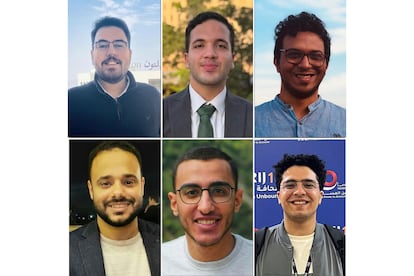

In a new escalation against the media, Egyptian authorities have arrested and pressed terrorism charges against six journalists who make up the editorial staff of Matsaddash, the country’s leading fact-checking platform. Since their arrest in late September, some of them have allegedly been tortured, the outlet and its legal team said. Human rights groups and press freedom advocates described the events as unprecedented and as an example of the limits on information in Egypt.
The arrests of the members of Matsaddash, which began publishing in 2018 and means Don’t believe it in Egyptian Arabic, took place between Monday and Tuesday of last week, the Egyptian Initiative for Personal Rights (EIPR) reported. The EIPR is a human rights group whose lawyers represent the six detainees. At the same time as the arrests, security forces searched the journalists’ homes without showing a court order, confiscated phones and computers — including those of relatives — and did not disclose where they would be taken or where they would be held, the EIPR said.
Egypt’s Interior Ministry announced the journalists’ arrest last Thursday in a statement accusing them of links to the Muslim Brotherhood, classified as a terrorist organization by Cairo since 2013, and of planning to “undermine” the country’s stability by “manufacturing lies and spreading rumors.” The ministry also said the outlet operates without a license and is run from abroad, and accused its founder, Abdel Rahman Mansour, of being a “fugitive member” of the Brotherhood.
After the statement was published, Matsaddash denied being part of a Muslim Brotherhood “media committee” or being managed from outside Egypt. It also denied that Mansour is a fugitive member of the Brotherhood, that the group receives inside-the-country assistance from the Brotherhood, or that it is funded from abroad. On Monday, the Egyptian Journalists’ Syndicate also said the platform’s staff had tried to verify their employment and regularize their labor status.
After five days missing, the journalists were presented on Sunday before the Supreme State Security Prosecution, which handles terrorism investigations. During statements lasting more than 10 hours, most said they had suffered torture at facilities of the National Security Agency, including beatings, forced nudity, electric shocks and threats to harm them and their relatives, the EIPR said. They also said they were forced to record fabricated confessions and were kept with their hands tied behind their backs and blindfolded during interrogations. After giving their statements, the six were taken again to an unknown location, presumably a detention center, and their whereabouts have been unknown since, according to the EIPR.
The Egyptian Interior Ministry denied the torture and ill-treatment allegations in a statement. The Egyptian prosecution, for its part, confirmed on Wednesday that it had indeed issued an arrest and search warrant for the journalists, said none showed visible injuries, and ordered pretrial detention for the group.
The EIPR also detailed that, according to documents their lawyers had access to, the journalists were accused of creating a platform “to agitate” the population and generate “a revolutionary climate,” based on a report prepared by the National Security Agency. Despite having appeared before the prosecution, the journalists’ families and lawyers did not know their place of detention until this Tuesday.
25 journalists behind bars
Last Wednesday, more than 50 press, human rights and freedom of information organizations signed a statement demanding an end to all persecution of Matsaddash and the release of journalists detained or imprisoned for their work in Egypt. According to the U.S.-based Committee to Protect Journalists, there are currently 25 journalists detained or behind bars in the country. Still, EIPR director Hossam Bahgat said this was “the first time in two centuries of Egyptian journalism that an entire newsroom has been arrested.”
In summer 2023, one of Matsaddash’s editors was detained for 48 hours, the EIPR said. That arrest followed the outlet’s reporting on the detention at a Zambian airport of several Egyptian nationals traveling on a jet believed to be carrying several gold bars, more than $5 million in cash (around €4.7 million) and several firearms. On this occasion, however, the reason for the arrests is unknown.
Alongside the arrests of the Matsaddash members, on Sunday another Egyptian journalist, Rasha Azab, reported on social media that she had received an official summons to appear on Monday before the Supreme State Security Prosecution, without revealing the charges or the facts under investigation. Azab received the summons after she and other journalists staged a sit-in inside the Egyptian Journalists’ Syndicate in Cairo on Saturday to demand the release of Matsaddash’s newsroom.
The journalist was released Monday night on bail of 10,000 Egyptian pounds, equivalent to €170, after being questioned on alleged “incitement to commit terrorist acts” in relation to a post on the platform X, her lawyer Ragia Omran told the Egyptian outlet Mada Masr. In a statement before her appearance to another Egyptian outlet, Al Manassa, Azab placed her summons in the context of a “fierce attack” on independent journalism in Egypt and said authorities open investigations against prominent journalists to use them when they see fit.
Sign up for our weekly newsletter to get more English-language news coverage from EL PAÍS USA Edition









































