
More than 100 days without water: The crisis hitting thousands in Puerto Rico, on top of the blackouts
Years of underinvestment and inadequate maintenance of key infrastructure have been compounded by a drought that threatens to trigger partial rationing
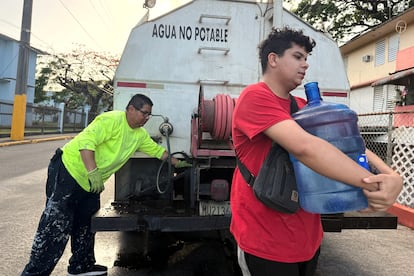

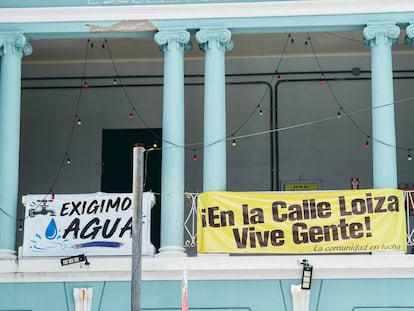
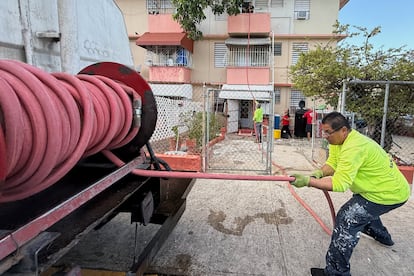
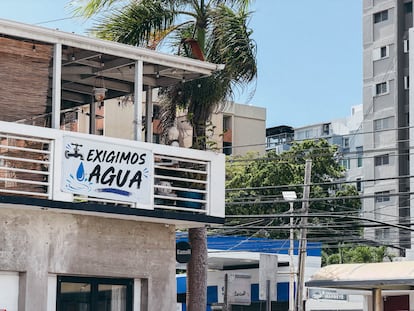
Residents and businesses in the Machuchal neighborhood and along Loíza Street in San Juan have had dry water pipes for more than half the days that have passed this year. As of Friday, the total stood at 118 days, meticulously recorded in a digital log maintained by nearly 100 residents of this area, located in one of the most tourist-heavy parts of Puerto Rico’s capital.
“No water again,” “It’s hard to live in this neighborhood and not move,” people wrote in the tool.
Service interruptions are so frequent that they far exceed the 22 days of power outages that, over the past decade, have become a widespread headache across this U.S. territory.
“I’ve lived here 26 years, and I had never seen a situation like this,” says Ángeles Acosta, a 75-year-old clinical psychologist. She says everyday tasks like cooking and cleaning become an ordeal every time service is interrupted. Whenever there is even a “trickle” coming from the garden tap, she fills large containers and stores them in a tank she keeps in the bathroom of her third-floor apartment. “I put all the water there, and then I go back down to get more,” she says.
The outages have been so frequent this year that she “spent $2,000 on a cistern because I don’t have room inside the apartment. I have to bring water from a small apartment at the back, on the roof. And for that I had to buy a pump, a pressure booster... But not everyone can afford that,” she admits.
Acosta and other residents have organized themselves into the coalition Exigimos Agua (We Demand Water) and have called a demonstration for August 4. One of its leaders is Alfredo Cuyar, who believes that the lack of experience among some employees of the Puerto Rico Aqueduct and Sewer Authority (AAA) in operating water valves is a key factor behind the supply problems affecting this particular area. Cuyar says the issue stems from management changes at the AAA following the start of Governor Jenniffer González’s administration in 2025. The valves, he explains, must be operated manually, and that is not being done.
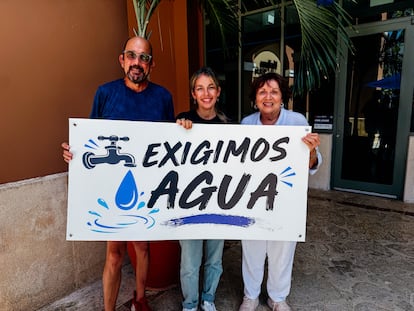
“This group of employees that has come in has a theory: that the water system should operate on its own, as if it were a modern network that automatically readjusts itself, and that they shouldn’t have to use staff to open and close valves. Because of that mismanagement, this area has repeatedly been left without water. [...] We’re desperate,” says Cuyar.
The issue even reached the courts. San Juan Mayor Miguel Romero, a member of the governing party, sued the water utility in an effort to force a solution to the recurring service disruptions.
Luis González, head of the AAA, says the problems affecting several communities in the capital are part of a broader pattern of deterioration in the archipelago’s water infrastructure. He blames the situation on the fact that improvement and maintenance works “that should have been carried out years ago” were never completed.
As the interruptions have worsened, Governor González has said that infrastructure improvement projects totaling at least $7 billion are either underway or in the planning stages.
From failures in a critical pipeline to drought
What is happening in parts of San Juan is only one element of a cocktail of large-scale supply problems that threaten an economy tightly overseen for a decade by a fiscal control board imposed by Washington.
For years, water production at key treatment plants has declined as investment fell amid the economic crisis. Essential maintenance has not been carried out on a critical water transfer system that supplies northern Puerto Rico and has become a major source of water for the metropolitan area, the island’s economic engine. Millions of gallons of water are lost every day through what are commonly known as “salideros" or “leaks” and what an official report classifies as ”non-revenue water,” resulting in annual losses of $98 million, based on the cost of producing that water.
Compounding these problems, this summer has brought a shortage of rainfall in areas containing key reservoirs, leaving 85% of Puerto Rico under moderate or severe drought conditions, according to data from the U.S. Drought Monitor, and putting thousands of Puerto Ricans on edge over the risk of partial water rationing amid soaring temperatures.
EL PAÍS spoke at length with engineer Carlos Pesquera to understand the state of Puerto Rico’s water infrastructure and the steps that have been taken, and still need to be taken, to improve it. Pesquera, a member of the governing party who is not currently part of the administration, is intimately familiar with the island’s water system. In the summer of 2025, Governor González commissioned him to prepare a report with recommendations after a series of breakdowns at facilities serving the metropolitan area. Months later, a failure shut down for days a massive pipeline, known as the Superaqueduct, which supplies water to 15 municipalities.
“Of the most urgent matters, we have two factors we are addressing now: one is the situation with basic infrastructure and the other is an added component, which is meteorological drought [due to low precipitation]. The lack of rain is now exacerbating a problem that we had already been grappling with over the past year,” Pesquera explains.
Three key pieces of infrastructure, he says, are the Superaqueduct and two aging treatment plants where projects are underway to increase daily output: Sergio Cuevas and Enrique Ortega. Both are critical to supplying the San Juan metropolitan area, and Pesquera expects them to boost production by 50 million gallons a day once the upgrades are completed. That increase would amount to roughly 20% of current demand in the metropolitan region, he estimates.
Infrastructure left unchecked
“On paper, all of that sounds fine, except that we had some recent problems with the Superacueducto,” Pesquera says. “The Superacueducto has a particular situation: it has no redundancy; if the pipe breaks, it’s broken [...] So we have a serious problem.” During the interview, he even describes it as a potential “catastrophic issue” because of the direct impact it could have on water supplies, as well as the broader knock-on effects on economic growth and new investment.
That is why the engineer recently added an appendix to the report he submitted to the governor in 2025, after new failures occurred in the pipeline this past June. It is here that one of the most significant risks to water service for thousands of households and businesses is concentrated. As production has declined at other treatment plants and wells that once served as water sources have been shut down, the metropolitan area and several municipalities farther east have become increasingly dependent on the water delivered by the Superaqueduct.
It is a pipeline inaugurated in the 2000s whose internal condition remains unknown, something Pesquera says urgently needs to be addressed because the structure depends on the proper maintenance of its steel linings and prestressed cables. He notes that officials do not even know the exact volume of water flowing through the pipeline to San Juan each day, and that it is difficult to determine whether leaks are occurring at any given moment.
“No one evaluates the pipeline,” the expert says. “There is a cathodic protection system, which is to minimize corrosion in the pipeline, that has not been working for many years. So it’s time to look at infrastructure that is 26 years old and review all possible deficiencies and create a capital improvement program to address it.”
For now, the head of the water company has announced a plan to deploy a kind of robot to analyze the pipeline. However, Pesquera recalls that the last time something similar was attempted, the device disappeared inside the structure. Instead, he proposes conducting an “exhaustive analysis” that examines everything from potential vulnerable points in river crossings to critical connections where the pipeline changes direction and where breaks have already occurred. “You have to do a complete analysis before deciding what to repair first.”
Broader improvements to Puerto Rico’s water infrastructure were launched in part with funds approved in Washington after Hurricane María struck in 2017. Those funds have sometimes been released reluctantly amid corruption scandals and concerns about inefficient spending in Puerto Rico, while Puerto Rican politicians in Washington have also criticized the lackadaisical way U.S. authorities handle Puerto Rican affairs.
“The problem Puerto Rico has now is execution, turning all those federal resources into real projects that deliver results before we lose the opportunity,” he says. “It’s not an impossible problem to solve. The people need certainty. First, system stability for everyone, and then we can count on new projects, because if not, our economy will collapse.”
In fact, the small and medium-sized business sector estimated in July that the interruptions at times caused daily losses of up to $20 million in that sector.
Millions of gallons lost every day
As service disruptions have become increasingly frequent, greater attention has focused on the fact that the water utility loses millions of gallons of water every day. That is according to a report on the utility prepared by Puerto Rico’s fiscal oversight board in July 2025.
The report states that the AAA produces about 513 million gallons of water per day. Of that total, nearly 267 million gallons, or just over half, are lost each day through what are classified as physical losses: leaks in the system, commonly known in Puerto Rico as salideros.
The head of the AAA disputes the report’s claim that water losses exceed 52%, but acknowledges that the figure remains high, putting it at around 40%. Governor González, meanwhile, has said that reducing those losses is one of the issues she has instructed officials to address.
Sign up for our weekly newsletter to get more English-language news coverage from EL PAÍS USA Edition









































