
United States identifies the inner circle of R3, the new leader of the Jalisco New Generation Cartel
El Mencho’s stepson has built a compact structure with some of the strongmen who served the cartel’s founder
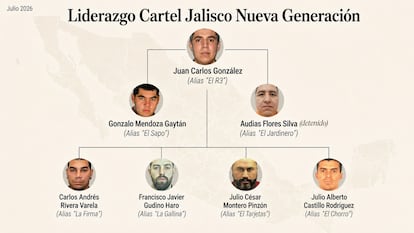
The succession at the helm of the Jalisco New Generation Cartel (CJNG) following the death of Nemesio Oseguera, alias “El Mencho,” appears settled. Leadership of the organization has fallen to Juan Carlos Valencia González, known as “R3,” one of the kingpin’s stepsons. That became clear after sanctions announced Thursday by the U.S. Treasury Department, in coordination with Mexico’s Finance Ministry, against 55 individuals and entities linked to the powerful criminal organization.
Washington has identified the core group of men supporting Valencia in running the cartel. They are longtime CJNG operatives who held strategic positions under El Mencho and have now sworn allegiance to R3. With the exception of one figure who has already been arrested, the group consists of five senior leaders who remain at large and active in Mexico.
Until a few months ago, there was widespread speculation about who would inherit El Mencho’s position, with several names emerging as possible successors alongside Valencia. In the organizational chart released by U.S. authorities, some of those same figures now appear beneath R3. Valencia, also known as “El Pelón,” comes from a family with deep criminal roots. Beyond his relationship to El Mencho, his mother and uncle, Rosalinda González Valencia and Abigael González Valencia, are linked to the Los Cuinis criminal network, which has strong ties to the state of Michoacán. Washington is offering a $5 million reward for information leading to Valencia’s capture.
Gonzalo Mendoza Gaytán, alias “El Sapo,” is the highest-ranking member of Valencia’s new inner circle and effectively serves as his right-hand man. Valencia’s other key lieutenant, Audias Flores Silva, alias “El Jardinero,” was arrested in April. El Sapo, 37, has served as CJNG’s regional boss in Puerto Vallarta, the jewel of Jalisco’s coastline, and has overseen the cartel’s forced recruitment operations in the state. Jalisco prosecutors have identified him as being responsible for the Izaguirre ranch in Teuchitlán, the notorious training camp where the CJNG allegedly trained and tortured recruits, many of whom were forcibly enlisted.
El Sapo has a reputation for extreme violence. He has been linked to the disappearance of five young men in Lagos de Moreno in 2023, a case that shocked Mexico after a video surfaced showing CJNG gunmen forcing the victims to kill one another. He has also been connected to the 2020 assassination of former Jalisco governor Aristóteles Sandoval and is accused of orchestrating a 2015 ambush on state police officers that left 15 officers dead.
The organizational chart also includes Francisco Javier Gudiño Haro, alias “La Gallina,” 38, who was likewise identified by Jalisco prosecutors as one of those responsible for the Izaguirre ranch alongside El Sapo. U.S. authorities also identified Gudiño Haro and Carlos Andrés Rivera Varela, alias “La Firma” — another member of Valencia’s inner circle — as leaders of “a CJNG repression group based in Puerto Vallarta that orchestrates the assassinations of rivals and politicians with high-caliber weapons.”
According to the Trump administration, both La Gallina and La Firma had long answered to orders from El Sapo. Rivera Varela, 40, a Colombian national, was also involved in the murder of former Jalisco governor Aristóteles Sandoval.
An investigation by The Washington Post, drawing on findings from Mexican prosecutors, identified La Firma as the alleged mastermind behind the 2020 assassination attempt on Omar García Harfuch, then Mexico City’s security chief and now the country’s federal security minister. The newspaper also described him as the architect of the CJNG’s territorial expansion. U.S. authorities also accuse him of laundering money to finance the cartel’s illicit activities.
The Washington Post reported that while La Firma planned the attack on García Harfuch, the man who oversaw its execution on the ground, in broad daylight in the heart of Mexico City, was Julio César Montero Pinzón, known as “El Tarjetas.” The gunman, who that day commanded a heavily armed team of hitmen, played another pivotal role within the CJNG: generating revenue for the organization. Washington has accused El Tarjetas of obtaining $350 million through a timeshare fraud scheme that defrauded roughly 6,000 U.S. citizens between 2019 and 2024.
The third member of the Valencia clan is Julio Alberto Castillo Rodríguez, alias “El Chorro,” whom U.S. authorities identify as El Mencho’s son-in-law. According to Washington, El Chorro controls the port of Manzanillo, in the western state of Colima, from where he “has facilitated the procurement of precursor chemicals used for the manufacture of fentanyl and other illicit drugs trafficked into the United States.”
As early as July 2025, the U.S. government had described El Chorro as a “potential successor to Oseguera,” a prospect that now appears, at least for the time being, to have been set aside. Mexican authorities arrested him twice, in 2015 and 2016, but judges ordered his release on both occasions, allowing him to continue his criminal career a decade later.
The Trump administration designated the Jalisco New Generation Cartel (CJNG), along with several other Mexican criminal groups, as a Foreign Terrorist Organization in February 2025. The move was part of a new approach to combating drug trafficking, one that places cartels in the same category as threats such as ISIS and other Islamist militant groups.
“President Trump has made clear that terrorist cartels will be dismantled,” Treasury Secretary Scott Bessent said in a statement on Thursday. “Today’s action strikes Jalisco New Generation Cartel’s leadership, financiers, and criminal networks, denying the cartel the resources it uses to traffic fentanyl, terrorize communities, and threaten American lives.”
In the often fraught relationship between Washington and Mexico City, Mexican President Claudia Sheinbaum has in recent months chosen to cooperate with U.S. authorities on security matters. On Thursday, the two governments were also engaged in trade talks aimed at defining a new framework for their bilateral relationship, with the future of the USMCA trade pact increasingly uncertain amid Trump’s continued attacks on the agreement.
Sign up for our weekly newsletter to get more English-language news coverage from EL PAÍS USA Edition









































