
The Chinese Communist Party turns 105 amidst technological splendor and Leninist rigor
The organization, which now boasts over 101 million members, seeks to combine the development of cutting-edge fields like AI with control over all facets of Chinese society

The plush panda’s eyes have just lit up: the electric blue color indicates that it’s on and alert. Thanks to integrated AI (artificial intelligence), it’s capable of holding a conversation.
“It can be used to help children learn without screens,” says Shi Pengfei, the founder of Nebula, a Beijing-based startup that designs these smart toys.
The panda can teach everything from basic math to advanced physics. And, of course, it can also tell users many other things: “The Chinese Communist Party is the central force driving China’s technological revolution,” the plush toy notes.
This soft little doll – which speaks with scrupulous respect for socialist values, as dictated by law for all Chinese AI – is a good example of how the Asian giant is trying to reconcile two sides that, at first glance, might seem incompatible: on the one hand, technological splendor, with artificial intelligence at its forefront; and, on the other hand, the rigor and tradition of the Chinese Communist Party.
The organization, which has Marxist-Leninist roots, has just celebrated 105 years since its founding in 1921. It currently has over 101 million members and indisputably controls all spheres of the Asian superpower.

The visit to the toy stall is perhaps the best example of how China tries to combine this dual image. The stop is part of an excursion organized for foreign correspondents by China’s Ministry of Foreign Affairs and local Beijing authorities.
In the morning, the journalists are herded through the Zhongguancun area, in the northwest of the Chinese capital. It’s one of the hubs of technological innovation, home to some of the country’s most cutting-edge companies. Entrepreneurs in their 20s are quick to call it “the next Silicon Valley.”
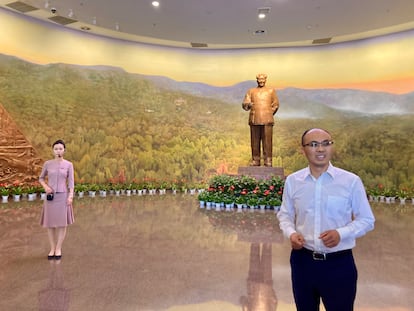
In the afternoon, it’s time to visit the Xiangshan Revolutionary Museum, located in the lush hills on the outskirts of Beijing. From there, in 1949, Mao Zedong and his troops made their final incursion, to proclaim the People’s Republic of China (PRC).
In the museum — after wandering through rooms filled with communist paraphernalia — Yang Jiayi, the museum’s director, concludes: “The prosperity we are experiencing today is exactly what he wanted.” He’s referring to Mao.
The world’s second-largest economy has placed technological advancement at the heart of its development model, in this era of rivalry between superpowers. China holds spectacular robotics competitions to the delight of its domestic audience. On a daily basis, the tightly-controlled state media is filled with news about cutting-edge achievements.
The obsession comes from the very top: Chinese President Xi Jinping has made it a national priority. And, on the rare occasions when images of his office have been made public, the shelves behind him have held (in addition to history books and volumes on the Party) texts such as The Deep Learning Revolution (2018), by renowned American computational neuroscience expert Terrence Sejnowski.
“In this wave of technological revolution, frontier technologies such as AI, quantum computing and biotech are emerging. Among them, AI is the most eye-catching,” Xi said back in January, during a meeting with senior officials at the Central Party School. AI, he added, speaking before ministers and provincial authorities, who were taking notes, “is considered the next epoch-making technological transformation, comparable to the changes brought about by the steam engine, electricity and the internet.”
The 15th Five-Year Plan, approved back in March, is the latest confirmation of this commitment. The extensive document mentions “artificial intelligence” more than 50 times, while also calling for “strengthening the Party’s leadership over the entire implementation process, [while] thoroughly studying and implementing Xi Jinping Thought on Socialism with Chinese Characteristics for a New Era, [as well as] continuously utilizing the Party’s innovative theory to unify thought, will and action.” The two notions coexist.
For British historian Adam Tooze, of Columbia University, the Party is indeed the “secret formula” that has allowed the PRC’s investments to be transformed into “high-quality growth.” He explained this in a talk during a forum with senior Western executives in Beijing, shortly after the plan’s approval. “I don’t think we, as Westerners, can afford to continue avoiding this conclusion.”
“Perhaps we don’t like to talk about it,” Tooze emphasized. “It’s politically awkward to admit that, in 2026, [we’re] participating in a panel alongside influential Western business leaders, celebrating the stability brought about by the 15th Five-Year Plan.” That number 15, he added, signifies that its use dates back to the 1950s and that its ancestors “were Stalinist.”
Long-term planning has been bearing fruit in China. Last year, the country experienced its breakthrough in the field of AI when DeepSeek – a relatively unknown company at the time – unveiled an affordable model that shook the foundations of Silicon Valley’s tech giants. This year, the excitement revolves around Z.ai, another leading AI company. In fact, its offices are one of the stops on the press tour of the Zhongguancun technology hub.
Also known as Zhipu AI, this company was born in 2019 as a spin-off from a Tsinghua University lab, and is considered to be one of China’s “AI tigers,” a select group of key players in Beijing’s efforts to compete with Washington and reduce its dependence on U.S. technology.
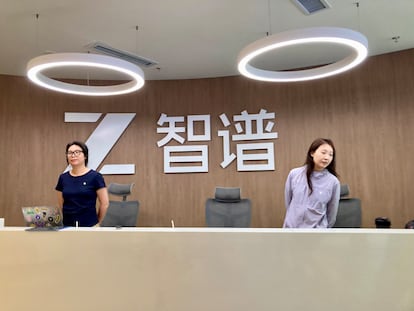
“We want machines to think like human beings,” says Zheng Qinkai, one of the researchers, during a visit to Zhipu AI’s headquarters. Shares in this startup, which is well-funded by the state and backed by Chinese tech giants like Alibaba and Tencent, have risen by more than 1,700% since its Hong Kong IPO in January, fueled by investor optimism regarding U.S.-based tools from OpenAI and Anthropic.
The standoff extends beyond the realm of technological dominance, however: it’s unfolding in the military arena and in the pursuit of influence on the geopolitical stage. In a study published this past May by Stanford University’s Center on China’s Economy and Institutions,“artificial intelligence has become the central arena of technological competition between the U.S. and China.” The report states that China surpassed the United States in the annual granting of AI patents around 2020. And, by 2023, it was issuing almost four times as many per year (183,302 compared to 48,197).
Last week, OpenAI focused on Z.ai. In a blog post, it drew attention to the company’s strong ties to Chinese state-owned enterprises, warned of Beijing’s objective to reach emerging markets “before U.S. or European rivals” and highlighted its links to Communist Party authorities. “[Zhipu AI] was added to the U.S. Commerce Department’s Entity List in January [of 2026] on the basis that it is advancing the PRC’s military modernization through the development and integration of advanced artificial intelligence research.”
At the company’s headquarters, replies are terse when questions are raised about government support. Zheng, the researcher, acknowledges the importance of “support for computing power” and speaks about the benefit of having a pool of “young talent” in the area and a tech ecosystem like Zhongguancun’s. The hub boasts 30 universities — including the prestigious Tsinghua — and a student body of around 100,000, according to local authorities.
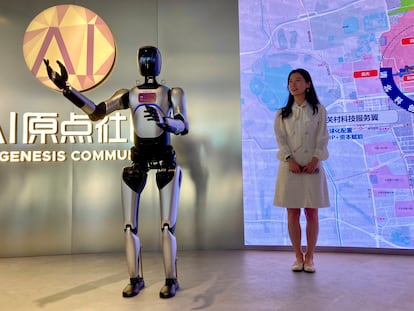
“We have universities, companies and, most importantly, investors. They’re the key drivers,” Cheng Hui emphasizes, during a press conference at AI Genesis Community, a tech business incubator promoted by the government in Beijing.
Cheng, the director of industrial promotion for Zhongguancun Science City, calls the area “the smartest three square kilometers” in the country, but asserts that such an ecosystem isn’t built overnight: “It requires the continuous effort of the government.” That is to say: the Party.
“China has succeeded better than any other authoritarian country in history at combining economic growth with political control,” Dan Wang emphasizes in his book Breakneck: China’s Quest to Engineer the Future (2025). A research fellow at the Hoover Institution, Wang argues that the rise of the Asian giant has had much to do with the policies of a government largely composed of engineers. This is quite unlike the United States, where lawyers dominate the political elite.
This “engineering state,” he argues, is more than just autocracy or advanced technology. It has positive aspects, such as the efficient management of cities and the expansion of the manufacturing base. But sometimes, this setup has also had disastrous consequences for the individual, “like holding on to a zero-Covid strategy until it drove the country mad.”
“The Communist Party,” Wang writes, “envisions itself as a grand master, coordinating unified actions across state and society, able to launch strategic maneuvers beyond the comprehension of its citizens. Its philosophy is to maximize the discretion of the state and minimize the rights of individuals.”
In the words of the plush panda, whose artificial brain has been trained according to the guidelines of the organization that’s currently celebrating its 105th anniversary, “the [Party’s] leadership and decision-making have had a profound impact on China’s technological innovation and industrial modernization.”
Sign up for our weekly newsletter to get more English-language news coverage from EL PAÍS USA Edition









































