
The Andean long-eared mouse, the mammal that holds the key to surviving at altitudes of more than 22,000 feet
A study examines the genetic and metabolic mechanisms that allow the South American rodent to live on the summit of the world’s second-highest active volcano

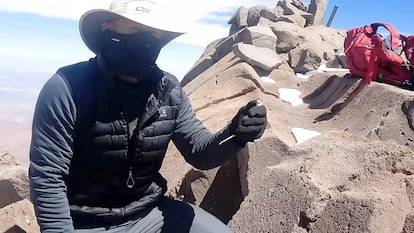
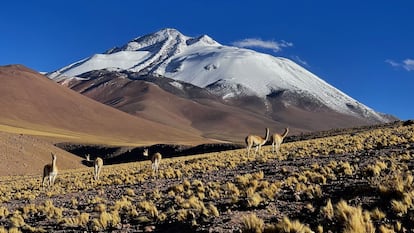
At the summit of the Llullaillaco volcano, on the border between Chile and Argentina, there is only rock, ice and snow. The white and arid landscape seems stripped of any sign of life. When evolutionary physiologist Jay Storz arrived at its peak, he had been tracking down the answer to a mystery for months. Mountain climbers had told him that they had observed a small, long-eared mouse that would have been living at the highest elevation ever documented for a mammal at the time: above 22,000 feet. “When I trapped the first one, I couldn’t believe it,” remembers the U.S. scientist.
He says his investigation began in 2019, during the sabbatical year Storz spent in Argentina. Some alpinists spoke to him about a rumor that had been circulating locally. They said they had seen mice at the summit, which upon sensing human presence, disappeared quickly between cracks in the rock and ice. “The news fascinated me,” remembers the researcher from the University of Nebraska. One year later, he organized a scientific expedition alongside Argentinian mammalogist Guillermo D’Elía that would travel from the base of Llullaillaco to its summit.
Their team also featured Bolivian guide Mario Pérez Mamani, who knew the mountain well, and had previously seen the small rodents. “It was logistical insanity,” sums up D’Elía, a researcher from the Austral University of Chile. “We had to acclimate for days, hire specialized mountaineers, and secure permits and funding,” he notes.
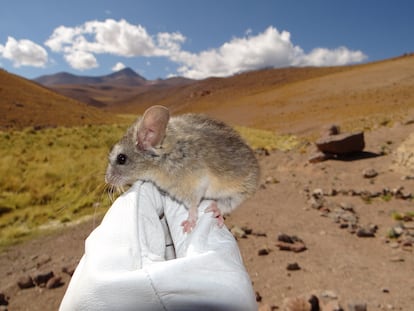
On that first expedition, they captured a live specimen at 22,109 feet of altitude, the all-time record for a mammal. “A mouse!,” Storz shouted to Mamani. Although he was exhausted, dizzy from the altitude, the biologist managed to trap it with his two hands.
Other expeditions followed, including one funded by National Geographic, which allowed the team to explore other volcanoes in the Altiplano and collect 167 complete animal genomes from the Pacific coast to the Andean peaks. “It’s a project that took years,” says D’Elía. The goal was to discover how a mammal manages to survive in a place where extreme cold and low oxygen levels turn any activity into a physiological challenge. The answer, the result of five years of expeditions, experiments and genetic analysis, was published Thursday in the prestigious Science journal.
Metabolic changes
Phyllotis vaccarum, the Andean long-eared mouse, belongs to a lineage of rodents whose ancestors came to South America more than three million years ago, when the continent had recently joined with North America.
On the summits on which it was sighted there are no trees, no fields, and hardly any food or shelter. Just volcanic rock, ice, and a constant wind that makes human respiration difficult. The atmospheric pressure is so low that available oxygen is just 44% of that of sea level. “You can’t over-exaggerate how hostile this environment is,” insists Storz. “Every time I get to the summit of a mountain like this one, I think about how incredible it is that animals live there.”
Researchers brought captured specimens, from the summit as well as the Chilean coast, to the physiologist Pablo Sabat’s laboratory at the University of Chile. There, they compared their behavior under conditions that reproduced the extreme hypoxia that takes place at high altitudes.
“We wanted to see if they had developed special physiological abilities to cope with the lack of oxygen,” explains Storz. They discovered that mice from the mountain peaks maintained a considerably higher aerobic capacity than those captured at sea level. In other words, they continued to produce energy even when oxygen was scarce.
Their research also revealed that much of this advantage lay in the mice’s muscles. “We observed changes in their metabolism that increase shivering-induced thermogenesis,” explains Storz. This mechanism allows them to generate heat through involuntary muscle contractions. “High-altitude mice are able to maintain a constant body temperature even under hypoxic conditions equivalent to those at an altitude of 22,000 feet,” says the researcher.
That finding contradicts the explanations typically offered to account for adaptation to high altitudes. Among llamas, Andean geese, and even some human groups who live in the Himalayas, adaptation usually involves changes in hemoglobin, the protein responsible for transporting oxygen in the blood. But that is not the case with this small rodent. “That came as a surprise,” admits Storz. Hemoglobin was identical among the high-altitude mice and those at sea level.
In addition to studying physiology, the team sequenced the complete genomes of specimens distributed across the species’ entire range. “We expected the populations to be much more isolated from one another,” explains Schulyer Liphardt, the study’s first author and the lead researcher on its genomic analysis. “But the mice living at 22,000 feet and those living at sea level were genetically very similar.”
The species has the widest known altitudinal range of any mammal: from sea level to nearly 22,300 feet. Logically, researchers note, populations living at the highest elevations would have accumulated significant genetic differences after thousands of generations of adapting to radically different environments. But this did not happen. “There is a continuous gene flow,” explains Liphardt. “Genes circulate between populations from the base to the summit and vice-versa.”
For a population to adapt despite this gene flow, he explains, “natural selection must be very intense.” Changes are concentrated in a small group of genes directly related to survival in extreme environments.
One of these groups is a family known as Glutathione S-transferase Mu, which is involved both in the elimination of toxic molecules generated by oxygen deprivation and in the degradation of chemical compounds present in plants. “We were very surprised,” Liphardt admits. “We knew that these genes help combat oxidative stress caused by hypoxia, but they also play a role in the metabolism of plant-derived toxic compounds.”
What does a mouse eat at 22,000 feet?
At more than 22,000 feet of altitude, there is practically no visible vegetation. Still, analysis of the stomach content of the mice revealed remains of plants. “We know that some of it came from species that grow on the slopes,” explains Storz. “But we don’t know exactly what they eat at the summit.” It’s possible, the scientist adds, that there are small patches of vegetation hidden among the crevices and rocky outcrops that go unnoticed by humans.
Analysis of the mice’s stomach contents also revealed plant remains that do not grow on summits, including coca leaves and garlic. Researchers believe these might come from waste left behind by mountaineers. “Coca leaves are often used to combat altitude sickness,” explains mammologist Guillermo D’Elía. “Our hypothesis is that the mouse took advantage of those leftovers. It’s like a deep freezer up there. Things don’t rot or spoil,” he notes.
Solving this puzzle is the teams’ primary objective. “Now we want to understand if these vegetable remains are related to the signals we find in some genes,” explains Liphardt. Yet another attempt to understand how this tiny mammal found a home where humans see only rock, ice and silence. “It’s easy to underestimate animals’ abilities,” D’Elía reflects.
Sign up for our weekly newsletter to get more English-language news coverage from EL PAÍS USA Edition









































