
The United States follows through on Trump’s threat, launching major strikes on Iran
After two days of exchanges of attacks between the two countries, the US president calls Iran’s leaders ‘scum’ and orders a new wave of attacks
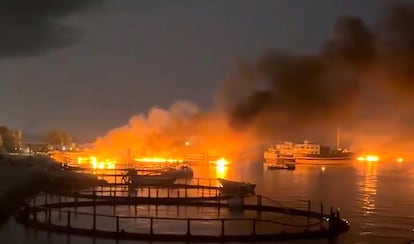

U.S. President Donald Trump announced it hours earlier and has now followed through. U.S. forces near the Strait of Hormuz launched heavy strikes on Iranian targets on Wednesday, after the Republican leader declared the provisional peace agreement with Tehran “over,” according to confirmation from U.S. Central Command.
“At the direction of the Commander in Chief, U.S. Central Command forces have started conducting additional strikes against Iran to further degrade their ability to threaten freedom of navigation in the Strait of Hormuz,” Central Command, which oversees U.S. forces in the Middle East, said in a statement shortly after 4 p.m. EDT. “The United States is holding Iran accountable for recent unjustified aggression against commercial shipping and civilian crews freely navigating a vital international waterway.”
The latest episode of clashes between the two countries — the umpteenth and most serious since they signed a memorandum of understanding last month aimed at ending their war — began on Monday, when Iran attacked at least three merchant vessels passing through the Strait of Hormuz that were linked to Saudi, Emirati and Qatari interests. In response, the United States announced that it was revoking its authorization for the international sale of Iranian oil, one of the concessions Tehran had secured under the bilateral agreement and which had been implemented immediately. On Tuesday night, the United States bombed more than 80 targets in Iran. The Islamic Republic, in turn, responded with strikes on Bahrain and Kuwait.
From Ankara, Turkey, where the NATO summit was held on Monday and Tuesday, Trump said the offensive would continue: “[We’ll] probably hit them hard again tonight.” Asked whether the ceasefire was over and whether the memorandum of understanding was no longer valid, he replied: “To me, I think it’s over. I don’t want to deal with them anymore, they’re scum. You know what scum is? They’re scum. They’re sick people.”
A few hours later, however, at the press conference concluding his visit to Ankara, the U.S. president softened his remarks, indicating that rather than signaling a definitive rupture, he wanted to send a warning that Iran would understand.
Trump clarified that the forthcoming attack would “be over very quickly.” “But when they hit, we hit,” he said. “We use their language and we speak their language.” Trump also said that he does not believe the war “is going to start again.”
The U.S. president’s initial comments triggered an immediate market sell-off: Spain’s Ibex index fell 2% and oil prices surged 6%.
The renewed tensions and hostilities between the two adversaries have once again raised concerns about the future of the memorandum of understanding, a document barely a page and a half long that lays out a roadmap for reaching a final peace agreement covering the two most contentious issues: Iran’s nuclear programme and the future of the Strait of Hormuz.
Under the memorandum, the two countries gave themselves 60 days — a deadline that expires on August 21 — to negotiate a deal. But if that goal already seemed ambitious when the document was signed remotely on June 17, it now appears more distant than ever. Trump’s remarks have made clear the animosity and mistrust that persist between the two sides.
Mohammad Bagher Ghalibaf, the speaker of Iran’s parliament who led Tehran’s ceasefire negotiating team, accused the United States on Wednesday of violating the ceasefire. Ghalibaf cited not only the latest U.S. military strikes, but also the reinstatement of the ban on Iranian oil sales and Israeli attacks in Lebanon, a country that Iran had insisted on including in the memorandum signed in mid-June. “The era of bullying and extortion is over,” Ghalibaf wrote on social media platform X. “We don’t fold.”
The memorandum of understanding provides for the gradual lifting of economic sanctions on Iran and the release of Iranian funds frozen in third countries, as well as the creation of a reconstruction fund for Iran worth at least $300 billion. Washington maintains that these benefits will be rolled out in stages and only if Tehran demonstrates a willingness to cooperate. It also insists that it will not contribute any money to the reconstruction fund. The memorandum further stipulates that the Strait of Hormuz will remain open and toll-free during the 60-day negotiation period.
Since the document’s 14 points became public, experts and lawmakers have argued that its terms are far more favourable to Iran — which receives tangible economic benefits — than to the United States. Washington, they contend, gains only the reopening of the strait, which had remained open until the war began, and Tehran’s commitment not to develop nuclear weapons, a pledge it had already made. The Islamic Republic is a signatory to the Nuclear Non-Proliferation Treaty (NPT) and has consistently maintained that it does not seek to acquire nuclear bombs. As for the strait, the toll-free reopening is only temporary, and Iran could impose transit fees after the negotiation period ends.
Sign up for our weekly newsletter to get more English-language news coverage from EL PAÍS USA Edition









































