
Marisol Donis, criminologist: ‘Asylums were tools for the confinement and social control of women’
The writer’s new book tells the stories of the victims who were locked away in psychiatric institutions simply for breaking the gender rules of their era
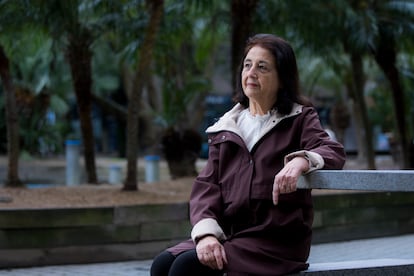

Luisa was locked up in an asylum for dreaming of cherubs. Juana was committed so her inheritance could be seized. Julia was confined for being irritable, energetic, and impulsive. Carmen was confined at her husband’s request, despite having no symptoms. The painter Leonora Carrington also ended up in a mental institution, on her father’s orders, after beginning a relationship with an older, married painter.
The diagnoses? Genital madness. Melancholic psychosis. Mental disturbance. Postpartum depression. They were all mad, deranged, hysterical, recounts Marisol Donis, a pharmacist and criminologist, in her new book, Mujeres grises sobre fondo negro (Gray Women on a Black Background). In the book, the author describes how, during the 19th and early 20th centuries, asylums were used as a tool of oppression to confine, subjugate, and silence women who did not meet the social and cultural expectations of the time.
Donis, speaking to EL PAÍS via video conference from the Spanish city of Vigo, where she lives, explains that the book originated from the exhibition Forgotten Voices, about women admitted to the Conxo psychiatric hospital in Santiago de Compostela. “There were handwritten letters from women begging to be released,” says Donis. “Letters that never reached their recipients. They were admitted without being mentally ill, simply for the first act of rebellion by a young woman. I was shocked; I didn’t think it could be so easy to admit a woman who had nothing wrong with her. But it was easy because the one in charge was the father or the husband.”
For smoking, for drinking, for being “shockingly cheerful.” For having “cynical and senseless conversations.” For being “odd” or “capricious.” For reading. Any excuse to lock them up would do, explains Donis in the book: “The initial diagnosis for all of them was hysteria. Asylums were tools of confinement and social control.” Many were healthy and perfectly sane, but they had transgressed established gender roles. And the directive was “to straighten out all women and remove them from public life,” the author reflects.
Donis illustrates the modus operandi of the time through stories with names and surnames. Very different women. Some famous, like Carrington or Emily Dickinson; but also anonymous, like the young woman whose family wanted to send her to Conxo after she led “a libertine life.” “This happened in all social classes. They went after them; neither the poor nor the rich had any escape.”
Each woman’s story is unique, but all of them converged in the same pattern. “They wanted to get rid of them,” Donis concludes.
The confinement was already terrible in itself, but the treatments the women were subjected to — some extremely violent — further broke their will. One young woman, wrongly diagnosed with schizophrenia, was given electroshock therapy, cold showers, boiling‑water vaginal douches, and was even scheduled for a lobotomy that, fortunately, was halted at the last minute, Donis recounts.
“For hysteria, mystical madness, mania, or puerperal madness, they started with bromides and warm baths. And they pumped them full of cacodylate injections, which are used to treat anemia. The point was to torment them,” says the writer. The doctor even forbade the poet Emily Dickinson, who voluntarily secluded herself in her room, from reading and thinking.
The legacy of that whole system of social oppression — the indiscriminate confinement of women — is difficult to digest. Donis argues that the labels of “mad” and “hysterical” still linger. “Now, of course, the law protects us and doesn’t allow you to be committed to a psychiatric institution without cause. But I think people’s attitudes haven’t changed that much,” she reflects. Stepping outside the norm is still punished with social criticism, she says.
But while some vestiges of the past remain, things have changed, she insists. Women, says Donis, are more empowered than ever — “they know what they want” — and she sees it as unlikely that history could repeat itself at the levels of repression and humiliation described in the book. “Much progress has been made. It’s very difficult to imagine a new tool for social control, much less one to silence them. Now, not even God can silence them.”
Sign up for our weekly newsletter to get more English-language news coverage from EL PAÍS USA Edition









































